
January 07, 2026
- AI Technology
- Interior Design
From "Saved" to "Sold": How Homeowners Are Planning Renovations with AI
Hemanth Velury
CEO & Co-FounderFrom "Saved" to "Sold": How Homeowners Are Planning Renovations with AI
It starts the same way for everyone. You are lying on the couch. It is 11:00 PM. The house is quiet, and the blue light of your phone is the only thing glowing in the room.
You are scrolling. Maybe it's a time-lapse renovation on TikTok. Maybe it's a perfectly curated living room on Instagram. Or perhaps it's a Facebook Marketplace find that would look perfect if you just knew how to refinish it.
Social media has fundamentally changed how we look at our homes. Platforms like Instagram and TikTok have democratized taste. We all know what "good design" looks like now. We see it every day. But there has always been a massive, frustrating gap between liking a photo on Instagram and actually achieving that look in your own living room.
For years, bridging that gap required money. Lots of it. You needed to hire an interior designer. You needed to pay for expensive CAD drawings. You had to trust a process you couldn't quite see.
But that is changing fast. The rise of AI interior design is shifting the power back to the homeowner. It is the dawn of the "Digital DIY" era. We are moving away from complex, expensive software and toward intuitive, instant gratification. Today, taking a 2D to 3D leap doesn't require a degree in architecture. It just requires an idea and the right AI tool.
Let's talk about how you can take those "Saved" posts and turn them into your actual reality.
The "Pinterest Problem": Why We Get Stuck
We have all been there. You have a vision. You want that modern farmhouse kitchen or that Scandi-minimalist bedroom. You have saved dozens of photos.
But when you stand in your actual kitchen, holding a paint chip, you freeze.
- "Will this color make the room look small?"
- "Does this sofa fit?"
- "I can't visualize how this wall removal will look."
This is the "Imagination Gap." Social media gives us the inspiration, but it doesn't give us the tools to execute. Until recently, the only way to close that gap was to pay for professional interior design renders. These interior design photoreal render services could cost hundreds or thousands of dollars for a single room. For the average DIY homeowner, that is a non-starter. You aren't going to pay $500 for a render just to see if a rug looks good. So, you guess. And often, you regret it.
This is where AI visualization steps in.
The Democratization of Design
The biggest shift in home renovation right now isn't a new type of flooring or a paint trend. It is software. Specifically, software that makes 3D Visualization accessible to everyone.
In the past, if you wanted to see your home in 3D, you needed to learn complex software like AutoCAD or SketchUp. These tools have steep learning curves. They are built for professionals, not for homeowners who just want to see a quick layout change. New tools like Foursite and VirtualSpaces are changing the game. They are built on the premise that design should be democratic. If you can take a picture or upload a file, you should be able to design your home.
This is critical because the modern homeowner is a visual creature. We are trained by high-definition video on TikTok. We expect to see things clearly. AI interior décor tools allow us to experiment without consequence. You can try that bold wallpaper. If it looks terrible in the AI 3D visualization, you just hit delete. No money lost. No messy walls to repaint.
From Blueprint to Beauty: How It Works
Let's break down the actual process. It sounds high-tech, but the user experience is incredibly human and simple. You don't need to be a tech wizard to convert blueprint to 3D.
The Input: Your Floor Plan - Every renovation starts with the bones of the house. Maybe you bought a new place and the builder gave you a brochure with 2D floor plans. Or maybe you have an old set of blueprints in a drawer somewhere. In the old days, these blue lines on paper were hard to read. You see "12x14 Bedroom," but you don't feel the space.
The Magic: 2D to 3D Conversion - This is where the magic happens. Using platforms like VirtualSpaces, you can upload those flat floor plans. The AI analyzes the lines. It understands where the walls are, where the windows are, and where the doors swing open. It instantly processes a floor plan to 3D conversion. It lifts those flat lines into walls. It creates a digital twin of your room. This used to take a human designer hours of modeling. AI does it in moments.
The Styling: AI Interior Décor - Once the structure is there, you get to play. This is the fun part. You can define the style. Do you want a Japandi aesthetic or maybe Industrial Chic or something else? The AI interior design engine populates the room. It adds textures to the floor. It places furniture that fits the scale of the room. It calculates the lighting.
The Result: Photorealism - The output isn't a cartoon. We are talking about interior design photoreal render quality. You get an image that looks like a photograph of a room that doesn't exist yet. You can see how the morning light hits the sofa. You can see the grain in the wood flooring.
Why DIY Warriors Love AI Virtual Staging
There is another massive use case that is exploding on social media: Virtual Staging. Traditionally, "staging" meant hiring a company to haul physical furniture into an empty house to help it sell. It is expensive and labor-intensive. But AI virtual staging is entirely digital and very inexpensive. If you are a homeowner selling your house, or even just trying to reimagine a spare room, virtual staging allows you to see the potential.
Imagine you have a cluttered guest room that you want to turn into a home office. It's hard to look past the clutter. By using AI visualization, you can wipe the slate clean digitally and stage it with a sleek desk, a rug, and bookshelves. You are essentially "shopping" for the look of the room before you buy a single item.
The Role of Foursite and VirtualSpaces
In this rapidly growing market, specific tools are rising to the top because they prioritize the user experience. This is where Foursite and VirtualSpaces shine.
They understand that the user isn't an architect. The user is a mom trying to figure out if a nursery will fit a crib and a glider. Or a bachelor trying to make his apartment look grown-up.
By focusing on the blueprint to 3D pipeline, these tools take the hardest part of the process, building the 3D model and visualizing it before making any serious investment, and automate it. VirtualSpaces has leveraged this to help people see the potential in properties before a single brick is laid. Foursite brings that capability to a granular level, helping visualize specific design choices.
These tools are the bridge. On one side, you have the chaotic inspiration of Pinterest and TikTok. On the other side, you have the expensive, inaccessible world of professional rendering. VirtualSpaces and Foursite sit right in the middle, giving professional power to everyday people.
Taking the Fear Out of Renovation
Renovation is scary because it is permanent. Once you knock down that wall, you can't put it back up easily. Once you order custom cabinets, you own them.
Fear paralyzes decision-making. It's why so many homeowners live with "temporary" furniture for ten years. They are afraid to commit.
AI interior décor tools remove the fear. They act as a truth serum for your ideas.
- Thinking about painting the ceiling black? Try it in the AI 3D visualization first.
- Want to see if an island fits in your kitchen? Convert floor plan to 3D and check the flow.
This validation is priceless. It gives homeowners the confidence to say "Yes" to contractors. It streamlines the shopping process. When you know exactly what the room should look like, you stop buying random items at Target/Ikea/Pepperfry (or whatever your preference is) hoping they will match.
How Social Media Drives the "Digital Twin" Trend
We cannot ignore the feedback loop of social media. Now, when homeowners finish a renovation, the first thing they do is post it online.
But we are seeing a new trend: people posting their renders before they start. On TikTok and Instagram, users are sharing "Before," "The AI Design," and "The After." It has become a content category of its own. Sharing your interior design 3D visualization allows you to get feedback from friends and followers before you spend money.
"Hey guys, Option A or Option B for the kitchen tile?"
This crowdsourced design process is only possible because tools like convert blueprint to 3D are now accessible. You can generate three options in minutes and let your social circle help you decide.
The Future is 3D
We are never going back to 2D. The human brain struggles to translate 2D lines into 3D space. It is a cognitive load that we no longer need to bear.
As AI visualization gets faster and more accurate, the standard for renovation planning will rise. Contractors will expect homeowners to show them an AI render, not just a sketch on a napkin. Real estate agents will expect AI virtual staging as the bare minimum for listings.
For the homeowner, this is liberation. It means that the gap between your taste and your home is finally closing. You don't need a massive budget. You don't need to hire a team. You just need your floor plans, a vision, and the right AI tool to bring it to life.
So, go ahead. Keep scrolling TikTok late at night. Save those photos. Dream big.
Now, you have the power to take those dreams and build them, one pixel, and eventually, one brick, at a time.
Recommended for you

August 19, 2026
The End of the Model Home? 3D Changes the Math | VirtualSpaces
HHemanth Velury
CEO & Co-Founder
August 17, 2026
Designing Spaces That Actually Get Built | VirtualSpaces
HHemanth Velury
CEO & Co-Founder
August 12, 2026
Designing Homes for the Stuff People Actually Own | VirtualSpaces
HHemanth Velury
CEO & Co-Founder
August 07, 2026
Floor Plan to Bill of Materials: The 3D Model as Data | VirtualSpaces
HHemanth Velury
CEO & Co-Founder.png&w=1080&q=75)
August 05, 2026
Designing Homes for How People Actually Live | VirtualSpaces
HHemanth Velury
CEO & Co-Founder
August 03, 2026
Honest by Design: Trust in AI Real Estate Imagery | VirtualSpaces
HHemanth Velury
CEO & Co-Founder
July 29, 2026
Kitchen and Bath: The Two Rooms That Decide Resale | VirtualSpaces
HHemanth Velury
CEO & Co-Founder
July 27, 2026
Why Empty Rooms Don't Sell: Virtual Staging | VirtualSpaces
HHemanth Velury
CEO & Co-Founder
July 24, 2026
The Quiet Sustainability Win of Deciding in 3D | VirtualSpaces
HHemanth Velury
CEO & Co-Founder
July 22, 2026
Why Paint Swatches Lie: Test Color in 3D First | VirtualSpaces
HHemanth Velury
CEO & Co-Founder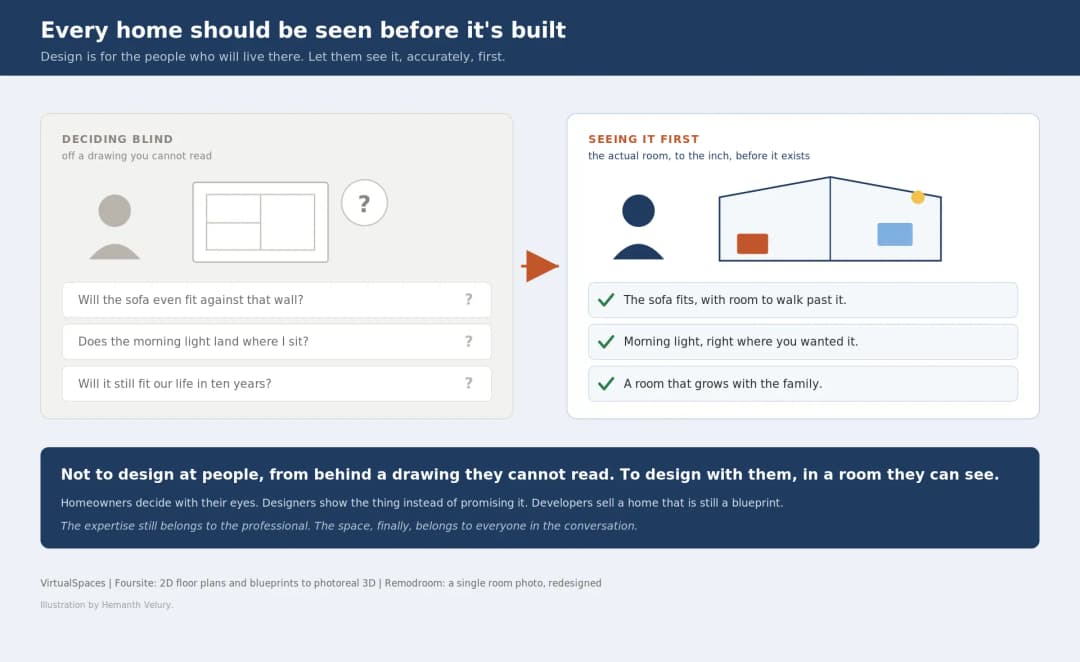
July 20, 2026
Why Every Home Should Be Seen Before It's Built | VirtualSpaces
HHemanth Velury
CEO & Co-Founder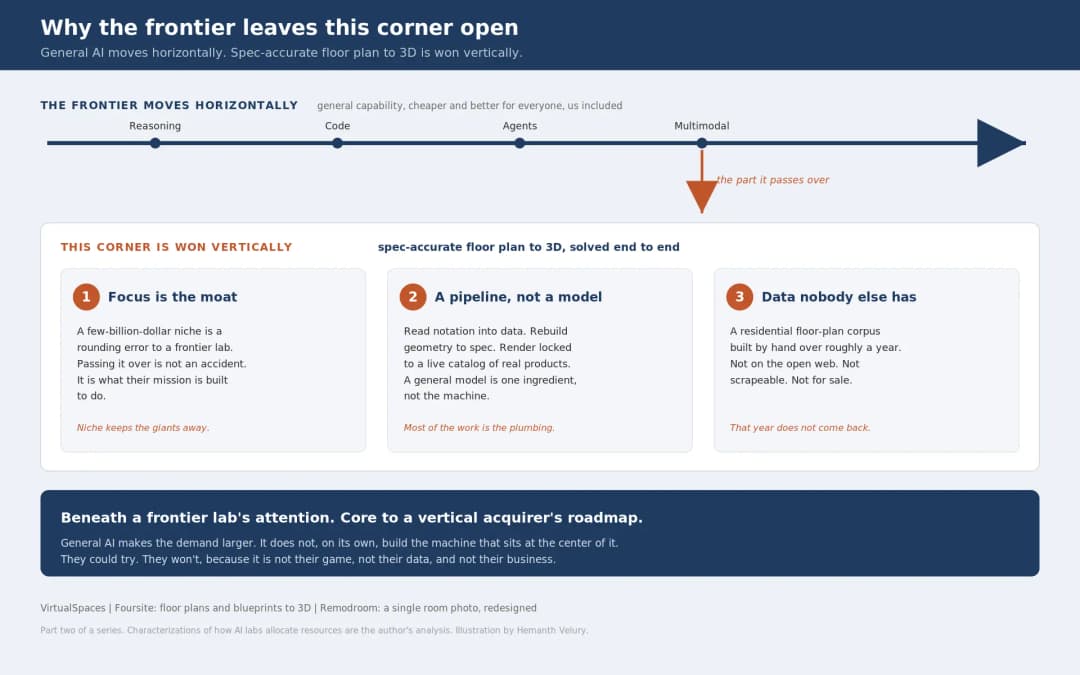
July 17, 2026
Why Big AI Labs Won't Build Floor Plan to 3D | VirtualSpaces
HHemanth Velury
CEO & Co-Founder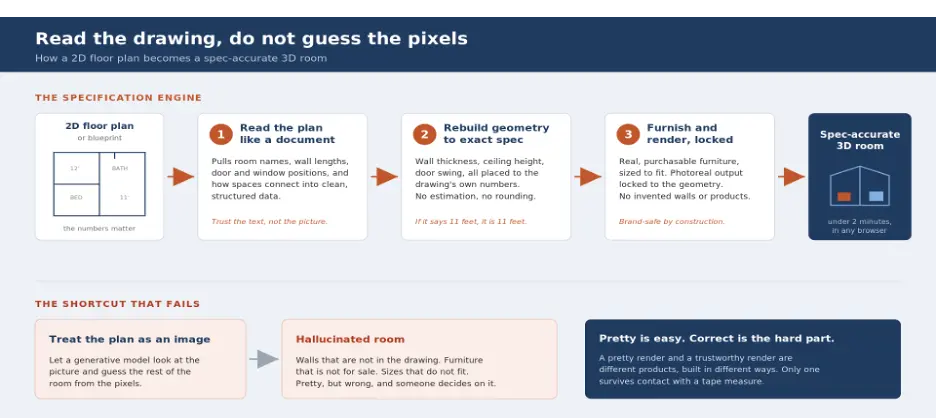
July 15, 2026
How We Solve Floor Plan to 3D, Accurately | VirtualSpaces
HHemanth Velury
CEO & Co-Founder
July 13, 2026
Designing Homes That Age With the People in Them | VirtualSpaces
HHemanth Velury
CEO & Co-Founder
July 10, 2026
Designing Spaces for How Light Actually Moves | VirtualSpaces
HHemanth Velury
CEO & Co-Founder
July 08, 2026
Designing Homes for Every Life Stage in 3D | VirtualSpaces
HHemanth Velury
CEO & Co-Founder
July 06, 2026
Build an Interior Design Portfolio Without Clients | VirtualSpaces
HHemanth Velury
CEO & Co-Founder
June 26, 2026
AI Interior Design: Full 3D Workflow in One Platform | VirtualSpaces
HHemanth Velury
CEO & Co-Founder
June 24, 2026
Scope Creep in Interior Design: How AI Visualization Fixes It | VirtualSpaces
HHemanth Velury
CEO & Co-Founder
June 22, 2026
What Buyers See on a Floor Plan: Your Biggest Sales Problem | VirtualSpaces
HHemanth Velury
CEO & Co-Founder
June 19, 2026
Small Design Studios vs Big Firms: The AI Advantage | VirtualSpaces
HHemanth Velury
CEO & Co-Founder
June 17, 2026
After the Mood Board: AI Interior Visualization | VirtualSpaces
HHemanth Velury
CEO & Co-Founder
June 15, 2026
Foursite Pro Editor: Full Floor Plan Control for Designers | VirtualSpaces
HHemanth Velury
CEO & Co-Founder
June 12, 2026
AI Interior Design: Style Any Room in Seconds with Foursite | VirtualSpaces
HHemanth Velury
CEO & Co-Founder
June 10, 2026
Foursite: Floor Plan to 3D Walkthrough in Minutes | VirtualSpaces
HHemanth Velury
CEO & Co-Founder
June 08, 2026
Win More Pitches With AI Renders Before the Meeting | VirtualSpaces
HHemanth Velury
CEO & Co-Founder
June 05, 2026
From Floor Plan to Finished Room: What AI Now Makes Possible | VirtualSpaces
HHemanth Velury
CEO & Co-Founder
June 03, 2026
The Interior Design Brief Is Broken. AI Fixes It | VirtualSpaces
HHemanth Velury
CEO & Co-Founder
June 01, 2026
Pre-Construction Home Sales: AI Interior Visualization Guide | VirtualSpaces
HHemanth Velury
CEO & Co-Founder
May 30, 2026
Interior Design Principles: Applied with AI | VirtualSpaces
HHemanth Velury
CEO & Co-Founder
May 28, 2026
Designing Spaces for People, Not Blueprints | VirtualSpaces
HHemanth Velury
CEO & Co-Founder
May 26, 2026
The Future of Interior Design: Closing the Visualization Gap with Foursite and Remodroom | VirtualSpaces
HHemanth Velury
CEO & Co-Founder
May 18, 2026
How AI Visualization Upgrades Property Data Platforms | VirtualSpaces
HHemanth Velury
CEO & Co-Founder
May 14, 2026
How AI-First Insurers Can Use 3D Property Data to Transform Home Claims | VirtualSpaces
HHemanth Velury
CEO & Co-FounderMay 12, 2026
Why Photoreal 3D Renders Are Replacing Mood Boards | Interior Design Client Presentations | VirtualSpaces
HHemanth Velury
CEO & Co-Founder
May 08, 2026
From 2D Floor Plans To Living Worlds: The Spec‑Accurate 3D Engine | VirtualSpaces
HHemanth Velury
CEO & Co-Founder
May 06, 2026
Why Furniture Brands Need AI 3D Visualization Now | VirtualSpaces
HHemanth Velury
CEO & Co-Founder
May 4, 2026
How Property Portals Can Turn 2D Floor Plans into 3D Design Decisions | VirtualSpaces
HHemanth Velury
CEO & Co-Founder
April 29, 2026
The Home-Fit Test: Why Square Footage Misleads | VirtualSpaces
HHemanth Velury
CEO & Co-Founder
April 27, 2026
Designing Homes That Sell: 3D Visualization ROI Data | VirtualSpaces
HHemanth Velury
CEO & Co-FounderApril 24, 2026
What's Next: Foursite & Remodroom's New AI Features | VirtualSpaces
HHemanth Velury
CEO & Co-Founder
April 22, 2026
AI in Architecture: Closing the 85% Exposure Gap | VirtualSpaces
HHemanth Velury
CEO & Co-Founder
April 20, 2026
Interior Design Pricing in 2026: From Hourly to Value-Based Fees | VirtualSpaces
HHemanth Velury
CEO & Co-FounderApril 17, 2026
How Foursite and Remodroom Help Designers Win Clients | VirtualSpaces
HHemanth Velury
CEO & Co-Founder
April 15, 2026
Designing Spaces for People: Remodroom + Foursite AI Guide | VirtualSpaces
HHemanth Velury
CEO & Co-Founder
April 13, 2026
Designing for the Way People Actually Live: How AI 3D Is Finally Closing the Gap Between Floor Plan and Reality
HHemanth Velury
CEO & Co-Founder
April 11, 2026
Design in Real Time: AI Renders in Your First Client Meeting
HHemanth Velury
CEO & Co-Founder
April 06, 2026
Why Real Estate Photography Is No Longer Enough: The Shift to Spatial-First Listings
HHemanth Velury
CEO & Co-Founder
April 03, 2026
Property Management's Hidden Weapon: AI 3D Floor Plans That Cut Vacancy Time and Raise Tenant Quality
HHemanth Velury
CEO & Co-Founder
April 01, 2026
Off-Plan and Oversubscribed: How AI 3D Visualization Is Transforming Real Estate Pre-Sales
HHemanth Velury
CEO & Co-Founder
March 30, 2026
Why Foursite Beats Generic AI Tools for Interior Design 3D Visualization
HHemanth Velury
CEO & Co-Founder
March 27, 2026
7 Tenets of Interior Design: How AI Accelerates Harmony in Residential Spaces
HHemanth Velury
CEO & Co-Founder
March 25, 2026
What Is the 3-5-7 Rule in Interior Design? Foursite's AI Guide for Residential Spaces
HHemanth Velury
CEO & Co-Founder
March 23, 2026
What Is the 70/30 Rule in Interior Design? Foursite's AI Guide for Residential Spaces
HHemanth Velury
CEO & Co-Founder
March 20, 2026
How AI 3D Visualization Is Rewriting Residential Interior Design Workflows
HHemanth Velury
CEO & Co-Founder
March 18, 2026
Beyond Marketing: How 3D Floorplans Transform FM, Retrofit Planning & ESG Operations
HHemanth Velury
CEO & Co-Founder
March 16, 2026
Why AI Companies Use Token Payments (And Why VirtualSpaces Is Returning To Fiat)
HHemanth Velury
CEO & Co-Founder
March 13, 2026
Floorplan‑Native Digital Twins: Beyond BIM for Consumer‑Ready Real Estate Experiences
HHemanth Velury
CEO & Co-Founder
March 11, 2026
The Foursite Platform Thesis: Why Floor Plans, Not Photos, Are the Next Property Software Primitive
HHemanth Velury
CEO & Co-Founder
March 09, 2026
Design Systems for Space: Building Reusable 3D Component Libraries on Top of AI Floorplan‑to‑3D Engines
HHemanth Velury
CEO & Co-Founder
March 06, 2026
How to Standardize Design Quality Across Global Projects Using AI Floorplan-to-3D Tools
HHemanth Velury
CEO & Co-Founder
March 04, 2026
From CAD-First to AI-First: Reskilling Your Team for AI-Native Design Workflows
HHemanth Velury
CEO & Co-Founder
March 02, 2026
Algorithmic Ergonomics Meets Photorealistic 3D: Designing Human-Centered Smart Homes with Foursite in 2026
HHemanth Velury
CEO & Co-Founder
February 27, 2026
The Ethics of AI in Interior Design: Ownership, Originality, and Client Transparency
HHemanth Velury
CEO & Co-Founder
February 25, 2026
Designing with Empathy: Using AI 3D Visualization to Improve Client Communication and Emotional Clarity
HHemanth Velury
CEO & Co-Founder
February 23, 2026
From Tool to Infrastructure: AI Floorplan-to-3D and the Next Wave of PropTech
HHemanth Velury
CEO & Co-Founder
February 20, 2026
AI Interior Design for Holiday Homes: Turn Spare Flats into High-Demand Short-Stay Rentals with 3D Visuals
HHemanth Velury
CEO & Co-Founder
February 18, 2026
The Pre‑Purchase Power Play: How Savvy Home Buyers Use 3D Floor Plan Visualization to Negotiate Better Deals
HHemanth Velury
CEO & Co-FounderFebruary 16, 2026
AI Interior Design for Non‑Designers: How Homeowners Can Brief Like Pros
HHemanth Velury
CEO & Co-Founder
February 13, 2026
Scaling a Design Business Without Hiring a 3D Team: An Owner's Guide
HHemanth Velury
CEO & Co-Founder
February 11, 2026
From Bland to Bold: How to Rescue Builder-Grade Interiors on Any Budget
HHemanth Velury
CEO & Co-Founder
February 6, 2026
The Psychology of Space: How Room Dimensions Influence Interior Design Decisions
HHemanth Velury
CEO & Co-Founder
February 4, 2026
The Future of Interior Design Visualization: How AI Technology is Transforming 2D Concepts Into 3D Reality
HHemanth Velury
CEO & Co-Founder
February 2, 2026
AI Interior Décor: How Artificial Intelligence Generates Design Options from Your Floor Plan
HHemanth Velury
CEO & Co-Founder
January 30, 2026
Photoreal vs. Reality: What Clients Actually Expect from Interior Design Visualization
HHemanth Velury
CEO & Co-Founder
January 28, 2026
The Design Approval Conversation That Changes Everything: Communication Strategy When Using Photorealistic Visualization
HHemanth Velury
CEO & Co-Founder
January 25, 2026
Interior Design as Experience Design: How 3D Visualization Changes Your Professional Identity
HHemanth Velury
CEO & Co-Founder
January 23, 2026
The Professional Gap: How 3D Visualization Changes Interior Design Client Perception
HHemanth Velury
CEO & Co-Founder
January 21, 2026
Why Clients Fire Designers (And How 3D Visualization Could Have Saved the Project)
HHemanth Velury
CEO & Co-Founder
January 16, 2026
Blueprint to Vision: Why Seeing Is Believing in Interior Design
HHemanth Velury
CEO & Co-Founder
January 14, 2026
The Speed of Responsiveness: How AI Visualization Tools Make You Look Like You Care More
HHemanth Velury
CEO & Co-Founder
January 12, 2026
Why Interior Designers and Architects Can't Compete Without AI 3D Visualization Tools
HHemanth Velury
CEO & Co-Founder
January 05, 2026
The Interior Designer's Secret Weapon: Speed as Premium Positioning
HHemanth Velury
CEO & Co-Founder
December 31, 2025
Gratitude, Growth & Game-Changing Innovation: VirtualSpaces' 2025 Journey & What's Coming in 2026
HHemanth Velury
CEO & Co-Founder
December 29, 2025
Why Interior Designers Are Switching to AI Floor Plan-to-3D Tools in 2026
HHemanth Velury
CEO & Co-Founder
December 26, 2025
AI Virtual Staging for Real Estate Agents: Sell More Homes Faster with Foursite
HHemanth Velury
CEO & Co-Founder
December 24, 2025
Why Architects Are Switching to AI 2D-to-3D: The SketchUp Alternative
HHemanth Velury
CEO & Co-Founder
December 22, 2025
Cut 3 Weeks from Real Estate Sales Cycle: The ROI of AI 2D to 3D Visualization
HHemanth Velury
CEO & Co-Founder
December 19, 2025
2D Floor Plans Are Dying: Why 3D Visualization & AI Virtual Staging Are the Future
HHemanth Velury
CEO & Co-Founder
December 17, 2025
Virtual Staging vs Physical Staging: How AI Saves Money Per Property
HHemanth Velury
CEO & Co-Founder
December 15, 2025
AI Floor Plan to Image: Revolutionizing Real Estate Marketing for Agents
HHemanth Velury
CEO & Co-Founder
December 12, 2025
Color of the Year 2026: Cloud Dancer | VirtualSpaces AI Interior Design Guide
HHemanth Velury
CEO & Co-Founder
December 10, 2025
AI Floor Plan to 3D: The New Standard for Interior Design Workflows
HHemanth Velury
CEO & Co-Founder
December 08, 2025
How Interior Design Studios Can Operationalize AI 2D-to-3D Workflows (Without Breaking Their Process)
HHemanth Velury
CEO & Co-Founder
December 06, 2025
How to Implement AI Interior Design Workflows in Your Studio
HHemanth Velury
CEO & Co-Founder
December 4, 2025
How Homeowners Can Use AI Interior Design Tools to Plan Renovations with Confidence
HHemanth Velury
CEO & Co-Founder
November 28, 2025
Interior Designers in the Age of AI: From Threat Narrative to Superpower
HHemanth Velury
CEO & Co-Founder
November 21, 2025
Foursite Launch: Embracing 'Release Early, Release Often'
HHemanth Velury
CEO & Co-Founder
November 13, 2025
Foursite by VirtSpaces: Empowering Interior Designers, Architects, and Homeowners
HHemanth Velury
CEO & Co-Founder
November 7, 2025
Reimagining Architectural Education: How AI Floorplan-to-3D Technology Can Transform Design Learning
VVirtualSpaces Research Labs
AI Research Initiative
October 27, 2025
Archisculpt AI: Turning Architectural Drawings into Photorealistic 3D Spaces
AAbhijeet Naik
Co-Founder & CTO
October 13, 2025
Home Makeover: From Floor Plan to Dream Space with AI
HHemanth Velury
CEO & Co-Founder
October 6, 2025
Real-Time Rendering & AI: Revolutionizing Interactive Property Walkthroughs with VirtSpaces
HHemanth Velury
CEO & Co-Founder
September 26, 2025
Foursite - A True AI-Native Experience in Design Visualization
AAbhijeet Naik
CTO & Co-Founder
September 18, 2025
Why PropTech Startups Are Betting on AI Interior Design
HHemanth Velury
CEO & Co-Founder
September 11, 2025
How AI Differs from Traditional 3D Rendering Software
HHemanth Velury
CEO & Co-Founder
September 2, 2025
From Client to Investor: How Nila Spaces and VirtSpaces Are Redefining Proptech with AI
HHemanth Velury
CEO & Co-Founder
August 25, 2025
VirtSpaces From Virtual Reality to AI – Transforming Real Estate Visualization.
HHemanth Velury
CEO & Co-Founder


We help teams collaborate seamlessly and reduce costs. Virtual Spaces offers cutting-edge technology with flexible plans designed to fit modern teams.
Copyright © VirtSpaces Pvt. Ltd. 2025 All Rights Reserved.
CIN: U74999KA2016PTC094921