May 1, 2026
- AI Technology
- 3D Visualization
Why 2D to 3D Floor Plans Are So Hard | VirtualSpaces
Hemanth Velury
CEO & Co-FounderWhy 2D to 3D Floor Plans Are So Hard
On paper, 2D to 3D looks simple: read the drawing, extrude the walls, drop in furniture, render.
In practice, it is one of the great unsolved problems of computer vision because floor plans compress complex 3D intent into a dense, lossy, highly stylized 2D language.
A typical residential floor plan mixes:
- Ultra-thin lines for walls, thicker lines for structure, and broken lines for openings.
- Dozens of domain-specific symbols for doors, windows, stairs, plumbing, and electrical.
- Crowded text at odd angles for room labels, dimensions, and material notes, often overlapping the graphics.
Humans learn this visual code over years of studio work.
Off-the-shelf computer vision models see it as noisy, cluttered clip art and often fail at the basics: which lines are walls, which rectangles are furniture, which number is the scale, and which label belongs to which room.
What Existing Research Has Achieved in 2D to 3D
Academic work has pushed the field forward, but each approach tends to solve only part of what architects and interior designers need.
Several studies reconstruct 3D models directly from 2D floor plans or CAD drawings.
One method parses CAD floor plans into components, restores wall integrity, subdivides space into polygons, then reconstructs a 3D indoor model for smart city applications. An earlier vector-based approach extrudes outer loops, cuts inner openings, and constructs door and window models to get a clean 3D shell.
More recent work applies deep learning:
- One pipeline uses image processing, feature extraction, and augmented reality to turn smartphone scans of floor plans into navigable 3D models.
- Another reconstructs full 3D residential layouts from a single floor plan by using deep networks for scale estimation, wall and opening segmentation, and skeleton curve analysis.
- A separate project builds a CNN-driven system that segments walls, doors, and windows, forms a layout graph, predicts heights, and generates an editable 3D mesh.
Research is also starting to combine floor plans with photos.
Cornell's C3Po model aligns real interior photos with floor plans using a large paired dataset and reduces pixel-to-plan correspondence errors by about one third versus prior methods.
These systems prove that 2D to 3D is solvable in controlled settings, yet most are prototypes, limited by strict input formats and narrow deployment contexts. They rarely deal with the messy, heterogeneous, low-quality plans that architects and residential developers handle every day.
Snapshot of research approaches:
| Approach | Typical Input | Strengths | Practical Limitations for Homes |
|---|---|---|---|
| Classical CAD extrusion | Clean vector CAD floor plans | Precise geometry, good for BIM pipelines | Assumes perfect CAD, struggles with scans, limited semantics for interior design decisions |
| Image processing plus AR | Smartphone photo of printed blueprint | Low hardware requirements, interactive AR view | Sensitive to noise, difficult to map all symbols and text correctly on real projects |
| Deep learning segmentation plus reconstruction | Raster floor plan image | Learns to recognize walls, doors, windows, and infer height and layout automatically | Needs curated datasets and often expects standardized legends and drawing styles |
| Floor plan plus photos (C3Po) | Floor plan plus interior photos | Better texture realism, connects lived space to plan | Complex pipelines, heavy data requirements, still early for everyday interior workflows |
The direction is clear: 2D to 3D is moving from handcrafted rules to learned systems.
What is still missing is a production-grade engine that treats floor plans as their own specialized visual language and uses that to deliver real-time 3D visualization for residential design and sales.
Floor Plans as a Specialized Visual Language
The key shift at VirtualSpaces is treating floor plans as a specialized visual language rather than just images with text.
In linguistic terms, the symbols, line weights, hatch patterns, and annotations form a structured grammar that encodes how people design homes and how families live in them.
Our engine reads that grammar in several layers:
- Geometry layer: walls, doors, windows, structural openings, and the basic topology of rooms and circulation.
- Semantic layer: room types, labels, dimensions, orientation, adjacency, and connectivity.
- Intent layer: likely furniture zones, focal walls, daylight directions, privacy gradients, and usable wall lengths.
This is exactly where AI, OCR, and computer vision meet: 2D to 3D is not just a geometry problem, it is a language problem.
By training models on thousands of real residential 2D floor plans, the system learns that a narrow room labeled "Utility" behaves differently from a similarly sized "Study", and that designing spaces for people means prioritizing circulation, sightlines, and natural light, not just fitting boxes together.
Inside the VirtualSpaces 2D to 3D Pipeline
The internal pipeline behind VirtualSpaces mirrors, but extends, the research literature.
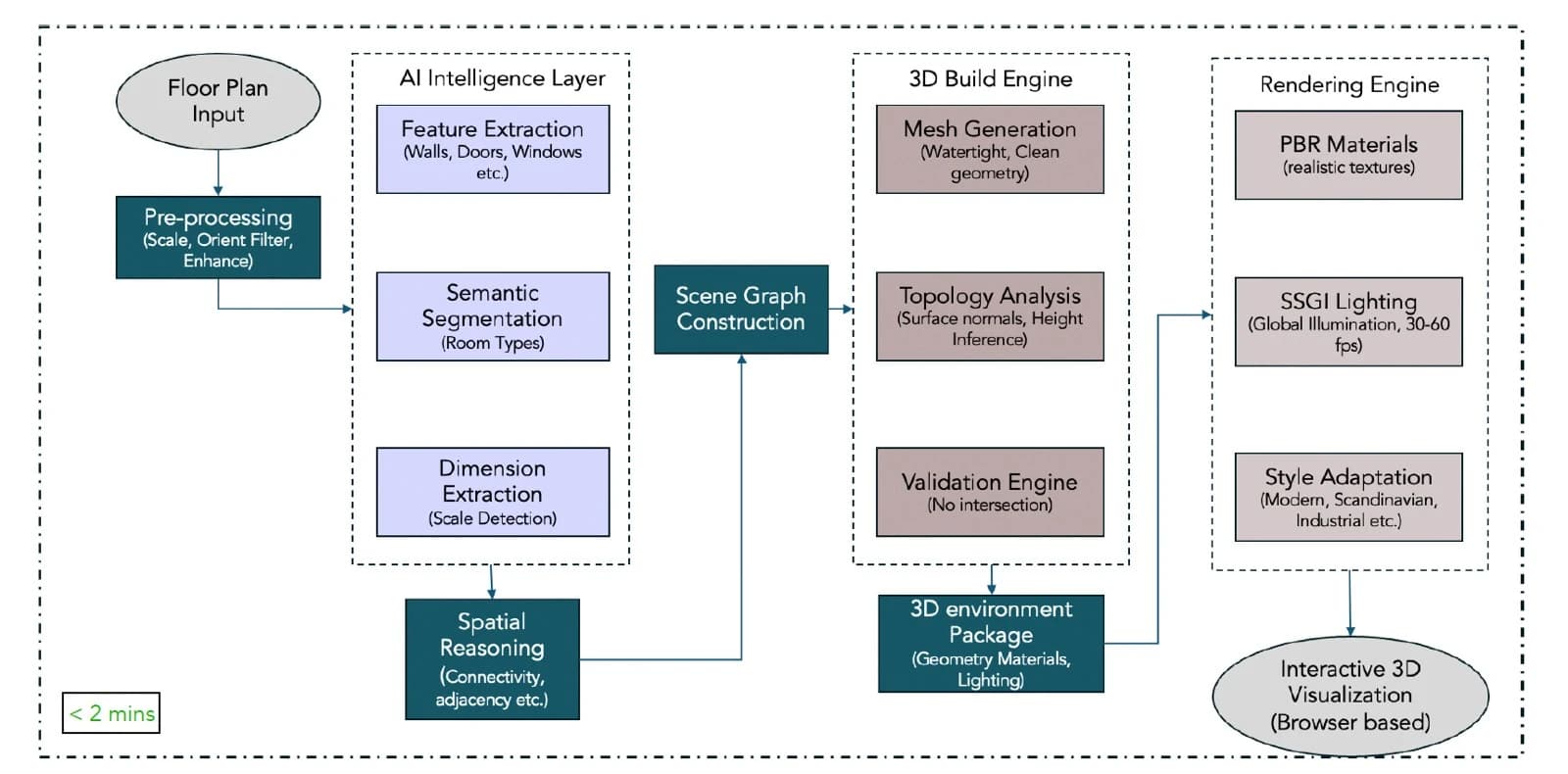
A typical 2D floor plan passes through:
- Pre-processing: Scale and orientation are detected, noise is reduced, and linework is cleaned. This is crucial because in the wild, floor plans arrive as scans, phone photos, or exported PDFs with wildly different resolutions.
- AI intelligence layer:
- Feature extraction isolates walls, doors, windows, and structural elements.
- Semantic segmentation detects room types and legends, similar to how academic models segment floor plans but tuned for residential layouts.
- Dimension extraction infers scale and critical measurements.
- Spatial reasoning learns adjacency and connectivity, so circulation paths and lines of sight make sense.
- Scene graph construction: All these entities are assembled into a structured scene graph that represents a home rather than a collection of polygons. This graph is the backbone for 3D visualization and downstream AI interior design.
- 3D build engine:
- Mesh generation creates watertight geometry for each room and structural element.
- Topology analysis infers heights, floor level changes, and surface normals.
- Validation ensures that doors are not colliding with walls, openings are consistent, and no geometry is impossible.
- Rendering engine: Physically based materials, Screen Space Global Illumination (SSGI) lighting, and style adaptation translate the structural model into photoreal interior design renders that run in a standard browser. The same engine powers AI interior decor, AI 3D visualization, and AI virtual staging.
This entire flow, from floor plan input to interactive 3D environment, runs in minutes instead of the days or weeks that external 3D artists often require. It allows practitioners to convert floor plan to 3D on demand and iterate directly with clients.
Product Momentum: From 3D Shells to Lived-In Spaces
The roadmap around this engine is focused on designing spaces for people, not just generating meshes.
Key capabilities in active development include:
- White modeling plus AI furnishing: Designers place coarse furniture placeholders, and the AI generates full interior design photoreal renders with detailed materials and decor styles in real time.
- Photorealistic graphics pipeline: Physically based rendering (PBR) materials and Screen Space Global Illumination (SSGI) lighting deliver high-quality interior design 3D visualization inside a browser with no dedicated GPU.
- Dynamic floor plan editor: Parametric controls allow quick changes to walls and openings, with instant structural validation.
- First-person and orbital views: Stakeholders can move between technical axonometric views and immersive walkthroughs, which mirrors approaches used in gaming engines and NeRF-based 3D reconstruction.
- Real-time shareable links: Every design state is a URL that architects, agents, and home buyers can explore without software hand-offs.
The result is a platform where 2D to 3D computer vision AI is not a demo, but the substrate for collaboration between professionals and homeowners.
How This Helps Architects and Interior Designers
For architects and interior designers who design homes every day, the gains are practical, not abstract.
- Faster pre-sales and approvals: Teams can upload 2D floor plans, run blueprint to 3D in minutes, and present multiple layout options or AI virtual staging concepts without outsourcing to render studios. Home buyers understand volume, light, and furniture fit much earlier, and decisions come faster.
- Reduced software hand-offs: Instead of bouncing between CAD, BIM, DCC tools, and ad hoc rendering services, the same pipeline handles floor plan to 3D, AI interior design, and AI interior decor inside one experience. This matters for residential developers running many unit variants at once.
- Augmented creative output: Designers are still in control of intent and taste. The system handles heavy lifting: extracting structure, keeping materials consistent, testing multiple styles, and generating interior design renders so humans can focus on designing spaces, designing homes, and designing for people.
- Clearer communication with homeowners: Photoreal AI 3D visualization, with first-person walkthroughs and shareable links, lets non-technical clients react to the actual feel of a space rather than abstract drawings.
Qualitative ROI for Residential Workflows
| Area | Traditional Workflow | With Floor Plan to 3D AI Engine | ROI Signal |
|---|---|---|---|
| Concept design | Manual CAD, hand sketches, outsourced renders | Floor plan to 3D plus AI interior design in a browser session | Higher iteration speed, more concepts explored |
| Client approvals | 2D drawings, static PDFs | Interactive AI 3D visualization, virtual staging, and style variations | Shorter decision cycles, fewer misunderstandings |
| Outsourcing spend | Repeated external render contracts | In-house use of Foursite and similar tools | Lower variable cost per project, better reuse of assets |
| Sales and marketing | Generic brochures | Photoreal experiences tailored to target buyer personas | Higher perceived quality and engagement |
Even without inserting hard numbers, most teams can map these qualitative gains directly to their own hourly rates and project timelines.
Foursite and Remodroom: Two Sides of the Same Engine
Foursite is the manifestation of this engine for floor plan to 3D at the project scale.
It takes 2D floor plans and architectural blueprints from residential developers and architects, runs them through the specialized parser, and generates interactive 3D visualization for full homes and towers.
Remodroom uses the same ideas at the room scale.
Instead of parsing a technical drawing, it reads a single room photo, uses AI to understand structure, light, and materials, then synthesizes photoreal alternatives in different styles.
For interior designers and homeowners this means:
- Testing layouts and finishes from floor plans with Foursite in early design phases.
- Using Remodroom later to fine-tune bedrooms, living rooms, and kitchens based on real photos.
- Keeping design intent coherent across 2D floor plans, 3D models, and lived-in snapshots.
The shared DNA is important.
A specialized visual language engine that understands homes makes it possible to keep geometry, materials, and style decisions consistent between planning, marketing, and renovation.
Beyond Architecture: A General Technical Document Parser
Once you view 2D to 3D for homes as technical document understanding plus spatial reasoning, it becomes clear that architecture is a starting point, not a ceiling.
Research on floor plan recognition already sits close to similar work on engineering drawings, facility management plans, and circuit diagrams:
- Surveys of deep learning for floor plan recognition emphasize multimodal models that combine layout, symbols, and OCR, which parallels approaches for mechanical and electrical schematics.
- WAFFLE, a large multimodal floorplan dataset, uses detection models to separate legends, scales, and other UI elements, patterns that are shared across technical diagrams.
- Industry I-OCR systems target engineering drawings in general and explicitly mention the need to read technical symbols, tables, and annotations, not just text.
A technical document parser that has learned the specialized visual language of residential architecture can, with retraining, be extended to:
- Structural engineering drawings: recognizing rebar layouts, slab edges, and load paths, then validating that proposed interior changes stay within structural limits.
- Mechanical, engineering, and plumbing (MEP) plans: parsing HVAC, plumbing, and electrical routes to ensure AI virtual staging respects service zones and clearances.
- Circuit schematics: understanding components and connectivity, then generating 3D panel or device layouts that match manufacturing constraints.
The core ingredients are the same: domain-specific OCR, symbol recognition, topology extraction, and a scene graph that knows the difference between lines on a page and a system that must work in the real world.
Why This Space Is Still Underserved
Despite the research momentum and isolated consumer tools that promise "upload a blueprint and get a 3D model", most professional residential teams still rely on manual CAD, offline render studios, and fragmented workflows.
The reasons are straightforward:
- Few systems handle the breadth of real-world plan formats and annotation styles that appear across regions and decades.
- Generic OCR and computer vision stacks cannot reach the precision needed for permitting, sales, and construction drawings.
- Many academic systems stop at clean 3D shells instead of delivering the AI interior design, AI visualization, and AI 3D visualization that stakeholders actually need.
By treating floor plans as a specialized visual language, building a robust technical document parser, and tying it directly to photoreal AI interior decor and virtual staging workflows, VirtualSpaces is trying to close that gap.
For technologists, gaming engine developers, residential real estate developers, architects, interior designers, and homeowners, that shift turns 2D to 3D from an offline service into a core capability that lives at the heart of how we design spaces for people.
Recommended for you

August 19, 2026
The End of the Model Home? 3D Changes the Math | VirtualSpaces
HHemanth Velury
CEO & Co-Founder
August 17, 2026
Designing Spaces That Actually Get Built | VirtualSpaces
HHemanth Velury
CEO & Co-Founder
August 12, 2026
Designing Homes for the Stuff People Actually Own | VirtualSpaces
HHemanth Velury
CEO & Co-Founder
August 07, 2026
Floor Plan to Bill of Materials: The 3D Model as Data | VirtualSpaces
HHemanth Velury
CEO & Co-Founder.png&w=1080&q=75)
August 05, 2026
Designing Homes for How People Actually Live | VirtualSpaces
HHemanth Velury
CEO & Co-Founder
August 03, 2026
Honest by Design: Trust in AI Real Estate Imagery | VirtualSpaces
HHemanth Velury
CEO & Co-Founder
July 29, 2026
Kitchen and Bath: The Two Rooms That Decide Resale | VirtualSpaces
HHemanth Velury
CEO & Co-Founder
July 27, 2026
Why Empty Rooms Don't Sell: Virtual Staging | VirtualSpaces
HHemanth Velury
CEO & Co-Founder
July 24, 2026
The Quiet Sustainability Win of Deciding in 3D | VirtualSpaces
HHemanth Velury
CEO & Co-Founder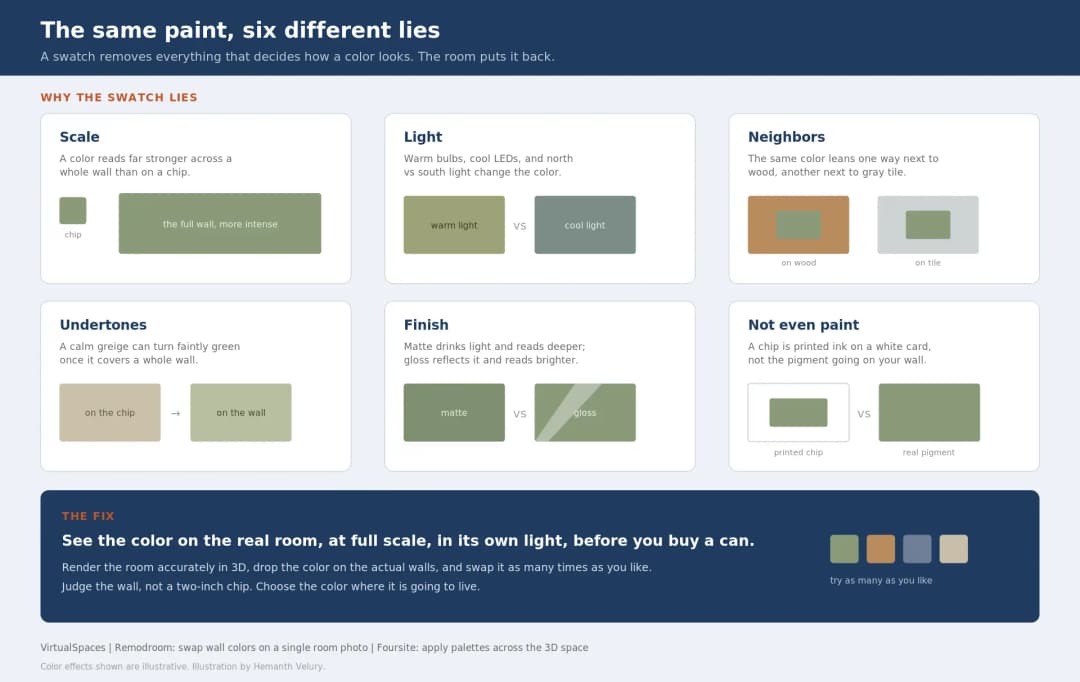
July 22, 2026
Why Paint Swatches Lie: Test Color in 3D First | VirtualSpaces
HHemanth Velury
CEO & Co-Founder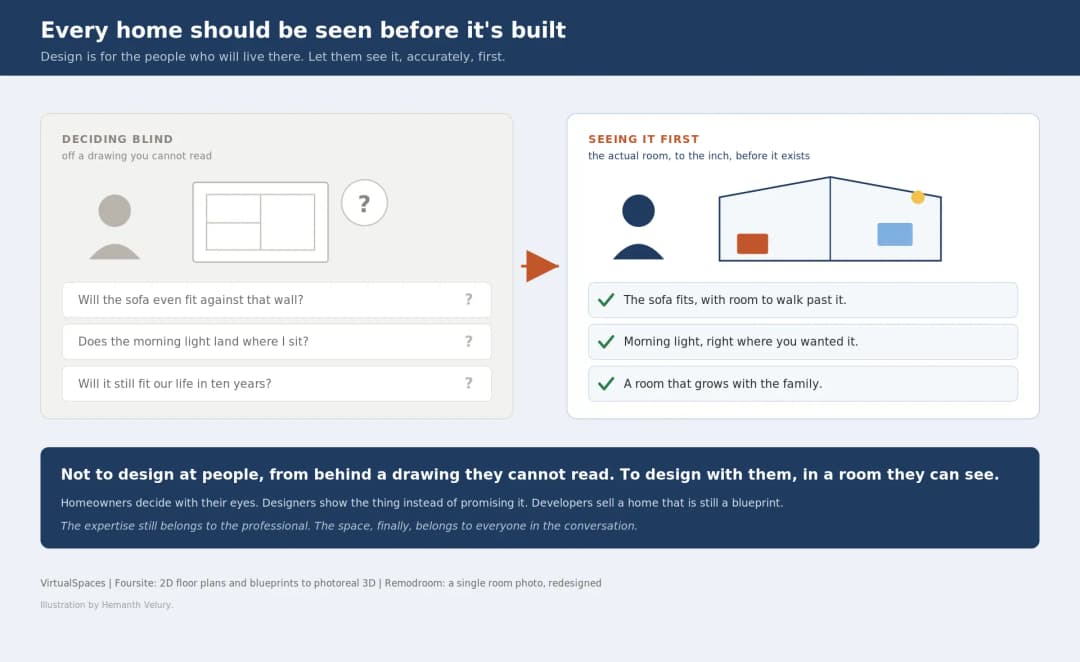
July 20, 2026
Why Every Home Should Be Seen Before It's Built | VirtualSpaces
HHemanth Velury
CEO & Co-Founder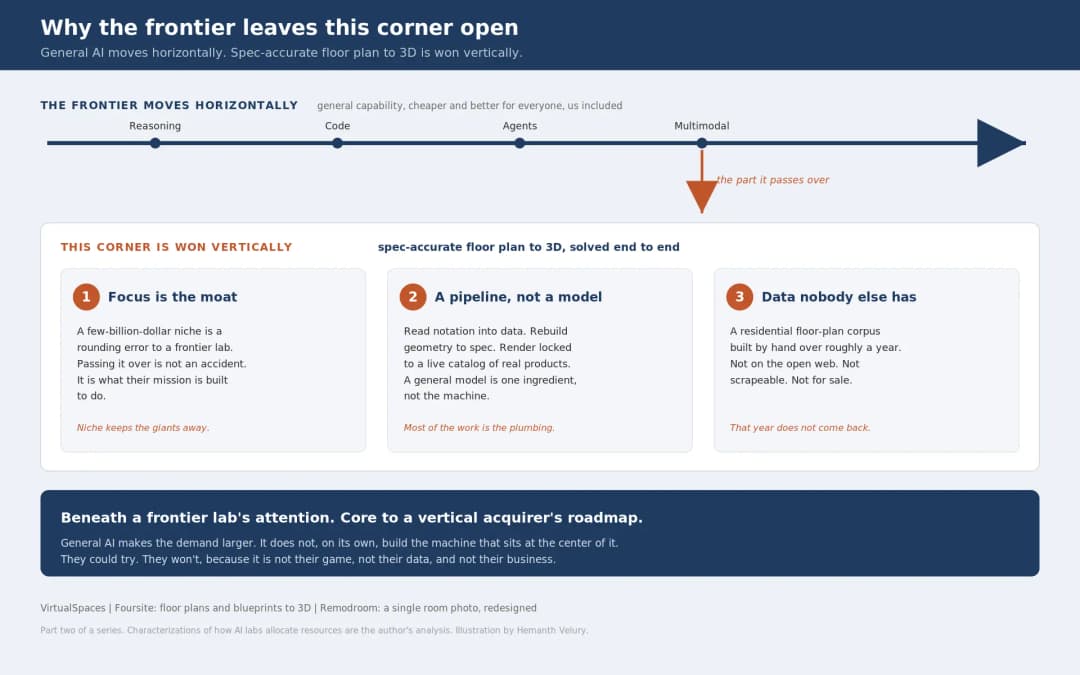
July 17, 2026
Why Big AI Labs Won't Build Floor Plan to 3D | VirtualSpaces
HHemanth Velury
CEO & Co-Founder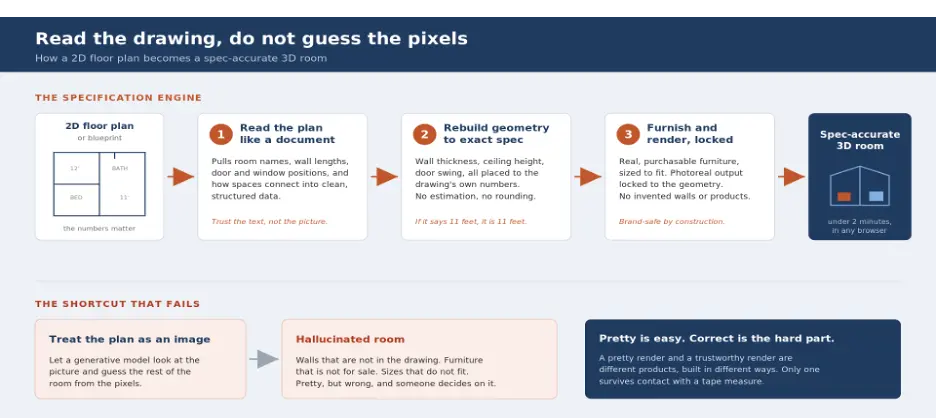
July 15, 2026
How We Solve Floor Plan to 3D, Accurately | VirtualSpaces
HHemanth Velury
CEO & Co-Founder
July 13, 2026
Designing Homes That Age With the People in Them | VirtualSpaces
HHemanth Velury
CEO & Co-Founder
July 10, 2026
Designing Spaces for How Light Actually Moves | VirtualSpaces
HHemanth Velury
CEO & Co-Founder
July 08, 2026
Designing Homes for Every Life Stage in 3D | VirtualSpaces
HHemanth Velury
CEO & Co-Founder
July 06, 2026
Build an Interior Design Portfolio Without Clients | VirtualSpaces
HHemanth Velury
CEO & Co-Founder
June 26, 2026
AI Interior Design: Full 3D Workflow in One Platform | VirtualSpaces
HHemanth Velury
CEO & Co-Founder
June 24, 2026
Scope Creep in Interior Design: How AI Visualization Fixes It | VirtualSpaces
HHemanth Velury
CEO & Co-Founder
June 22, 2026
What Buyers See on a Floor Plan: Your Biggest Sales Problem | VirtualSpaces
HHemanth Velury
CEO & Co-Founder
June 19, 2026
Small Design Studios vs Big Firms: The AI Advantage | VirtualSpaces
HHemanth Velury
CEO & Co-Founder
June 17, 2026
After the Mood Board: AI Interior Visualization | VirtualSpaces
HHemanth Velury
CEO & Co-Founder
June 15, 2026
Foursite Pro Editor: Full Floor Plan Control for Designers | VirtualSpaces
HHemanth Velury
CEO & Co-Founder
June 12, 2026
AI Interior Design: Style Any Room in Seconds with Foursite | VirtualSpaces
HHemanth Velury
CEO & Co-Founder
June 10, 2026
Foursite: Floor Plan to 3D Walkthrough in Minutes | VirtualSpaces
HHemanth Velury
CEO & Co-Founder
June 08, 2026
Win More Pitches With AI Renders Before the Meeting | VirtualSpaces
HHemanth Velury
CEO & Co-Founder
June 05, 2026
From Floor Plan to Finished Room: What AI Now Makes Possible | VirtualSpaces
HHemanth Velury
CEO & Co-Founder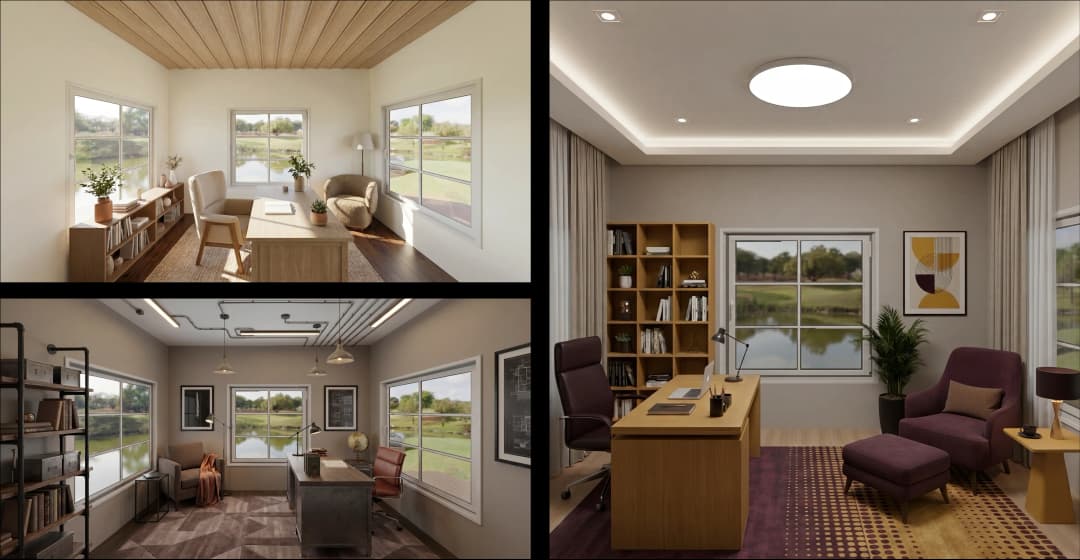
June 03, 2026
The Interior Design Brief Is Broken. AI Fixes It | VirtualSpaces
HHemanth Velury
CEO & Co-Founder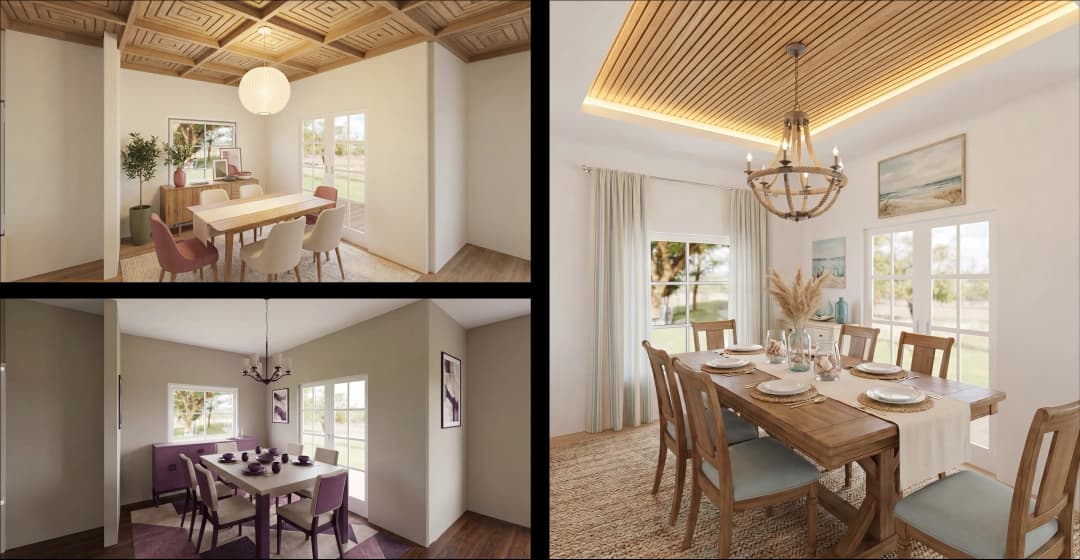
June 01, 2026
Pre-Construction Home Sales: AI Interior Visualization Guide | VirtualSpaces
HHemanth Velury
CEO & Co-Founder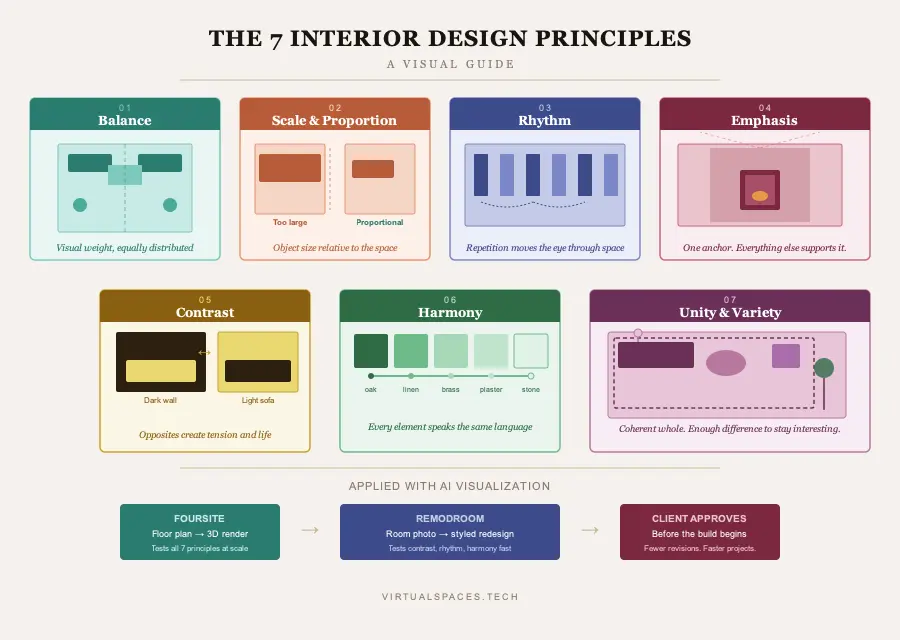
May 30, 2026
Interior Design Principles: Applied with AI | VirtualSpaces
HHemanth Velury
CEO & Co-Founder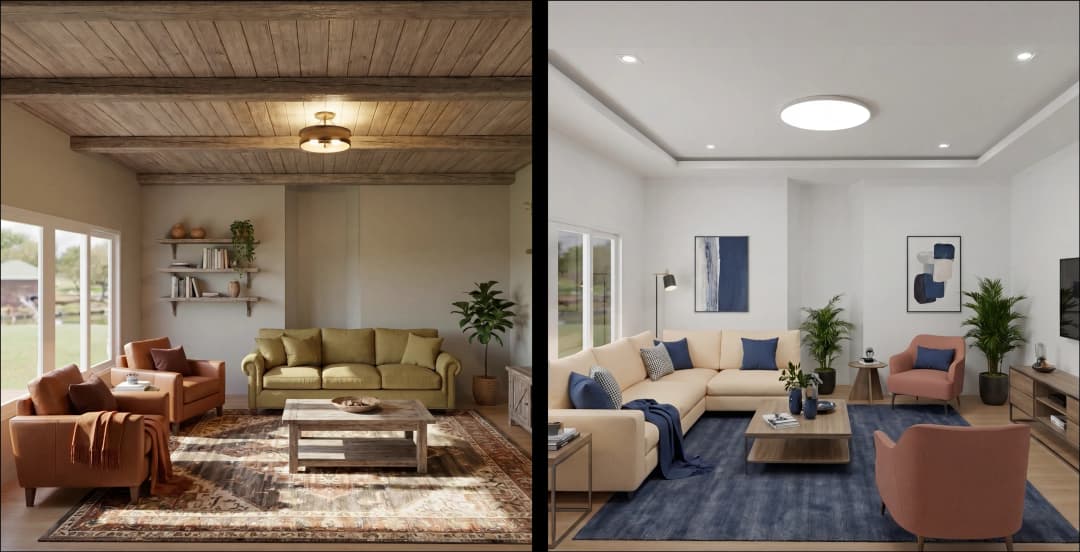
May 28, 2026
Designing Spaces for People, Not Blueprints | VirtualSpaces
HHemanth Velury
CEO & Co-Founder
May 26, 2026
The Future of Interior Design: Closing the Visualization Gap with Foursite and Remodroom | VirtualSpaces
HHemanth Velury
CEO & Co-Founder
May 18, 2026
How AI Visualization Upgrades Property Data Platforms | VirtualSpaces
HHemanth Velury
CEO & Co-Founder
May 14, 2026
How AI-First Insurers Can Use 3D Property Data to Transform Home Claims | VirtualSpaces
HHemanth Velury
CEO & Co-FounderMay 12, 2026
Why Photoreal 3D Renders Are Replacing Mood Boards | Interior Design Client Presentations | VirtualSpaces
HHemanth Velury
CEO & Co-Founder
May 08, 2026
From 2D Floor Plans To Living Worlds: The Spec‑Accurate 3D Engine | VirtualSpaces
HHemanth Velury
CEO & Co-Founder
May 06, 2026
Why Furniture Brands Need AI 3D Visualization Now | VirtualSpaces
HHemanth Velury
CEO & Co-Founder
May 4, 2026
How Property Portals Can Turn 2D Floor Plans into 3D Design Decisions | VirtualSpaces
HHemanth Velury
CEO & Co-Founder
April 29, 2026
The Home-Fit Test: Why Square Footage Misleads | VirtualSpaces
HHemanth Velury
CEO & Co-Founder
April 27, 2026
Designing Homes That Sell: 3D Visualization ROI Data | VirtualSpaces
HHemanth Velury
CEO & Co-FounderApril 24, 2026
What's Next: Foursite & Remodroom's New AI Features | VirtualSpaces
HHemanth Velury
CEO & Co-Founder
April 22, 2026
AI in Architecture: Closing the 85% Exposure Gap | VirtualSpaces
HHemanth Velury
CEO & Co-Founder
April 20, 2026
Interior Design Pricing in 2026: From Hourly to Value-Based Fees | VirtualSpaces
HHemanth Velury
CEO & Co-FounderApril 17, 2026
How Foursite and Remodroom Help Designers Win Clients | VirtualSpaces
HHemanth Velury
CEO & Co-Founder
April 15, 2026
Designing Spaces for People: Remodroom + Foursite AI Guide | VirtualSpaces
HHemanth Velury
CEO & Co-Founder
April 13, 2026
Designing for the Way People Actually Live: How AI 3D Is Finally Closing the Gap Between Floor Plan and Reality
HHemanth Velury
CEO & Co-Founder
April 11, 2026
Design in Real Time: AI Renders in Your First Client Meeting
HHemanth Velury
CEO & Co-Founder
April 06, 2026
Why Real Estate Photography Is No Longer Enough: The Shift to Spatial-First Listings
HHemanth Velury
CEO & Co-Founder
April 03, 2026
Property Management's Hidden Weapon: AI 3D Floor Plans That Cut Vacancy Time and Raise Tenant Quality
HHemanth Velury
CEO & Co-Founder
April 01, 2026
Off-Plan and Oversubscribed: How AI 3D Visualization Is Transforming Real Estate Pre-Sales
HHemanth Velury
CEO & Co-Founder
March 30, 2026
Why Foursite Beats Generic AI Tools for Interior Design 3D Visualization
HHemanth Velury
CEO & Co-Founder
March 27, 2026
7 Tenets of Interior Design: How AI Accelerates Harmony in Residential Spaces
HHemanth Velury
CEO & Co-Founder
March 25, 2026
What Is the 3-5-7 Rule in Interior Design? Foursite's AI Guide for Residential Spaces
HHemanth Velury
CEO & Co-Founder
March 23, 2026
What Is the 70/30 Rule in Interior Design? Foursite's AI Guide for Residential Spaces
HHemanth Velury
CEO & Co-Founder
March 20, 2026
How AI 3D Visualization Is Rewriting Residential Interior Design Workflows
HHemanth Velury
CEO & Co-Founder
March 18, 2026
Beyond Marketing: How 3D Floorplans Transform FM, Retrofit Planning & ESG Operations
HHemanth Velury
CEO & Co-Founder
March 16, 2026
Why AI Companies Use Token Payments (And Why VirtualSpaces Is Returning To Fiat)
HHemanth Velury
CEO & Co-Founder
March 13, 2026
Floorplan‑Native Digital Twins: Beyond BIM for Consumer‑Ready Real Estate Experiences
HHemanth Velury
CEO & Co-Founder
March 11, 2026
The Foursite Platform Thesis: Why Floor Plans, Not Photos, Are the Next Property Software Primitive
HHemanth Velury
CEO & Co-Founder
March 09, 2026
Design Systems for Space: Building Reusable 3D Component Libraries on Top of AI Floorplan‑to‑3D Engines
HHemanth Velury
CEO & Co-Founder
March 06, 2026
How to Standardize Design Quality Across Global Projects Using AI Floorplan-to-3D Tools
HHemanth Velury
CEO & Co-Founder
March 04, 2026
From CAD-First to AI-First: Reskilling Your Team for AI-Native Design Workflows
HHemanth Velury
CEO & Co-Founder
March 02, 2026
Algorithmic Ergonomics Meets Photorealistic 3D: Designing Human-Centered Smart Homes with Foursite in 2026
HHemanth Velury
CEO & Co-Founder
February 27, 2026
The Ethics of AI in Interior Design: Ownership, Originality, and Client Transparency
HHemanth Velury
CEO & Co-Founder
February 25, 2026
Designing with Empathy: Using AI 3D Visualization to Improve Client Communication and Emotional Clarity
HHemanth Velury
CEO & Co-Founder
February 23, 2026
From Tool to Infrastructure: AI Floorplan-to-3D and the Next Wave of PropTech
HHemanth Velury
CEO & Co-Founder
February 20, 2026
AI Interior Design for Holiday Homes: Turn Spare Flats into High-Demand Short-Stay Rentals with 3D Visuals
HHemanth Velury
CEO & Co-Founder
February 18, 2026
The Pre‑Purchase Power Play: How Savvy Home Buyers Use 3D Floor Plan Visualization to Negotiate Better Deals
HHemanth Velury
CEO & Co-FounderFebruary 16, 2026
AI Interior Design for Non‑Designers: How Homeowners Can Brief Like Pros
HHemanth Velury
CEO & Co-Founder
February 13, 2026
Scaling a Design Business Without Hiring a 3D Team: An Owner's Guide
HHemanth Velury
CEO & Co-Founder
February 11, 2026
From Bland to Bold: How to Rescue Builder-Grade Interiors on Any Budget
HHemanth Velury
CEO & Co-Founder
February 6, 2026
The Psychology of Space: How Room Dimensions Influence Interior Design Decisions
HHemanth Velury
CEO & Co-Founder
February 4, 2026
The Future of Interior Design Visualization: How AI Technology is Transforming 2D Concepts Into 3D Reality
HHemanth Velury
CEO & Co-Founder
February 2, 2026
AI Interior Décor: How Artificial Intelligence Generates Design Options from Your Floor Plan
HHemanth Velury
CEO & Co-Founder
January 30, 2026
Photoreal vs. Reality: What Clients Actually Expect from Interior Design Visualization
HHemanth Velury
CEO & Co-Founder
January 28, 2026
The Design Approval Conversation That Changes Everything: Communication Strategy When Using Photorealistic Visualization
HHemanth Velury
CEO & Co-Founder
January 25, 2026
Interior Design as Experience Design: How 3D Visualization Changes Your Professional Identity
HHemanth Velury
CEO & Co-Founder
January 23, 2026
The Professional Gap: How 3D Visualization Changes Interior Design Client Perception
HHemanth Velury
CEO & Co-Founder
January 21, 2026
Why Clients Fire Designers (And How 3D Visualization Could Have Saved the Project)
HHemanth Velury
CEO & Co-Founder
January 16, 2026
Blueprint to Vision: Why Seeing Is Believing in Interior Design
HHemanth Velury
CEO & Co-Founder
January 14, 2026
The Speed of Responsiveness: How AI Visualization Tools Make You Look Like You Care More
HHemanth Velury
CEO & Co-Founder
January 12, 2026
Why Interior Designers and Architects Can't Compete Without AI 3D Visualization Tools
HHemanth Velury
CEO & Co-Founder
January 07, 2026
From "Saved" to "Sold": How Homeowners Are Planning Renovations with AI
HHemanth Velury
CEO & Co-Founder
January 05, 2026
The Interior Designer's Secret Weapon: Speed as Premium Positioning
HHemanth Velury
CEO & Co-Founder
December 31, 2025
Gratitude, Growth & Game-Changing Innovation: VirtualSpaces' 2025 Journey & What's Coming in 2026
HHemanth Velury
CEO & Co-Founder
December 29, 2025
Why Interior Designers Are Switching to AI Floor Plan-to-3D Tools in 2026
HHemanth Velury
CEO & Co-Founder
December 26, 2025
AI Virtual Staging for Real Estate Agents: Sell More Homes Faster with Foursite
HHemanth Velury
CEO & Co-Founder
December 24, 2025
Why Architects Are Switching to AI 2D-to-3D: The SketchUp Alternative
HHemanth Velury
CEO & Co-Founder
December 22, 2025
Cut 3 Weeks from Real Estate Sales Cycle: The ROI of AI 2D to 3D Visualization
HHemanth Velury
CEO & Co-Founder
December 19, 2025
2D Floor Plans Are Dying: Why 3D Visualization & AI Virtual Staging Are the Future
HHemanth Velury
CEO & Co-Founder
December 17, 2025
Virtual Staging vs Physical Staging: How AI Saves Money Per Property
HHemanth Velury
CEO & Co-Founder
December 15, 2025
AI Floor Plan to Image: Revolutionizing Real Estate Marketing for Agents
HHemanth Velury
CEO & Co-Founder
December 12, 2025
Color of the Year 2026: Cloud Dancer | VirtualSpaces AI Interior Design Guide
HHemanth Velury
CEO & Co-Founder
December 10, 2025
AI Floor Plan to 3D: The New Standard for Interior Design Workflows
HHemanth Velury
CEO & Co-Founder
December 08, 2025
How Interior Design Studios Can Operationalize AI 2D-to-3D Workflows (Without Breaking Their Process)
HHemanth Velury
CEO & Co-Founder
December 06, 2025
How to Implement AI Interior Design Workflows in Your Studio
HHemanth Velury
CEO & Co-Founder
December 4, 2025
How Homeowners Can Use AI Interior Design Tools to Plan Renovations with Confidence
HHemanth Velury
CEO & Co-Founder
November 28, 2025
Interior Designers in the Age of AI: From Threat Narrative to Superpower
HHemanth Velury
CEO & Co-Founder
November 21, 2025
Foursite Launch: Embracing 'Release Early, Release Often'
HHemanth Velury
CEO & Co-Founder
November 13, 2025
Foursite by VirtSpaces: Empowering Interior Designers, Architects, and Homeowners
HHemanth Velury
CEO & Co-Founder
November 7, 2025
Reimagining Architectural Education: How AI Floorplan-to-3D Technology Can Transform Design Learning
VVirtualSpaces Research Labs
AI Research Initiative
October 27, 2025
Archisculpt AI: Turning Architectural Drawings into Photorealistic 3D Spaces
AAbhijeet Naik
Co-Founder & CTO
October 13, 2025
Home Makeover: From Floor Plan to Dream Space with AI
HHemanth Velury
CEO & Co-Founder
October 6, 2025
Real-Time Rendering & AI: Revolutionizing Interactive Property Walkthroughs with VirtSpaces
HHemanth Velury
CEO & Co-Founder
September 26, 2025
Foursite - A True AI-Native Experience in Design Visualization
AAbhijeet Naik
CTO & Co-Founder
September 18, 2025
Why PropTech Startups Are Betting on AI Interior Design
HHemanth Velury
CEO & Co-Founder
September 11, 2025
How AI Differs from Traditional 3D Rendering Software
HHemanth Velury
CEO & Co-Founder
September 2, 2025
From Client to Investor: How Nila Spaces and VirtSpaces Are Redefining Proptech with AI
HHemanth Velury
CEO & Co-Founder
August 25, 2025
VirtSpaces From Virtual Reality to AI – Transforming Real Estate Visualization.
HHemanth Velury
CEO & Co-Founder


We help teams collaborate seamlessly and reduce costs. Virtual Spaces offers cutting-edge technology with flexible plans designed to fit modern teams.
Copyright © VirtSpaces Pvt. Ltd. 2025 All Rights Reserved.
CIN: U74999KA2016PTC094921