April 17, 2026
- AI Technology
- Interior Design
How Foursite and Remodroom Help Designers Win Clients | VirtualSpaces
Hemanth Velury
CEO & Co-FounderWhen Your Floor Plan Doesn't Match Reality: How Foursite and Remodroom Help Interior Designers Win More Clients
Most interior designers do not lose clients because their taste is off. They lose clients at the moment a prospect says, "let me think about it."
That pause is rarely a budget problem. It is a visualization problem. The client cannot picture the living room. They cannot feel the scale of the kitchen island. They do not know if their sofa will sit well next to the window. The conversation ends politely, the follow-up email goes unanswered, and a well-briefed lead quietly becomes a missed booking.
This is the business cost of the cognitive gap between a designer and a homeowner, and it shows up in quarterly revenue as much as it shows up in a client's hesitation. Foursite and Remodroom, built by VirtualSpaces on the Archisculpt AI model, exist to close that gap before it swallows the contract.
The Silent Stage Where Designers Lose Clients
Talk to any practitioner with ten years of residential work and the same pattern appears. The brief feels aligned, the budget feels workable, the site walk feels positive. Then a proposal and a flat plan arrive by email, and the conversation slows.
Interior designers designing for people, not for other designers, feel this sharply. A homeowner does not speak in axial drawings or elevation sections. They speak in stories: where their children will study, where guests will sit, how morning light hits the breakfast counter. A floor plan strips those stories out and replaces them with abstract geometry.
The effect compounds across a designer's funnel. A practice that wins four out of ten qualified leads covers rent. A practice that wins seven out of ten has a waiting list. The difference between those two outcomes is almost never craft; it is whether the client could see what the designer could see.
This is the quiet conversion leak inside most residential practices. It is not visible on a calendar or a P&L line, but it determines how many projects a studio can actually book in a year.
Why Floor Plans Fail the Human Brain
A plan is a map of a building as viewed from the ceiling. Nobody lives in a building that way. People navigate homes as sequences of landmarks: the front door, the hallway, the turn into the living room, the chair near the window. Cognitive psychologists call this route-based spatial cognition, and most adults rely on it far more than on abstract survey knowledge.
That is why a floor plan doesn't match reality for most buyers and homeowners. The plan tells them where the walls are. It does not tell them what the space will feel like at 7 pm when the lamp is on. Since the feel is what they are buying, the plan alone cannot close.
Once this is understood, a lot of the friction in residential work makes sense. Endless revision rounds are often not a design failure; they are a translation failure. Every translation failure costs billable hours, slows cash collection, and erodes the client's confidence in the relationship.
What Foursite Actually Changes for Interior Designers
Foursite takes a two-dimensional floor plan, or an architectural blueprint, and rebuilds it as a photorealistic 3D interior in minutes. No render studio, no CAD pipeline, no week of waiting.
For practitioners building a residential practice, this is less about render quality and more about sales motion. Designing spaces for people starts with letting people see the space.
The impact shows up in four concrete ways:
- The first consultation becomes a design moment, not a discovery call. The designer walks in with a usable 3D model of the client's own apartment.
- Material, lighting, and style direction can be swapped live. When the client asks about a warmer palette, the answer is shown instead of described.
- Dimensions stay accurate because the model is built from the actual plan; there is no ambiguity about how a 10-foot sofa sits in a 14-foot room.
- Export in .GLTF keeps the model usable in any downstream pipeline, including Blender, 3ds Max, or Unity, if a studio wants to polish select frames later.
The impact on client acquisition is immediate. A designer showing a photorealistic render of the client's own plan during the consultation is not asking them to imagine; they are asking them to choose. That is a very different conversation, and it converts at a very different rate.
What Remodroom Changes for Redesign and Staging Work
Foursite handles the new-build and full-plan case. Remodroom handles the other half of the residential market: the homeowner who already lives in the space and wants to see it transformed before they commit.
Remodroom takes a photograph of an existing room and generates photorealistic redesigns around the furniture, walls, and architectural elements already present. The AI recognizes what is in the room and lets a designer swap specific elements without re-rendering the whole space.
For a designer pitching a renovation or refresh, this is a closing tool. The homeowner is not looking at a stock showroom image; they are looking at their own living room, restyled. That emotional distance between inspiration photo and personal transformation is the distance between polite interest and signed deposit.
Designing homes people already live in carries a specific weight. Clients know where the dog sleeps, where the sun is too bright, and which corner never works. Remodroom speaks to that lived context directly because it starts from the real photo. A designer can present three stylistic directions in the time it used to take to assemble a single mood-board.
The New Sales Motion, in Practical Terms
Put Foursite and Remodroom together and a designer's client acquisition flow looks different from one built around long-render cycles:
- A lead fills in an inquiry form and sends a plan or photo before the first meeting.
- The designer arrives at the consultation with a photorealistic 3D render or a restyled photo of the client's actual space.
- Revisions happen in the room, not in a follow-up email a week later.
- Sign-off arrives in the same meeting or within a few days, rather than after multiple rounds.
- A walkthrough, still frames, and styling references become proposal collateral without hiring an external render studio.
This is how to visualize floor plan before buying into a design contract, and it compresses the sales cycle in a way that carries second-order effects on revenue: more clients served per month, fewer consultations that evaporate, and a cleaner cash cycle because approval lands earlier.
Winning More Clients per Designer-Hour
Capacity is the hidden ceiling on most residential design practices. A principal designer has roughly 40 to 60 usable client-facing hours a week. Every hour spent waiting for an outsourced render, reworking a model after a brief change, or writing clarifying emails to a client who cannot quite picture the proposal is an hour stolen from delivery and from new business.
Foursite and Remodroom return time to the top of the funnel. The practical lift:
- Faster pitches mean more consultations booked per week.
- Fewer render hand-offs mean lower project overhead.
- Shorter proposal cycles mean more projects in flight at once.
- Photorealistic collateral means more portfolio pieces per project, which feeds social channels and referrals.
- Junior staff can carry more of the visual presentation load, freeing the principal to focus on new-client conversations.
There is also a quieter effect. When clients see their own ideas materialized quickly, they refer more aggressively. Referral pipelines grow on trust and storytelling, and nothing tells a story better than a render of the client's own home sent to a friend along with the recommendation.
Designing Spaces for People, Not for Plans
Designing spaces for people is, in the end, an empathy practice. The designer's job is to translate a family's life into an environment that supports it. Every tool that shortens the distance between what the designer imagines and what the family understands raises the quality of that translation.
Foursite and Remodroom do not replace design talent; they extend it. They let the designer's intent reach the client without getting lost in an abstract plan or an approximate mood-board. The result is fewer revision rounds driven by miscommunication, more design decisions driven by taste and craft, and a higher percentage of prospects turning into clients because the pitch itself does much of the convincing.
Architects working on residential projects see a similar shift. Early-scheme conversations with a homeowner or developer become grounded in photorealistic interiors that match the exact plan on the table. Trade-off conversations about ceiling height, window placement, or material choice become visible rather than hypothetical. Decisions land sooner, and scope creep loses its favorite hiding place.
What Architects and Residential Developers Gain in the Pitch Room
Architects and residential developers face the same client-acquisition problem from a different angle. Their buyers are often homeowners or purchasers making a multi-year financial commitment based on a plan they cannot mentally inhabit. When a buyer cannot visualize a unit, they delay, ask for concessions, or walk away entirely. Every delayed decision in a residential pre-sales pipeline has a measurable cost on carrying charges and sales team time.
Foursite changes that pitch room in a few specific ways:
- Unit types can be shown as photorealistic interiors at the first walk-through, not at handover.
- Style variants per unit let a sales team show one plan in three aesthetic directions, matched to buyer profiles.
- Common-area renders become collateral for brochures, microsites, and social campaigns without a separate content shoot.
- Architects can present early scheme options to homeowners with a consistent visual language across every room, avoiding the mismatch between concept sketches and polished kitchen-only renders.
For a residential architect, this also reshapes the consultation itself. Clients stop arguing about abstract choices and start reacting to actual spaces. Scope discussions become specific, and fee conversations become easier because the value is visible on screen. The firm that can show a client the finished home during scheme presentation simply looks more capable than one that cannot, even before the first line of construction documentation is drawn.
The Shape of a Residential Design Practice That Scales
A residential design firm that adopts these tools does not simply do the same work faster. It changes the underlying economics:
- Revenue per designer rises because consultation-to-contract conversion improves.
- Outsourcing spend on render studios falls, often to zero for standard deliverables.
- Principals spend more time on creative direction and client relationships and less on file shepherding.
- Marketing collateral, including pre-sales visuals for developer partners, becomes a byproduct of daily work rather than a separate project.
- Designers can credibly serve clients in neighboring cities because the presentation no longer requires a physical review session to land.
This is what it looks like when an AI layer sits underneath a creative practice rather than next to it. Across residential markets, buyers and homeowners have begun to expect the ability to see a space before they commit to it. The firms that meet that expectation inside the first meeting win a disproportionate share of the pipeline. The rest spend another week waiting for renders that arrive after the decision has already drifted.
Closing the Gap Between Intent and Signed Contract
The designers and architects winning more clients in 2026 are not the ones with the biggest studios. They are the ones who can show a client the finished room before a single material is ordered. Foursite and Remodroom are the two halves of that workflow: one for new plans, one for existing rooms, both built to close the visualization gap that quietly kills deals.
In a market where a floor plan doesn't match reality for most buyers, the competitive edge belongs to the practitioners who let their clients see the reality first. Interior designers designing for people already know this instinctively. The tools are finally catching up to the job.
Recommended for you

August 19, 2026
The End of the Model Home? 3D Changes the Math | VirtualSpaces
HHemanth Velury
CEO & Co-Founder
August 17, 2026
Designing Spaces That Actually Get Built | VirtualSpaces
HHemanth Velury
CEO & Co-Founder
August 12, 2026
Designing Homes for the Stuff People Actually Own | VirtualSpaces
HHemanth Velury
CEO & Co-Founder
August 07, 2026
Floor Plan to Bill of Materials: The 3D Model as Data | VirtualSpaces
HHemanth Velury
CEO & Co-Founder.png&w=1080&q=75)
August 05, 2026
Designing Homes for How People Actually Live | VirtualSpaces
HHemanth Velury
CEO & Co-Founder
August 03, 2026
Honest by Design: Trust in AI Real Estate Imagery | VirtualSpaces
HHemanth Velury
CEO & Co-Founder
July 29, 2026
Kitchen and Bath: The Two Rooms That Decide Resale | VirtualSpaces
HHemanth Velury
CEO & Co-Founder
July 27, 2026
Why Empty Rooms Don't Sell: Virtual Staging | VirtualSpaces
HHemanth Velury
CEO & Co-Founder
July 24, 2026
The Quiet Sustainability Win of Deciding in 3D | VirtualSpaces
HHemanth Velury
CEO & Co-Founder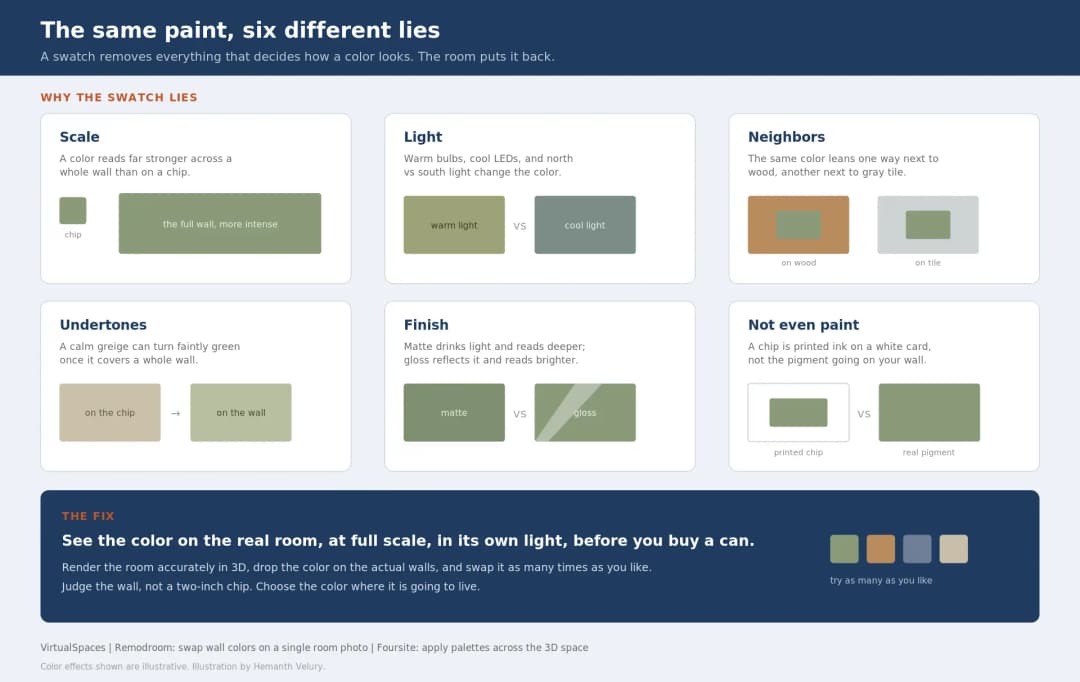
July 22, 2026
Why Paint Swatches Lie: Test Color in 3D First | VirtualSpaces
HHemanth Velury
CEO & Co-Founder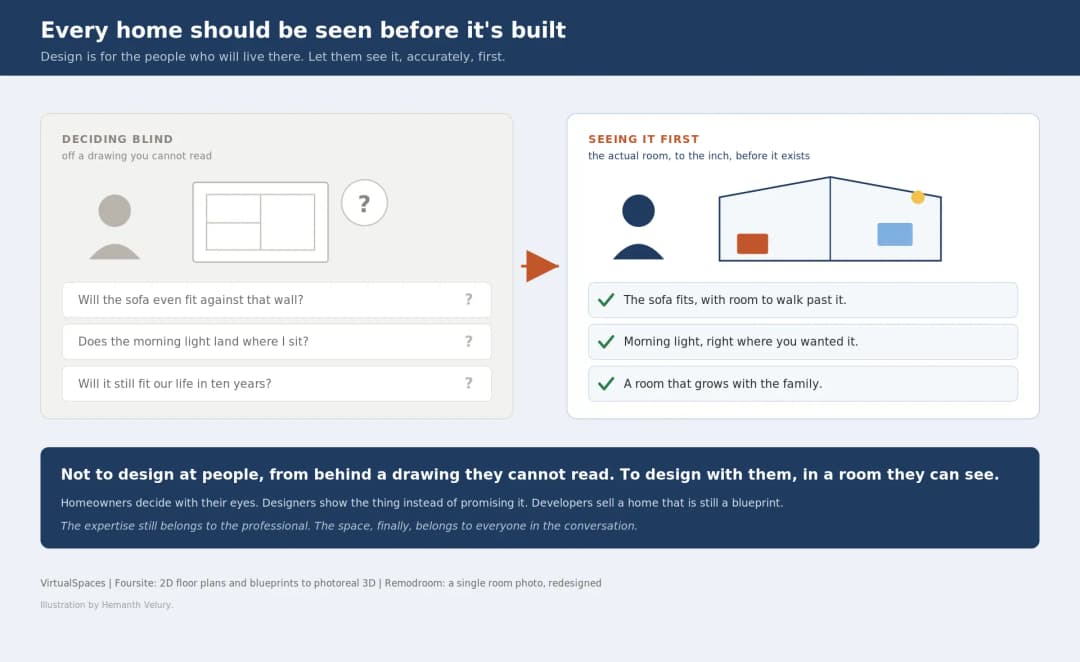
July 20, 2026
Why Every Home Should Be Seen Before It's Built | VirtualSpaces
HHemanth Velury
CEO & Co-Founder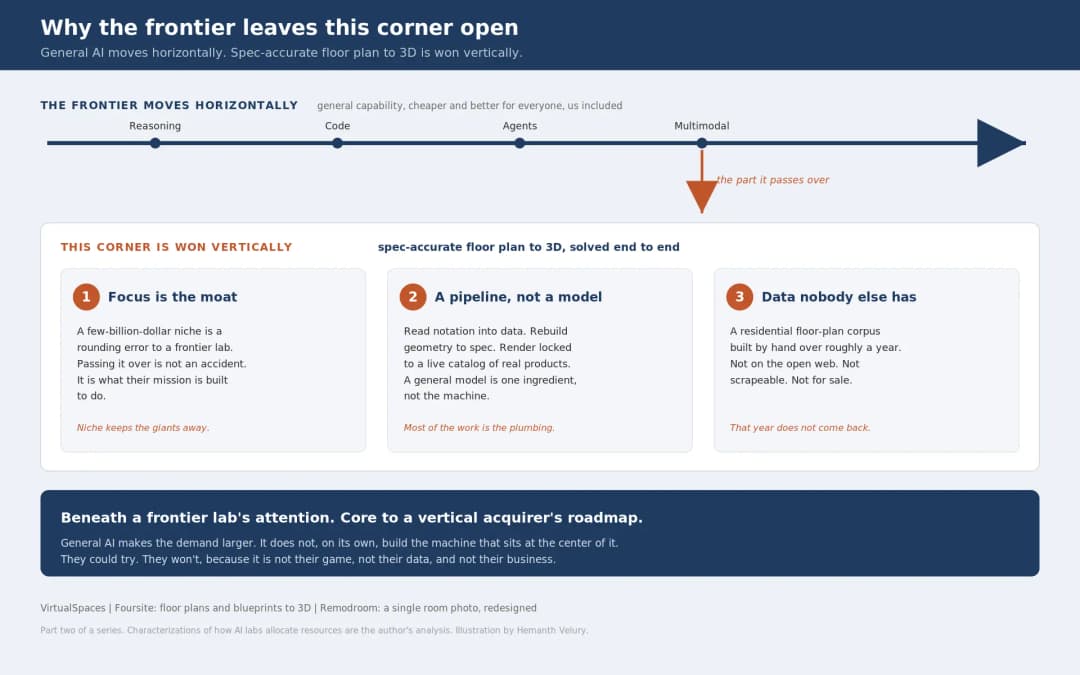
July 17, 2026
Why Big AI Labs Won't Build Floor Plan to 3D | VirtualSpaces
HHemanth Velury
CEO & Co-Founder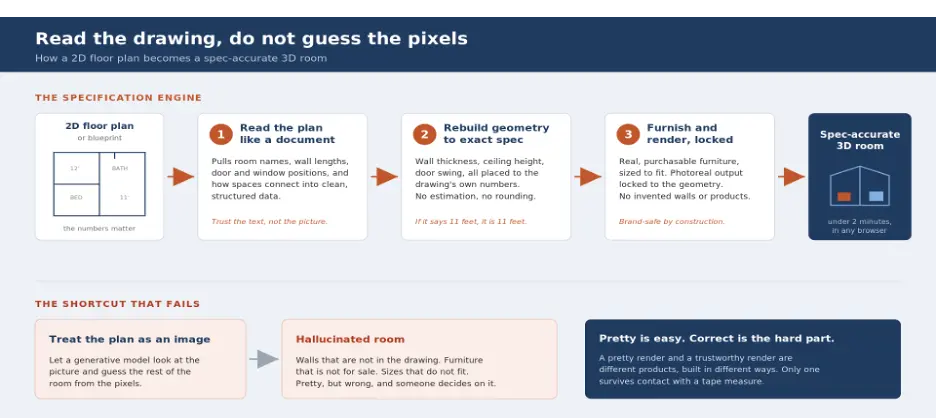
July 15, 2026
How We Solve Floor Plan to 3D, Accurately | VirtualSpaces
HHemanth Velury
CEO & Co-Founder
July 13, 2026
Designing Homes That Age With the People in Them | VirtualSpaces
HHemanth Velury
CEO & Co-Founder
July 10, 2026
Designing Spaces for How Light Actually Moves | VirtualSpaces
HHemanth Velury
CEO & Co-Founder
July 08, 2026
Designing Homes for Every Life Stage in 3D | VirtualSpaces
HHemanth Velury
CEO & Co-Founder
July 06, 2026
Build an Interior Design Portfolio Without Clients | VirtualSpaces
HHemanth Velury
CEO & Co-Founder
June 26, 2026
AI Interior Design: Full 3D Workflow in One Platform | VirtualSpaces
HHemanth Velury
CEO & Co-Founder
June 24, 2026
Scope Creep in Interior Design: How AI Visualization Fixes It | VirtualSpaces
HHemanth Velury
CEO & Co-Founder
June 22, 2026
What Buyers See on a Floor Plan: Your Biggest Sales Problem | VirtualSpaces
HHemanth Velury
CEO & Co-Founder
June 19, 2026
Small Design Studios vs Big Firms: The AI Advantage | VirtualSpaces
HHemanth Velury
CEO & Co-Founder
June 17, 2026
After the Mood Board: AI Interior Visualization | VirtualSpaces
HHemanth Velury
CEO & Co-Founder
June 15, 2026
Foursite Pro Editor: Full Floor Plan Control for Designers | VirtualSpaces
HHemanth Velury
CEO & Co-Founder
June 12, 2026
AI Interior Design: Style Any Room in Seconds with Foursite | VirtualSpaces
HHemanth Velury
CEO & Co-Founder
June 10, 2026
Foursite: Floor Plan to 3D Walkthrough in Minutes | VirtualSpaces
HHemanth Velury
CEO & Co-Founder
June 08, 2026
Win More Pitches With AI Renders Before the Meeting | VirtualSpaces
HHemanth Velury
CEO & Co-Founder
June 05, 2026
From Floor Plan to Finished Room: What AI Now Makes Possible | VirtualSpaces
HHemanth Velury
CEO & Co-Founder
June 03, 2026
The Interior Design Brief Is Broken. AI Fixes It | VirtualSpaces
HHemanth Velury
CEO & Co-Founder
June 01, 2026
Pre-Construction Home Sales: AI Interior Visualization Guide | VirtualSpaces
HHemanth Velury
CEO & Co-Founder
May 30, 2026
Interior Design Principles: Applied with AI | VirtualSpaces
HHemanth Velury
CEO & Co-Founder
May 28, 2026
Designing Spaces for People, Not Blueprints | VirtualSpaces
HHemanth Velury
CEO & Co-Founder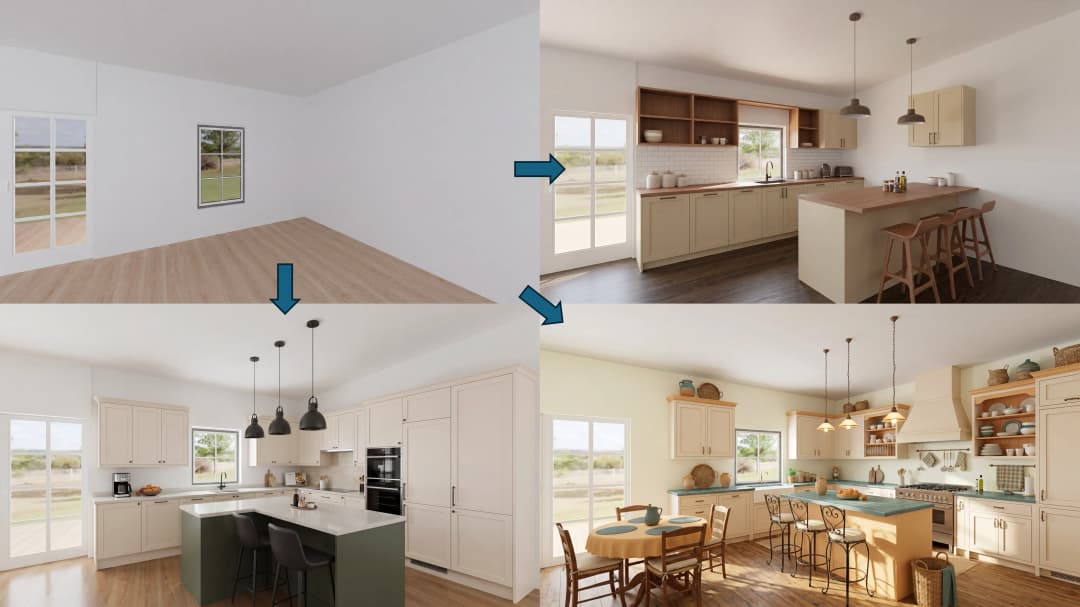
May 26, 2026
The Future of Interior Design: Closing the Visualization Gap with Foursite and Remodroom | VirtualSpaces
HHemanth Velury
CEO & Co-Founder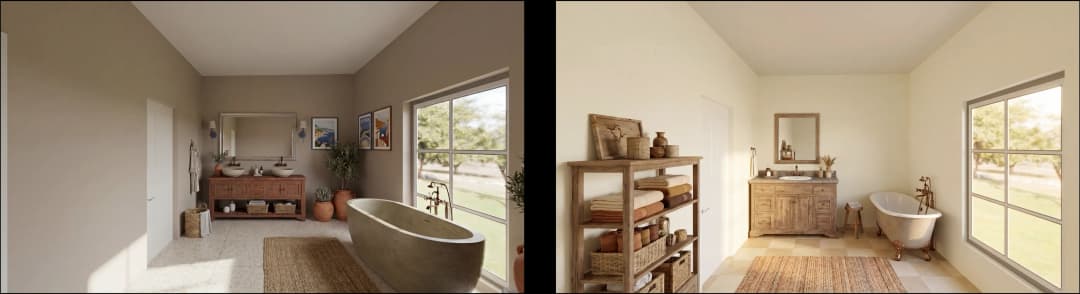
May 18, 2026
How AI Visualization Upgrades Property Data Platforms | VirtualSpaces
HHemanth Velury
CEO & Co-Founder
May 14, 2026
How AI-First Insurers Can Use 3D Property Data to Transform Home Claims | VirtualSpaces
HHemanth Velury
CEO & Co-FounderMay 12, 2026
Why Photoreal 3D Renders Are Replacing Mood Boards | Interior Design Client Presentations | VirtualSpaces
HHemanth Velury
CEO & Co-Founder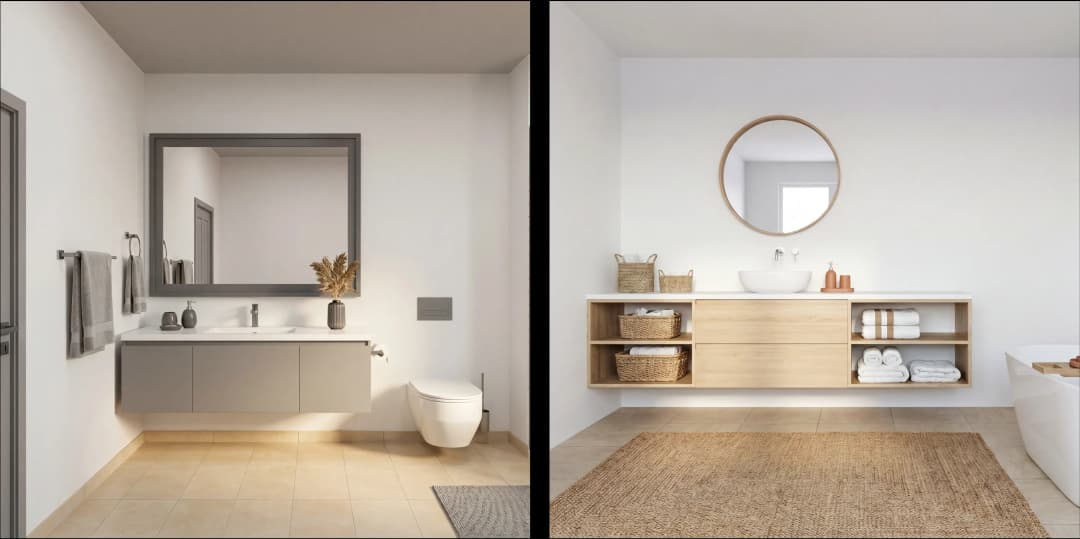
May 08, 2026
From 2D Floor Plans To Living Worlds: The Spec‑Accurate 3D Engine | VirtualSpaces
HHemanth Velury
CEO & Co-Founder
May 06, 2026
Why Furniture Brands Need AI 3D Visualization Now | VirtualSpaces
HHemanth Velury
CEO & Co-Founder
May 4, 2026
How Property Portals Can Turn 2D Floor Plans into 3D Design Decisions | VirtualSpaces
HHemanth Velury
CEO & Co-Founder
April 29, 2026
The Home-Fit Test: Why Square Footage Misleads | VirtualSpaces
HHemanth Velury
CEO & Co-Founder
April 27, 2026
Designing Homes That Sell: 3D Visualization ROI Data | VirtualSpaces
HHemanth Velury
CEO & Co-FounderApril 24, 2026
What's Next: Foursite & Remodroom's New AI Features | VirtualSpaces
HHemanth Velury
CEO & Co-Founder
April 22, 2026
AI in Architecture: Closing the 85% Exposure Gap | VirtualSpaces
HHemanth Velury
CEO & Co-Founder
April 20, 2026
Interior Design Pricing in 2026: From Hourly to Value-Based Fees | VirtualSpaces
HHemanth Velury
CEO & Co-Founder
April 15, 2026
Designing Spaces for People: Remodroom + Foursite AI Guide | VirtualSpaces
HHemanth Velury
CEO & Co-Founder
April 13, 2026
Designing for the Way People Actually Live: How AI 3D Is Finally Closing the Gap Between Floor Plan and Reality
HHemanth Velury
CEO & Co-Founder
April 11, 2026
Design in Real Time: AI Renders in Your First Client Meeting
HHemanth Velury
CEO & Co-Founder
April 06, 2026
Why Real Estate Photography Is No Longer Enough: The Shift to Spatial-First Listings
HHemanth Velury
CEO & Co-Founder
April 03, 2026
Property Management's Hidden Weapon: AI 3D Floor Plans That Cut Vacancy Time and Raise Tenant Quality
HHemanth Velury
CEO & Co-Founder
April 01, 2026
Off-Plan and Oversubscribed: How AI 3D Visualization Is Transforming Real Estate Pre-Sales
HHemanth Velury
CEO & Co-Founder
March 30, 2026
Why Foursite Beats Generic AI Tools for Interior Design 3D Visualization
HHemanth Velury
CEO & Co-Founder
March 27, 2026
7 Tenets of Interior Design: How AI Accelerates Harmony in Residential Spaces
HHemanth Velury
CEO & Co-Founder
March 25, 2026
What Is the 3-5-7 Rule in Interior Design? Foursite's AI Guide for Residential Spaces
HHemanth Velury
CEO & Co-Founder
March 23, 2026
What Is the 70/30 Rule in Interior Design? Foursite's AI Guide for Residential Spaces
HHemanth Velury
CEO & Co-Founder
March 20, 2026
How AI 3D Visualization Is Rewriting Residential Interior Design Workflows
HHemanth Velury
CEO & Co-Founder
March 18, 2026
Beyond Marketing: How 3D Floorplans Transform FM, Retrofit Planning & ESG Operations
HHemanth Velury
CEO & Co-Founder
March 16, 2026
Why AI Companies Use Token Payments (And Why VirtualSpaces Is Returning To Fiat)
HHemanth Velury
CEO & Co-Founder
March 13, 2026
Floorplan‑Native Digital Twins: Beyond BIM for Consumer‑Ready Real Estate Experiences
HHemanth Velury
CEO & Co-Founder
March 11, 2026
The Foursite Platform Thesis: Why Floor Plans, Not Photos, Are the Next Property Software Primitive
HHemanth Velury
CEO & Co-Founder
March 09, 2026
Design Systems for Space: Building Reusable 3D Component Libraries on Top of AI Floorplan‑to‑3D Engines
HHemanth Velury
CEO & Co-Founder
March 06, 2026
How to Standardize Design Quality Across Global Projects Using AI Floorplan-to-3D Tools
HHemanth Velury
CEO & Co-Founder
March 04, 2026
From CAD-First to AI-First: Reskilling Your Team for AI-Native Design Workflows
HHemanth Velury
CEO & Co-Founder
March 02, 2026
Algorithmic Ergonomics Meets Photorealistic 3D: Designing Human-Centered Smart Homes with Foursite in 2026
HHemanth Velury
CEO & Co-Founder
February 27, 2026
The Ethics of AI in Interior Design: Ownership, Originality, and Client Transparency
HHemanth Velury
CEO & Co-Founder
February 25, 2026
Designing with Empathy: Using AI 3D Visualization to Improve Client Communication and Emotional Clarity
HHemanth Velury
CEO & Co-Founder
February 23, 2026
From Tool to Infrastructure: AI Floorplan-to-3D and the Next Wave of PropTech
HHemanth Velury
CEO & Co-Founder
February 20, 2026
AI Interior Design for Holiday Homes: Turn Spare Flats into High-Demand Short-Stay Rentals with 3D Visuals
HHemanth Velury
CEO & Co-Founder
February 18, 2026
The Pre‑Purchase Power Play: How Savvy Home Buyers Use 3D Floor Plan Visualization to Negotiate Better Deals
HHemanth Velury
CEO & Co-FounderFebruary 16, 2026
AI Interior Design for Non‑Designers: How Homeowners Can Brief Like Pros
HHemanth Velury
CEO & Co-Founder
February 13, 2026
Scaling a Design Business Without Hiring a 3D Team: An Owner's Guide
HHemanth Velury
CEO & Co-Founder
February 11, 2026
From Bland to Bold: How to Rescue Builder-Grade Interiors on Any Budget
HHemanth Velury
CEO & Co-Founder
February 6, 2026
The Psychology of Space: How Room Dimensions Influence Interior Design Decisions
HHemanth Velury
CEO & Co-Founder
February 4, 2026
The Future of Interior Design Visualization: How AI Technology is Transforming 2D Concepts Into 3D Reality
HHemanth Velury
CEO & Co-Founder
February 2, 2026
AI Interior Décor: How Artificial Intelligence Generates Design Options from Your Floor Plan
HHemanth Velury
CEO & Co-Founder
January 30, 2026
Photoreal vs. Reality: What Clients Actually Expect from Interior Design Visualization
HHemanth Velury
CEO & Co-Founder
January 28, 2026
The Design Approval Conversation That Changes Everything: Communication Strategy When Using Photorealistic Visualization
HHemanth Velury
CEO & Co-Founder
January 25, 2026
Interior Design as Experience Design: How 3D Visualization Changes Your Professional Identity
HHemanth Velury
CEO & Co-Founder
January 23, 2026
The Professional Gap: How 3D Visualization Changes Interior Design Client Perception
HHemanth Velury
CEO & Co-Founder
January 21, 2026
Why Clients Fire Designers (And How 3D Visualization Could Have Saved the Project)
HHemanth Velury
CEO & Co-Founder
January 16, 2026
Blueprint to Vision: Why Seeing Is Believing in Interior Design
HHemanth Velury
CEO & Co-Founder
January 14, 2026
The Speed of Responsiveness: How AI Visualization Tools Make You Look Like You Care More
HHemanth Velury
CEO & Co-Founder
January 12, 2026
Why Interior Designers and Architects Can't Compete Without AI 3D Visualization Tools
HHemanth Velury
CEO & Co-Founder
January 07, 2026
From "Saved" to "Sold": How Homeowners Are Planning Renovations with AI
HHemanth Velury
CEO & Co-Founder
January 05, 2026
The Interior Designer's Secret Weapon: Speed as Premium Positioning
HHemanth Velury
CEO & Co-Founder
December 31, 2025
Gratitude, Growth & Game-Changing Innovation: VirtualSpaces' 2025 Journey & What's Coming in 2026
HHemanth Velury
CEO & Co-Founder
December 29, 2025
Why Interior Designers Are Switching to AI Floor Plan-to-3D Tools in 2026
HHemanth Velury
CEO & Co-Founder
December 26, 2025
AI Virtual Staging for Real Estate Agents: Sell More Homes Faster with Foursite
HHemanth Velury
CEO & Co-Founder
December 24, 2025
Why Architects Are Switching to AI 2D-to-3D: The SketchUp Alternative
HHemanth Velury
CEO & Co-Founder
December 22, 2025
Cut 3 Weeks from Real Estate Sales Cycle: The ROI of AI 2D to 3D Visualization
HHemanth Velury
CEO & Co-Founder
December 19, 2025
2D Floor Plans Are Dying: Why 3D Visualization & AI Virtual Staging Are the Future
HHemanth Velury
CEO & Co-Founder
December 17, 2025
Virtual Staging vs Physical Staging: How AI Saves Money Per Property
HHemanth Velury
CEO & Co-Founder
December 15, 2025
AI Floor Plan to Image: Revolutionizing Real Estate Marketing for Agents
HHemanth Velury
CEO & Co-Founder
December 12, 2025
Color of the Year 2026: Cloud Dancer | VirtualSpaces AI Interior Design Guide
HHemanth Velury
CEO & Co-Founder
December 10, 2025
AI Floor Plan to 3D: The New Standard for Interior Design Workflows
HHemanth Velury
CEO & Co-Founder
December 08, 2025
How Interior Design Studios Can Operationalize AI 2D-to-3D Workflows (Without Breaking Their Process)
HHemanth Velury
CEO & Co-Founder
December 06, 2025
How to Implement AI Interior Design Workflows in Your Studio
HHemanth Velury
CEO & Co-Founder
December 4, 2025
How Homeowners Can Use AI Interior Design Tools to Plan Renovations with Confidence
HHemanth Velury
CEO & Co-Founder
November 28, 2025
Interior Designers in the Age of AI: From Threat Narrative to Superpower
HHemanth Velury
CEO & Co-Founder
November 21, 2025
Foursite Launch: Embracing 'Release Early, Release Often'
HHemanth Velury
CEO & Co-Founder
November 13, 2025
Foursite by VirtSpaces: Empowering Interior Designers, Architects, and Homeowners
HHemanth Velury
CEO & Co-Founder
November 7, 2025
Reimagining Architectural Education: How AI Floorplan-to-3D Technology Can Transform Design Learning
VVirtualSpaces Research Labs
AI Research Initiative
October 27, 2025
Archisculpt AI: Turning Architectural Drawings into Photorealistic 3D Spaces
AAbhijeet Naik
Co-Founder & CTO
October 13, 2025
Home Makeover: From Floor Plan to Dream Space with AI
HHemanth Velury
CEO & Co-Founder
October 6, 2025
Real-Time Rendering & AI: Revolutionizing Interactive Property Walkthroughs with VirtSpaces
HHemanth Velury
CEO & Co-Founder
September 26, 2025
Foursite - A True AI-Native Experience in Design Visualization
AAbhijeet Naik
CTO & Co-Founder
September 18, 2025
Why PropTech Startups Are Betting on AI Interior Design
HHemanth Velury
CEO & Co-Founder
September 11, 2025
How AI Differs from Traditional 3D Rendering Software
HHemanth Velury
CEO & Co-Founder
September 2, 2025
From Client to Investor: How Nila Spaces and VirtSpaces Are Redefining Proptech with AI
HHemanth Velury
CEO & Co-Founder
August 25, 2025
VirtSpaces From Virtual Reality to AI – Transforming Real Estate Visualization.
HHemanth Velury
CEO & Co-Founder


We help teams collaborate seamlessly and reduce costs. Virtual Spaces offers cutting-edge technology with flexible plans designed to fit modern teams.
Copyright © VirtSpaces Pvt. Ltd. 2025 All Rights Reserved.
CIN: U74999KA2016PTC094921