May 08, 2026
- AI Technology
- Interior Design
From 2D Floor Plans To Living Worlds: The Spec‑Accurate 3D Engine | VirtualSpaces
Hemanth Velury
CEO & Co-FounderFrom Floor Plans To Living Worlds: The Spec‑Accurate 3D Engine Behind VirtualSpaces
Every project in interiors starts with the same artifact: a floor plan or a room photo that only a specialist can really read. Lines, labels, and dimensions mean something to architects and designers, but for clients, homeowners, and buyers, they are little more than guesswork. VirtualSpaces was built to close that gap by turning those flat inputs into photoreal, navigable 3D environments in minutes, not weeks.
What began as tools for interior design and home renovation has grown into something larger: a spec‑accurate world‑building engine that can read real drawings, construct precise geometry, furnish with AI, and stream the result in a browser. That engine now powers Foursite and Remodroom today and is evolving into an infrastructure layer for how people design, sell, and experience real spaces online.
What We've Already Built
VirtualSpaces today ships two core products: Foursite and Remodroom.
Foursite converts 2D floor plans and architectural blueprints into fully modeled 3D interiors, complete with walls, doors, windows, and room types recognized automatically by the AI. Designers, architects, and homeowners upload a simple JPG or PNG of a plan, and within minutes they can walk through the resulting space in a real‑time 3D viewer. They can then generate photorealistic renders from any point of view with a single click, without touching traditional 3D or CAD software.
Remodroom works from the other direction. Instead of a floor plan, it starts from a single room photograph, taken on a phone or pulled from a shoot, and turns it into a fully redesigned, photorealistic interior image. The system reads the existing furniture, flooring, wall finishes, and lighting, then lets users swap pieces, change styles, and re‑light the space while preserving realism. The output looks like a professional photograph of a completed project, ready to send to a client, contractor, or listing, no manual masking, no layer juggling.
These products already solve a painful, daily problem for anyone working in residential interiors: the visualization gap between what is drawn, what is pitched, and what the buyer or client can actually imagine. Foursite compresses the step from blueprint to believable 3D walkthrough; Remodroom compresses the step from current state photo to future state proposal. Together they give designers, homeowners, and sales teams a way to make decisions with visuals that feel close to the final space instead of generic mood boards or rough sketches.
Why 2D To 3D Was A Hard Problem
On paper, read a floor plan and extrude it into 3D sounds simple. In practice, floor plans are one of the hardest inputs in computer vision: dense, stylized, often low‑quality scans where lines, symbols, text, and scale all overlap. Off‑the‑shelf models tend to treat them as noisy clip art, struggling with basic questions like which lines are walls, which rectangles are fixtures, and which annotations map to which rooms. Academic systems have shown partial solutions, but most assume perfectly clean CAD or strictly formatted plans, nothing like the messy, heterogeneous drawings that real projects actually use.
VirtualSpaces had to build an end‑to‑end pipeline that could handle those real‑world constraints. The system pre‑processes each floor plan to normalize orientation, scale, and clarity, then passes it through an AI intelligence layer that performs feature extraction for walls, doors, and windows, semantic segmentation for room types, and dimension extraction for scale. That combination yields enough structure to construct a scene graph: a machine‑readable map of what exists where, and how spaces are connected.
From there, a 3D build engine turns that scene graph into watertight geometry, generating meshes for walls and floors, analyzing topology to avoid errors, and validating that rooms are actually walkable spaces without impossible intersections. Finally, a rendering engine applies physically based materials, lighting, and textures to produce an interactive 3D environment that runs in a standard browser. The result is a pipeline that goes from flat plan to navigable 3D package in under two minutes, without relying on manual modeling or GPU‑heavy desktop software.
The Spec‑Accurate Engine Under The Hood
The core idea behind the VirtualSpaces engine is simple but powerful: treat architectural drawings as structured specifications, not just images. Instead of estimating geometry from pixels alone, the system uses OCR and natural language processing to read the room names, dimensions, and area labels that architects have already written into the drawing. Those values become the ground truth for room sizes, adjacencies, and proportions.
Once extracted, that specification feeds into a spatial reconstruction engine that builds geometry at exact scale. Walls are generated at the right thickness and height, doors and windows respect their stated positions and clearances, and room adjacencies follow the logic of the plan instead of the guesswork of an artist recreating a reference photo. The difference is not just visual; it's structural. A spec‑accurate model can be trusted for layout decisions, furniture fit, and circulation analysis in a way that a close enough approximation never can.
On top of that geometry, VirtualSpaces layers its photorealistic graphics pipeline. Screen Space Global Illumination (SSGI) and Screen Space Reflections (SSR) simulate how light actually behaves inside interiors, while PBR materials and high‑resolution textures give surfaces the subtle variation of real wood, stone, and fabrics. All of this runs in a browser‑native WebGL engine with automatic lighting, so stakeholders can explore the space on any modern device without installing heavy software or streaming from a dedicated graphics machine.
This is what makes the engine more than just a visualization tool. Because it is built around the numbers in the drawing, the lengths, labels, and specifications, it becomes a reliable backbone for workflows that care about layout fidelity, not only aesthetics. Design teams can iterate on interior schemes knowing that the spatial logic is correct; sales teams can show apartments and homes with confidence that the rooms a buyer walks through on screen map closely to the real unit.
What's Coming Next In The Product
The engine is not static. Over the next cycle, VirtualSpaces is shipping a set of capabilities that change how design happens inside the 3D environment itself, not just what the final render looks like.
The first is White Modeling with AI Furnishing. In Foursite, designers will be able to drop simple 3D furniture placeholders, what the team calls base designs, directly into the floor plan in real time. The AI will then generate high‑fidelity interior visuals based on those placements, with controls for style, finish, and arrangement. Instead of designing on paper and checking renders later, the creative loop collapses into a single session where layout, furnishing, and photoreal feedback all coexist.
Next is a photorealistic graphics pipeline tuned for interiors. By combining SSGI lighting, SSR reflections, and carefully calibrated PBR materials, the system will deliver near‑offline quality lighting inside an ordinary browser. Floors will show accurate sheen and grain; walls will pick up subtle bounce light; metals and glass will respond convincingly to virtual spotlights and daylight. Importantly, all of this will be automatic: users will not need to tweak render settings or manage complex light rigs to get believable results.
VirtualSpaces is also shipping first‑person and orbital views as first‑class modes. Users will be able to toggle between an axonometric technical perspective, which makes it easy to reason about layout, and an immersive first‑person walkthrough with adjustable camera height and field of view. That means the same model can serve as both a design tool for professionals and an experience layer for non‑technical clients during approvals.
On the workflow side, real‑time shareable links will make distribution as simple as sending a URL. Any space built in Foursite can be shared without logins, and as a design evolves, viewers will always see the latest version when they refresh. This compresses feedback cycles from days of email threads and static PDFs to minutes of collaborative exploration in a live 3D room.
Finally, a dynamic floorplan editor with precision controls will let users make structural changes directly in the browser: moving walls, inserting arcs, adjusting heights, and snapping imported models to real‑world units computed from the underlying spatial data. Floor‑to‑ceiling height, door lintel height, and window‑sill height become sliders instead of hours in a modeling package.
Why This Matters For Design, Sales, And Retail
These capabilities are not just nice features for render quality. They are a response to how decisions get made in residential design and home retail. A project rarely stalls because of the lack of another mood board; it stalls because clients and buyers cannot see themselves in the proposed space. They do not know whether the sofa will actually fit, whether the dining table will feel cramped, or whether the wardrobe will block natural light. The result is hesitation, slow approvals, and, in retail, expensive returns.
With a spec‑accurate engine under the hood, Foursite and Remodroom can give each stakeholder a trustworthy preview of what they are about to commit to. Designers can iterate layouts and finishes in the same environment where clients will walk through the space. Homeowners can test multiple schemes before approving renovation work. Furniture brands and property portals can show their pieces and listings inside a buyer's actual layout instead of a generic, perfectly staged room.
For online furniture and home goods, this shift is especially important. Today, a customer often sees a beautiful product shot that bears little resemblance to their real apartment. Different wall lengths, ceiling heights, and circulation patterns make it difficult to translate that image into a confident purchase. By anchoring the visual experience in the customer's own floor plan or photo, the engine turns those products into context‑aware objects that can be placed, rearranged, and approved in seconds. That is not just a better UX; it is a structural advantage in conversion rate and return reduction.
Beyond A Single Use Case
Because the engine is built around real‑world floor plans and spec data, its usefulness extends beyond any single industry. Residential designers and homeowners use it to visualize projects. Property portals can embed it to let buyers step through floor plans before a site visit. Furniture brands can plug it into their product pages so shoppers can place pieces into an accurate model of their room with a single upload. And any workflow that depends on from drawing to believable 3D space can, in principle, sit on top of the same pipeline.
This is why VirtualSpaces has invested in a REST API and SDK layer alongside its own applications. The engine is accessible not only through Foursite's interface but also as an integration surface for other products and platforms that want floor‑plan‑to‑3D as a native capability. A single API call can send a plan and receive back a navigable 3D scene, ready to embed inside an existing experience.
As the feature set grows, white modeling, AI furnishing, first‑person walkthroughs, shareable links, the distinction between tool and infrastructure becomes clearer. Instead of treating 3D visualization as a one‑off step handled by a specialist, the VirtualSpaces engine positions it as a shared layer that design, sales, and operations can use together. The same model that drives an internal design review can power a client presentation, a furniture upsell, and a portal's listing experience.
Where We're Headed
VirtualSpaces is not trying to replace designers, nor to chase buzzwords about extended reality. The goal is much more grounded: to make the path from intent to a trustworthy visual incredibly short, and to make that path available to anyone working with residential spaces. When a homeowner uploads a plan, they should see a believable version of their future home within minutes. When a furniture brand launches a new collection, customers should be able to see it inside their own rooms on day one.
Achieving that vision requires more than pretty renders. It requires an engine that understands structure, respects specification, handles messy real‑world inputs, and serves them through modern, accessible interfaces. That is the engine VirtualSpaces has been quietly building: a system that reads drawings like an architect, rebuilds them like a 3D artist, lights them like a visualizer, and ships them like a web product.
The next wave of features, AI‑driven white modeling, photoreal browser graphics, immersive walkthroughs, live shareable links, and precision editing in the browser, push that engine closer to being an invisible layer beneath how interiors are bought, sold, and approved. If you work in residential design, staging, renovation, or furniture retail, the promise is straightforward: less guesswork, fewer surprises, and a faster, more confident path from drawing to decision.
Recommended for you

August 19, 2026
The End of the Model Home? 3D Changes the Math | VirtualSpaces
HHemanth Velury
CEO & Co-Founder
August 17, 2026
Designing Spaces That Actually Get Built | VirtualSpaces
HHemanth Velury
CEO & Co-Founder
August 12, 2026
Designing Homes for the Stuff People Actually Own | VirtualSpaces
HHemanth Velury
CEO & Co-Founder
August 07, 2026
Floor Plan to Bill of Materials: The 3D Model as Data | VirtualSpaces
HHemanth Velury
CEO & Co-Founder.png&w=1080&q=75)
August 05, 2026
Designing Homes for How People Actually Live | VirtualSpaces
HHemanth Velury
CEO & Co-Founder
August 03, 2026
Honest by Design: Trust in AI Real Estate Imagery | VirtualSpaces
HHemanth Velury
CEO & Co-Founder
July 29, 2026
Kitchen and Bath: The Two Rooms That Decide Resale | VirtualSpaces
HHemanth Velury
CEO & Co-Founder
July 27, 2026
Why Empty Rooms Don't Sell: Virtual Staging | VirtualSpaces
HHemanth Velury
CEO & Co-Founder
July 24, 2026
The Quiet Sustainability Win of Deciding in 3D | VirtualSpaces
HHemanth Velury
CEO & Co-Founder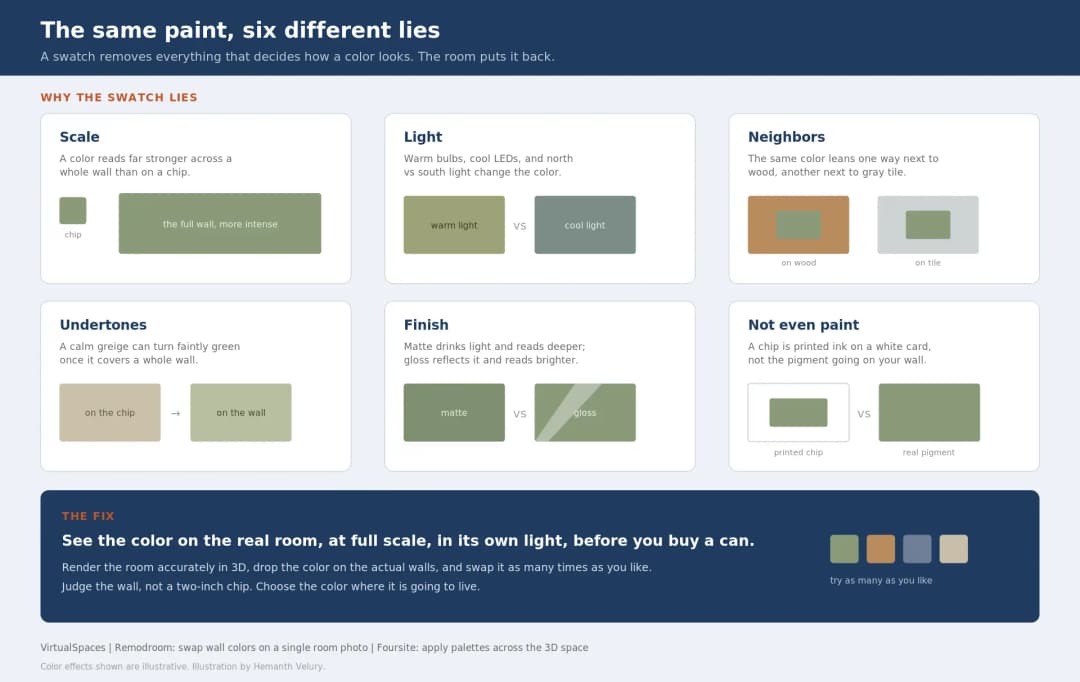
July 22, 2026
Why Paint Swatches Lie: Test Color in 3D First | VirtualSpaces
HHemanth Velury
CEO & Co-Founder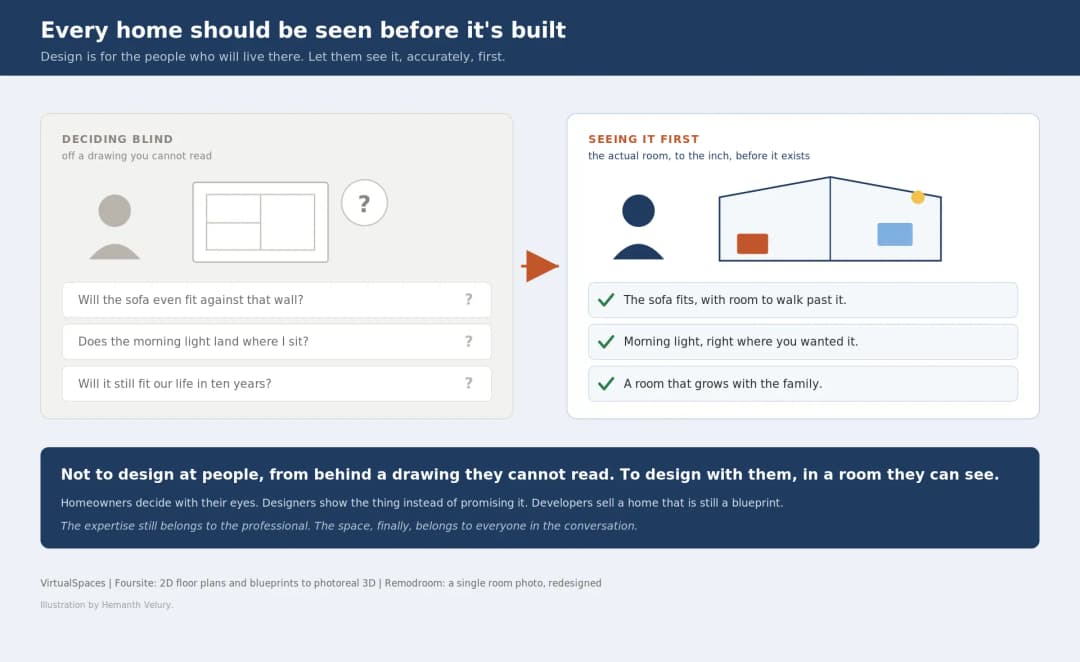
July 20, 2026
Why Every Home Should Be Seen Before It's Built | VirtualSpaces
HHemanth Velury
CEO & Co-Founder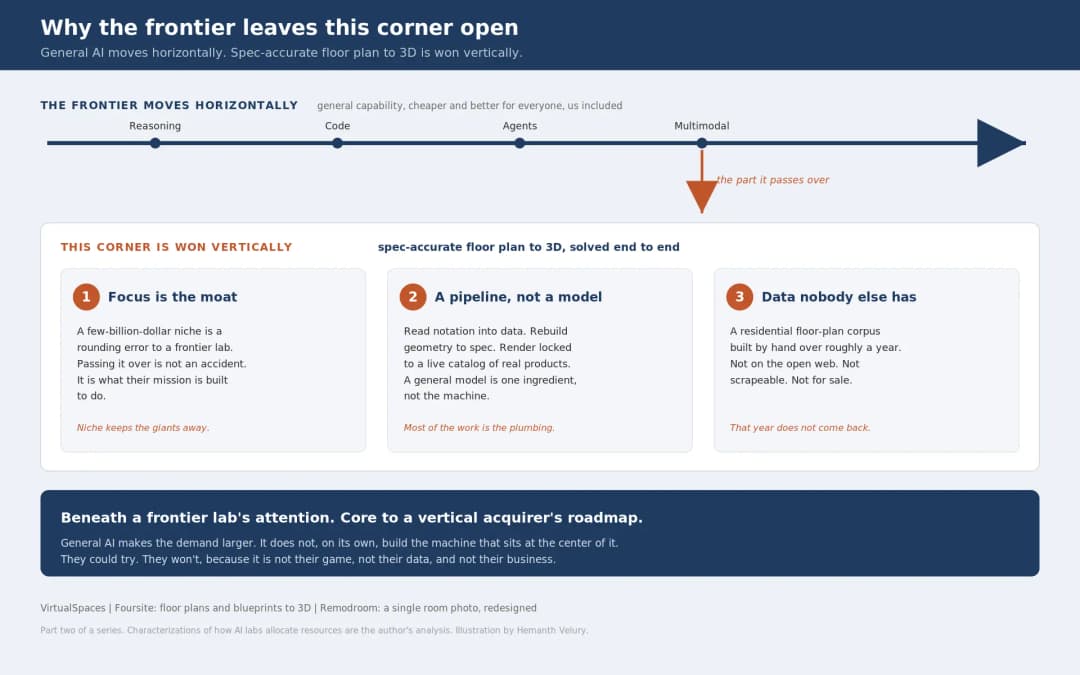
July 17, 2026
Why Big AI Labs Won't Build Floor Plan to 3D | VirtualSpaces
HHemanth Velury
CEO & Co-Founder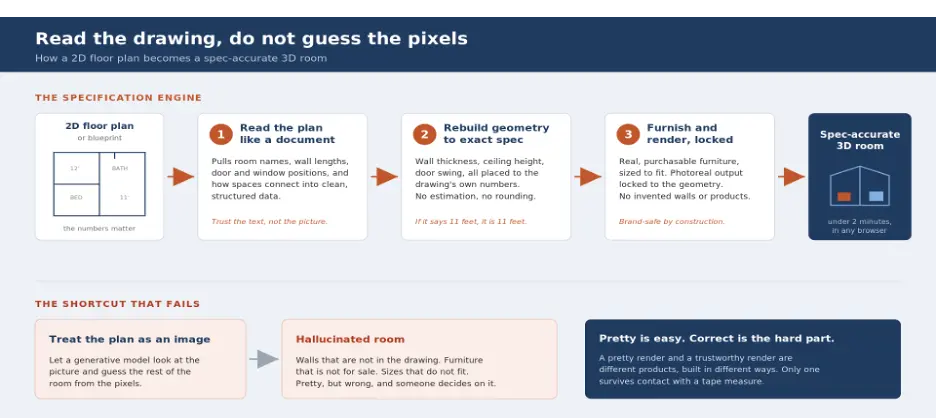
July 15, 2026
How We Solve Floor Plan to 3D, Accurately | VirtualSpaces
HHemanth Velury
CEO & Co-Founder
July 13, 2026
Designing Homes That Age With the People in Them | VirtualSpaces
HHemanth Velury
CEO & Co-Founder
July 10, 2026
Designing Spaces for How Light Actually Moves | VirtualSpaces
HHemanth Velury
CEO & Co-Founder
July 08, 2026
Designing Homes for Every Life Stage in 3D | VirtualSpaces
HHemanth Velury
CEO & Co-Founder
July 06, 2026
Build an Interior Design Portfolio Without Clients | VirtualSpaces
HHemanth Velury
CEO & Co-Founder
June 26, 2026
AI Interior Design: Full 3D Workflow in One Platform | VirtualSpaces
HHemanth Velury
CEO & Co-Founder
June 24, 2026
Scope Creep in Interior Design: How AI Visualization Fixes It | VirtualSpaces
HHemanth Velury
CEO & Co-Founder
June 22, 2026
What Buyers See on a Floor Plan: Your Biggest Sales Problem | VirtualSpaces
HHemanth Velury
CEO & Co-Founder
June 19, 2026
Small Design Studios vs Big Firms: The AI Advantage | VirtualSpaces
HHemanth Velury
CEO & Co-Founder
June 17, 2026
After the Mood Board: AI Interior Visualization | VirtualSpaces
HHemanth Velury
CEO & Co-Founder
June 15, 2026
Foursite Pro Editor: Full Floor Plan Control for Designers | VirtualSpaces
HHemanth Velury
CEO & Co-Founder
June 12, 2026
AI Interior Design: Style Any Room in Seconds with Foursite | VirtualSpaces
HHemanth Velury
CEO & Co-Founder
June 10, 2026
Foursite: Floor Plan to 3D Walkthrough in Minutes | VirtualSpaces
HHemanth Velury
CEO & Co-Founder
June 08, 2026
Win More Pitches With AI Renders Before the Meeting | VirtualSpaces
HHemanth Velury
CEO & Co-Founder
June 05, 2026
From Floor Plan to Finished Room: What AI Now Makes Possible | VirtualSpaces
HHemanth Velury
CEO & Co-Founder
June 03, 2026
The Interior Design Brief Is Broken. AI Fixes It | VirtualSpaces
HHemanth Velury
CEO & Co-Founder
June 01, 2026
Pre-Construction Home Sales: AI Interior Visualization Guide | VirtualSpaces
HHemanth Velury
CEO & Co-Founder
May 30, 2026
Interior Design Principles: Applied with AI | VirtualSpaces
HHemanth Velury
CEO & Co-Founder
May 28, 2026
Designing Spaces for People, Not Blueprints | VirtualSpaces
HHemanth Velury
CEO & Co-Founder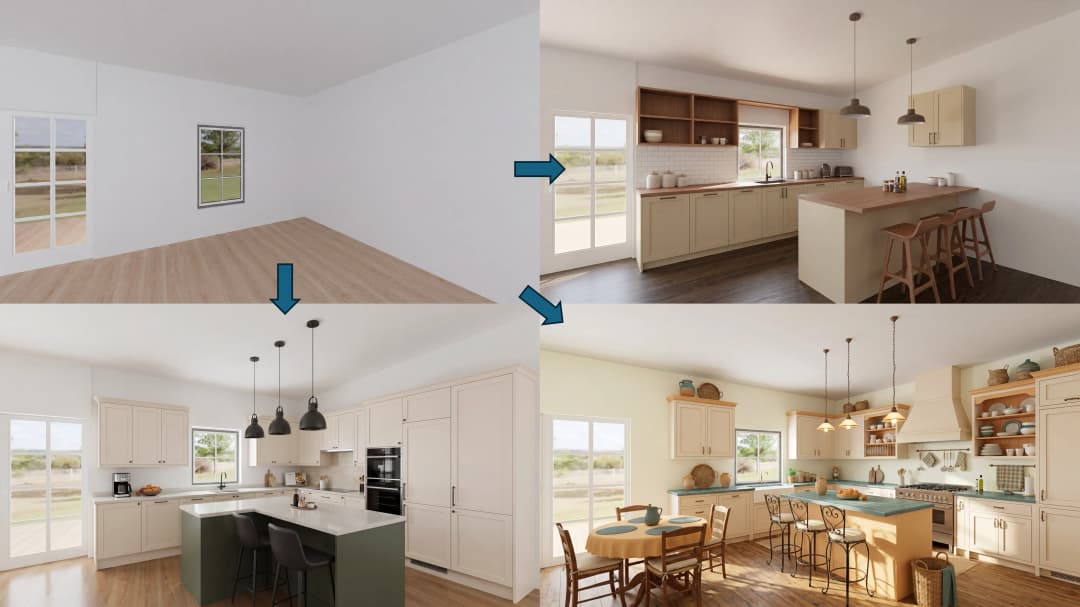
May 26, 2026
The Future of Interior Design: Closing the Visualization Gap with Foursite and Remodroom | VirtualSpaces
HHemanth Velury
CEO & Co-Founder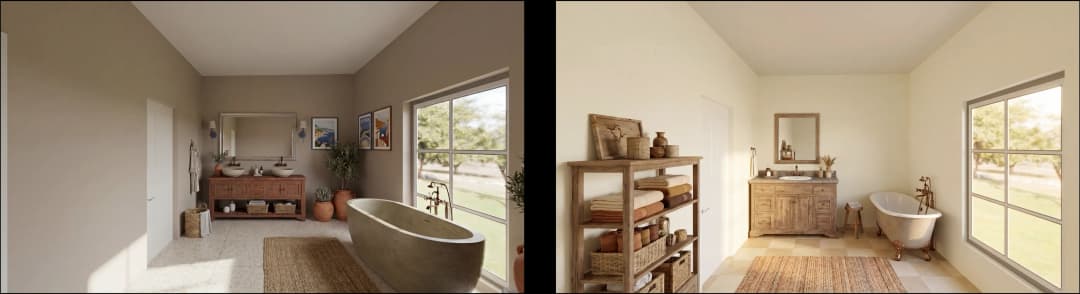
May 18, 2026
How AI Visualization Upgrades Property Data Platforms | VirtualSpaces
HHemanth Velury
CEO & Co-Founder
May 14, 2026
How AI-First Insurers Can Use 3D Property Data to Transform Home Claims | VirtualSpaces
HHemanth Velury
CEO & Co-FounderMay 12, 2026
Why Photoreal 3D Renders Are Replacing Mood Boards | Interior Design Client Presentations | VirtualSpaces
HHemanth Velury
CEO & Co-Founder
May 06, 2026
Why Furniture Brands Need AI 3D Visualization Now | VirtualSpaces
HHemanth Velury
CEO & Co-Founder
May 4, 2026
How Property Portals Can Turn 2D Floor Plans into 3D Design Decisions | VirtualSpaces
HHemanth Velury
CEO & Co-Founder
April 29, 2026
The Home-Fit Test: Why Square Footage Misleads | VirtualSpaces
HHemanth Velury
CEO & Co-Founder
April 27, 2026
Designing Homes That Sell: 3D Visualization ROI Data | VirtualSpaces
HHemanth Velury
CEO & Co-FounderApril 24, 2026
What's Next: Foursite & Remodroom's New AI Features | VirtualSpaces
HHemanth Velury
CEO & Co-Founder
April 22, 2026
AI in Architecture: Closing the 85% Exposure Gap | VirtualSpaces
HHemanth Velury
CEO & Co-Founder
April 20, 2026
Interior Design Pricing in 2026: From Hourly to Value-Based Fees | VirtualSpaces
HHemanth Velury
CEO & Co-FounderApril 17, 2026
How Foursite and Remodroom Help Designers Win Clients | VirtualSpaces
HHemanth Velury
CEO & Co-Founder
April 15, 2026
Designing Spaces for People: Remodroom + Foursite AI Guide | VirtualSpaces
HHemanth Velury
CEO & Co-Founder
April 13, 2026
Designing for the Way People Actually Live: How AI 3D Is Finally Closing the Gap Between Floor Plan and Reality
HHemanth Velury
CEO & Co-Founder
April 11, 2026
Design in Real Time: AI Renders in Your First Client Meeting
HHemanth Velury
CEO & Co-Founder
April 06, 2026
Why Real Estate Photography Is No Longer Enough: The Shift to Spatial-First Listings
HHemanth Velury
CEO & Co-Founder
April 03, 2026
Property Management's Hidden Weapon: AI 3D Floor Plans That Cut Vacancy Time and Raise Tenant Quality
HHemanth Velury
CEO & Co-Founder
April 01, 2026
Off-Plan and Oversubscribed: How AI 3D Visualization Is Transforming Real Estate Pre-Sales
HHemanth Velury
CEO & Co-Founder
March 30, 2026
Why Foursite Beats Generic AI Tools for Interior Design 3D Visualization
HHemanth Velury
CEO & Co-Founder
March 27, 2026
7 Tenets of Interior Design: How AI Accelerates Harmony in Residential Spaces
HHemanth Velury
CEO & Co-Founder
March 25, 2026
What Is the 3-5-7 Rule in Interior Design? Foursite's AI Guide for Residential Spaces
HHemanth Velury
CEO & Co-Founder
March 23, 2026
What Is the 70/30 Rule in Interior Design? Foursite's AI Guide for Residential Spaces
HHemanth Velury
CEO & Co-Founder
March 20, 2026
How AI 3D Visualization Is Rewriting Residential Interior Design Workflows
HHemanth Velury
CEO & Co-Founder
March 18, 2026
Beyond Marketing: How 3D Floorplans Transform FM, Retrofit Planning & ESG Operations
HHemanth Velury
CEO & Co-Founder
March 16, 2026
Why AI Companies Use Token Payments (And Why VirtualSpaces Is Returning To Fiat)
HHemanth Velury
CEO & Co-Founder
March 13, 2026
Floorplan‑Native Digital Twins: Beyond BIM for Consumer‑Ready Real Estate Experiences
HHemanth Velury
CEO & Co-Founder
March 11, 2026
The Foursite Platform Thesis: Why Floor Plans, Not Photos, Are the Next Property Software Primitive
HHemanth Velury
CEO & Co-Founder
March 09, 2026
Design Systems for Space: Building Reusable 3D Component Libraries on Top of AI Floorplan‑to‑3D Engines
HHemanth Velury
CEO & Co-Founder
March 06, 2026
How to Standardize Design Quality Across Global Projects Using AI Floorplan-to-3D Tools
HHemanth Velury
CEO & Co-Founder
March 04, 2026
From CAD-First to AI-First: Reskilling Your Team for AI-Native Design Workflows
HHemanth Velury
CEO & Co-Founder
March 02, 2026
Algorithmic Ergonomics Meets Photorealistic 3D: Designing Human-Centered Smart Homes with Foursite in 2026
HHemanth Velury
CEO & Co-Founder
February 27, 2026
The Ethics of AI in Interior Design: Ownership, Originality, and Client Transparency
HHemanth Velury
CEO & Co-Founder
February 25, 2026
Designing with Empathy: Using AI 3D Visualization to Improve Client Communication and Emotional Clarity
HHemanth Velury
CEO & Co-Founder
February 23, 2026
From Tool to Infrastructure: AI Floorplan-to-3D and the Next Wave of PropTech
HHemanth Velury
CEO & Co-Founder
February 20, 2026
AI Interior Design for Holiday Homes: Turn Spare Flats into High-Demand Short-Stay Rentals with 3D Visuals
HHemanth Velury
CEO & Co-Founder
February 18, 2026
The Pre‑Purchase Power Play: How Savvy Home Buyers Use 3D Floor Plan Visualization to Negotiate Better Deals
HHemanth Velury
CEO & Co-FounderFebruary 16, 2026
AI Interior Design for Non‑Designers: How Homeowners Can Brief Like Pros
HHemanth Velury
CEO & Co-Founder
February 13, 2026
Scaling a Design Business Without Hiring a 3D Team: An Owner's Guide
HHemanth Velury
CEO & Co-Founder
February 11, 2026
From Bland to Bold: How to Rescue Builder-Grade Interiors on Any Budget
HHemanth Velury
CEO & Co-Founder
February 6, 2026
The Psychology of Space: How Room Dimensions Influence Interior Design Decisions
HHemanth Velury
CEO & Co-Founder
February 4, 2026
The Future of Interior Design Visualization: How AI Technology is Transforming 2D Concepts Into 3D Reality
HHemanth Velury
CEO & Co-Founder
February 2, 2026
AI Interior Décor: How Artificial Intelligence Generates Design Options from Your Floor Plan
HHemanth Velury
CEO & Co-Founder
January 30, 2026
Photoreal vs. Reality: What Clients Actually Expect from Interior Design Visualization
HHemanth Velury
CEO & Co-Founder
January 28, 2026
The Design Approval Conversation That Changes Everything: Communication Strategy When Using Photorealistic Visualization
HHemanth Velury
CEO & Co-Founder
January 25, 2026
Interior Design as Experience Design: How 3D Visualization Changes Your Professional Identity
HHemanth Velury
CEO & Co-Founder
January 23, 2026
The Professional Gap: How 3D Visualization Changes Interior Design Client Perception
HHemanth Velury
CEO & Co-Founder
January 21, 2026
Why Clients Fire Designers (And How 3D Visualization Could Have Saved the Project)
HHemanth Velury
CEO & Co-Founder
January 16, 2026
Blueprint to Vision: Why Seeing Is Believing in Interior Design
HHemanth Velury
CEO & Co-Founder
January 14, 2026
The Speed of Responsiveness: How AI Visualization Tools Make You Look Like You Care More
HHemanth Velury
CEO & Co-Founder
January 12, 2026
Why Interior Designers and Architects Can't Compete Without AI 3D Visualization Tools
HHemanth Velury
CEO & Co-Founder
January 07, 2026
From "Saved" to "Sold": How Homeowners Are Planning Renovations with AI
HHemanth Velury
CEO & Co-Founder
January 05, 2026
The Interior Designer's Secret Weapon: Speed as Premium Positioning
HHemanth Velury
CEO & Co-Founder
December 31, 2025
Gratitude, Growth & Game-Changing Innovation: VirtualSpaces' 2025 Journey & What's Coming in 2026
HHemanth Velury
CEO & Co-Founder
December 29, 2025
Why Interior Designers Are Switching to AI Floor Plan-to-3D Tools in 2026
HHemanth Velury
CEO & Co-Founder
December 26, 2025
AI Virtual Staging for Real Estate Agents: Sell More Homes Faster with Foursite
HHemanth Velury
CEO & Co-Founder
December 24, 2025
Why Architects Are Switching to AI 2D-to-3D: The SketchUp Alternative
HHemanth Velury
CEO & Co-Founder
December 22, 2025
Cut 3 Weeks from Real Estate Sales Cycle: The ROI of AI 2D to 3D Visualization
HHemanth Velury
CEO & Co-Founder
December 19, 2025
2D Floor Plans Are Dying: Why 3D Visualization & AI Virtual Staging Are the Future
HHemanth Velury
CEO & Co-Founder
December 17, 2025
Virtual Staging vs Physical Staging: How AI Saves Money Per Property
HHemanth Velury
CEO & Co-Founder
December 15, 2025
AI Floor Plan to Image: Revolutionizing Real Estate Marketing for Agents
HHemanth Velury
CEO & Co-Founder
December 12, 2025
Color of the Year 2026: Cloud Dancer | VirtualSpaces AI Interior Design Guide
HHemanth Velury
CEO & Co-Founder
December 10, 2025
AI Floor Plan to 3D: The New Standard for Interior Design Workflows
HHemanth Velury
CEO & Co-Founder
December 08, 2025
How Interior Design Studios Can Operationalize AI 2D-to-3D Workflows (Without Breaking Their Process)
HHemanth Velury
CEO & Co-Founder
December 06, 2025
How to Implement AI Interior Design Workflows in Your Studio
HHemanth Velury
CEO & Co-Founder
December 4, 2025
How Homeowners Can Use AI Interior Design Tools to Plan Renovations with Confidence
HHemanth Velury
CEO & Co-Founder
November 28, 2025
Interior Designers in the Age of AI: From Threat Narrative to Superpower
HHemanth Velury
CEO & Co-Founder
November 21, 2025
Foursite Launch: Embracing 'Release Early, Release Often'
HHemanth Velury
CEO & Co-Founder
November 13, 2025
Foursite by VirtSpaces: Empowering Interior Designers, Architects, and Homeowners
HHemanth Velury
CEO & Co-Founder
November 7, 2025
Reimagining Architectural Education: How AI Floorplan-to-3D Technology Can Transform Design Learning
VVirtualSpaces Research Labs
AI Research Initiative
October 27, 2025
Archisculpt AI: Turning Architectural Drawings into Photorealistic 3D Spaces
AAbhijeet Naik
Co-Founder & CTO
October 13, 2025
Home Makeover: From Floor Plan to Dream Space with AI
HHemanth Velury
CEO & Co-Founder
October 6, 2025
Real-Time Rendering & AI: Revolutionizing Interactive Property Walkthroughs with VirtSpaces
HHemanth Velury
CEO & Co-Founder
September 26, 2025
Foursite - A True AI-Native Experience in Design Visualization
AAbhijeet Naik
CTO & Co-Founder
September 18, 2025
Why PropTech Startups Are Betting on AI Interior Design
HHemanth Velury
CEO & Co-Founder
September 11, 2025
How AI Differs from Traditional 3D Rendering Software
HHemanth Velury
CEO & Co-Founder
September 2, 2025
From Client to Investor: How Nila Spaces and VirtSpaces Are Redefining Proptech with AI
HHemanth Velury
CEO & Co-Founder
August 25, 2025
VirtSpaces From Virtual Reality to AI – Transforming Real Estate Visualization.
HHemanth Velury
CEO & Co-Founder


We help teams collaborate seamlessly and reduce costs. Virtual Spaces offers cutting-edge technology with flexible plans designed to fit modern teams.
Copyright © VirtSpaces Pvt. Ltd. 2025 All Rights Reserved.
CIN: U74999KA2016PTC094921