May 12, 2026
- AI Technology
- Interior Design
Why Photoreal 3D Renders Are Replacing Mood Boards | Interior Design Client Presentations | VirtualSpaces
Hemanth Velury
CEO & Co-FounderThe New Client Presentation: Why Photoreal 3D Renders Are Replacing Mood-Boards
The Moment Every Designer Dreads
You've spent three evenings building a mood board. Carefully curated images. A cohesive palette. Fabric swatches. A font reference for the signage. You walk into the client meeting, pull it up on your laptop, and watch their face. They nod politely. Then they say: "It's nice, but I'm just not sure I can see it in our space."
That's not a design problem. That's a communication problem. And it costs the industry thousands of hours and millions in unrealized projects every single year.
The mood board had a good run. For decades, it was the industry standard for translating a designer's vision into something a client could react to. But it was always an approximation, a proxy, a leap of faith. Clients were expected to mentally bridge the gap between a Pinterest collage and their actual living room. Many couldn't. And that gap is where deals died.
Something has shifted. Photoreal AI 3D visualization is not a niche tool for luxury firms with rendering studios anymore. It is becoming the baseline expectation in residential design, and the designers who understand why are winning more clients, closing faster, and iterating with less friction than ever before.
What a Mood Board Was Actually Doing
To understand why the shift is happening now, it helps to be honest about what mood boards were solving, and where they fell short.
A mood board was a shorthand. It told a client: here is the feeling, the palette, the material register I have in mind. It worked well when:
-
The client had strong visual literacy
-
The designer had a long-standing relationship with them
-
The project was relatively simple in scope
-
The budget allowed for multiple revision cycles
That's a narrow window. Most residential clients, even affluent ones, are not trained to read spatial design from flat images. They react emotionally to photos that are not their home. They fall in love with a sofa in a beautifully lit editorial and then hate how it looks once it's delivered. They approve a color palette in a PDF and balk when they see the paint on the wall.
The mood board was a tool designed for designers, not for clients. It communicated intent to someone who already knew how to decode it.
What 3D Visualization Actually Changes
Interior design 3D visualization changes the fundamental nature of the conversation. Instead of asking a client to imagine, you are showing them.
Not a stock image of someone else's home. Their home. Their floor plan. Their room dimensions. Their chosen material finishes, rendered in photoreal quality, with accurate lighting and spatial proportion.
The cognitive load on the client drops dramatically. They are no longer translating. They are reacting. And reactions, in a design sales context, are currency.
Here is what changes when you shift from mood board to photoreal render:
-
Approval speed: Clients who can see the space typically approve concepts in 1-2 rounds instead of 4-6
-
Scope clarity: Misunderstandings about furniture scale, traffic flow, or material combinations surface in the render, not after delivery
-
Upsell opportunity: When clients see a fully visualized room, they often ask for more: an adjacent room, a second concept, a different finish option
-
Referral quality: A client who received a photoreal walkthrough talks about it differently to their network than one who saw a PDF
This is not speculation. The shift toward immersive visualization in residential real estate and interior design has been building for years. What's new is that the tools to produce it have become fast enough, affordable enough, and intelligent enough to fit into a working designer's actual workflow, not just a dedicated rendering studio's pipeline.
Where Foursite Changes the Floor Plan Conversation
The traditional workflow for a designer working from 2D floor plans looks like this: receive CAD files or hand-drawn blueprints, interpret spatial relationships mentally, build a concept in your head, communicate that concept through mood boards and references, and then hope the client makes the same mental leap you did.
Foursite removes the leap.
It converts 2D floor plans and blueprints into fully navigable 3D environments. A designer can take a client's flat floor plan, convert it to 3D, place furniture, apply material finishes, and produce a photoreal walkthrough, without outsourcing to a rendering studio, without waiting five business days, and without switching between six different software tools.
For architects and designers working on new builds or major renovations, this is the workflow change that matters most. The moment a client can walk through their not-yet-built home in 3D, before a single wall goes up, the entire pre-sales process changes.
What this means practically:
-
Fewer change orders post-construction because spatial misunderstandings are caught early
-
Faster sign-off on design concepts because clients are reacting to reality, not imagination
-
Stronger differentiation when pitching against firms that still present flat plans
-
The ability to run convert blueprint to 3D workflows in-house, eliminating outsourcing spend on external rendering
The blueprint to 3D capability alone can justify the tool in the first project. Design firms that used to spend around $12,000 per render with external studios are now producing comparable outputs internally, at a fraction of the cost and timeline.
Where Remodroom Changes the Renovation Conversation
Not every client is starting from a blank floor plan. Most residential design projects involve an existing space: a living room that needs rethinking, a master bedroom that feels dated, a kitchen that's functionally broken.
For these clients, the presentation challenge is different. They can see the room. They just can't see the room after you're done with it.
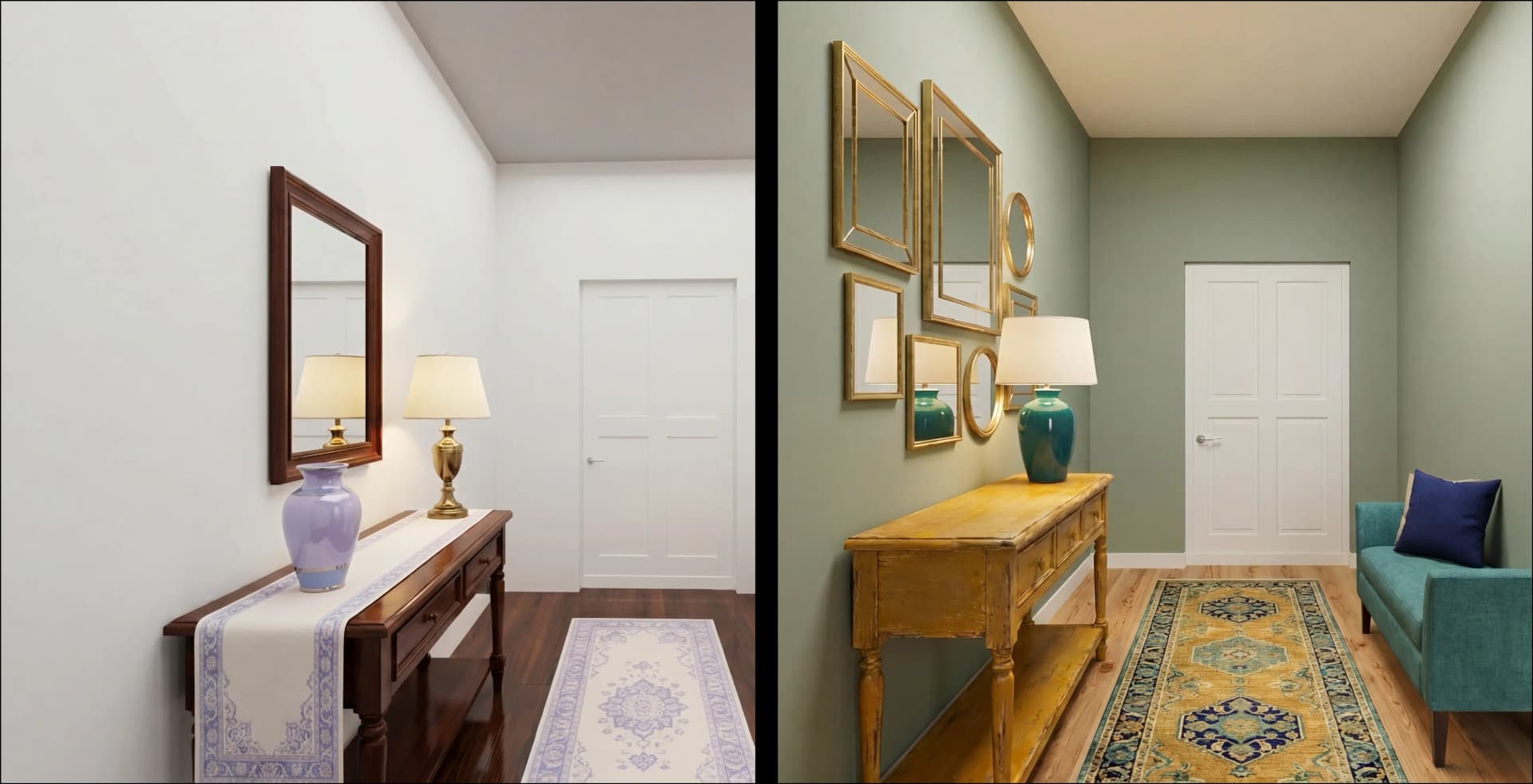
Remodroom is built for exactly this scenario. A designer uploads a photo of the existing room, and the AI generates a photorealistic redesign based on the chosen style direction, palette, and material inputs. No 3D modelling skills required. No rendering software licenses. No outsourced studio.
The client stops imagining and starts reacting. They can see what their actual room looks like with a different layout, a bolder wall treatment, or a complete furniture replacement. They can compare two concepts side by side. They can say yes faster, because they are not being asked to trust a process; they are being shown an outcome.
For designers who work predominantly on single-room or apartment-scale projects, Remodroom compresses the presentation cycle significantly. What used to require multiple rounds of concept boards, reference images, and client calls can often be resolved in a single visual.
The Comparison That Matters
| Dimension | Mood-board | Photoreal 3D Render |
|---|---|---|
| Client Comprehension | Requires visual literacy | Immediately intuitive |
| Revision Cycles | 4-6 rounds average | 1-2 rounds average |
| Spatial Accuracy | Approximate | Exact to floor plan dimensions |
| Material Representation | Flat Image reference | Photoreal texture & light |
| Approval Timeline | Days to weeks | Hours to days |
| Outsourcing Dependency | High (renders & visuals) | Low to none |
| Differentiation in Pitch | Standard expectation | Competitive advantage (for now) |
The "for now" in that last row matters. The window in which offering interior design photoreal renders is a differentiator is closing. Within 18-24 months, it will be a baseline expectation, the same way email replaced fax and digital portfolios replaced physical ones. The designers who build this into their workflow now are the ones who will own the reputation for it later.
The AI Interior Design Shift: What's Actually Happening Under the Hood
It is worth being precise about what AI is doing in this context, because "AI interior design" has become a phrase that means everything and nothing.
In the context of tools like VirtualSpaces, the AI is doing specific, high-value work:
-
Spatial interpretation: Reading a 2D floor plan and inferring ceiling heights, wall adjacencies, natural light corridors, and circulation paths
-
Material rendering: Applying photorealistic texture, reflectance, and shadow behavior to materials in a 3D environment
-
Style coherence: Generating redesign outputs that hold together as a design concept, not just a random placement of furniture assets
-
Iteration speed: Making changes to a render in minutes, not hours, so the designer can explore options in the meeting room, not after it
This is AI augmenting creative output, not replacing it. The designer is still making the decisions: the spatial logic, the material selections, the style direction, the client relationship. The AI is eliminating the manual production work that sat between the idea and the image.
That distinction matters. The best designers who are adopting these tools are not using them to produce generic outputs faster. They are using them to spend more time on the creative decisions that actually require their expertise, and less time on the production pipeline that anyone with a rendering license could execute.
What a Modern Design Presentation Looks Like
A designer using VirtualSpaces tools today walks into a client meeting with a fundamentally different kind of deck.
For new builds or full-home projects:
-
Client shares 2D floor plans or architect's blueprints
-
Designer uses Foursite to convert blueprint to 3D
-
Materials, furniture, and lighting are applied to the 3D model
-
Client receives a photoreal walkthrough of their not-yet-built home
-
Revisions are made to the model directly, not across a five-email chain
For renovation or single-room projects:
-
Client shares photos of the existing space
-
Designer uploads to Remodroom with style and material inputs
-
AI generates photoreal redesign options within minutes
-
Client compares options in the same meeting
-
One concept is selected, revised, and approved before the designer leaves the room
This is not a theoretical workflow. It is what the fastest-moving residential design practices are already doing. The mood board has not disappeared entirely, but it has been repositioned: from the primary deliverable to a supporting artefact, a reference document rather than the centerpiece of the presentation.
The Business Case, Plain and Simple
Designers adopt new tools when they solve a real business problem, not when they are interesting. Here is the business problem that AI visualization solves:
Client confidence is the bottleneck in residential design sales.
Clients who can see the outcome are more likely to approve the concept, commit to the budget, and refer the designer to their network. Every tool that increases client confidence without increasing the designer's workload improves the economics of the practice.
The shift from mood board to photoreal render is not a technology trend. It is a business model improvement. Less time per presentation. Faster approvals. Fewer revision cycles. Lower outsourcing spends. Higher close rates. More projects from the same team.
VirtualSpaces is building the infrastructure layer for this shift in the residential design market. Foursite and Remodroom are not isolated tools; they are two surfaces of the same underlying capability: the ability to take any residential space, at any stage of its life, and show it the way it could be.
The designers who recognize that are not waiting for the industry to catch up. They are already presenting differently, closing faster, and wondering why they ever printed a mood board in the first place.
Recommended for you

August 19, 2026
The End of the Model Home? 3D Changes the Math | VirtualSpaces
HHemanth Velury
CEO & Co-Founder
August 17, 2026
Designing Spaces That Actually Get Built | VirtualSpaces
HHemanth Velury
CEO & Co-Founder
August 12, 2026
Designing Homes for the Stuff People Actually Own | VirtualSpaces
HHemanth Velury
CEO & Co-Founder
August 07, 2026
Floor Plan to Bill of Materials: The 3D Model as Data | VirtualSpaces
HHemanth Velury
CEO & Co-Founder.png&w=1080&q=75)
August 05, 2026
Designing Homes for How People Actually Live | VirtualSpaces
HHemanth Velury
CEO & Co-Founder
August 03, 2026
Honest by Design: Trust in AI Real Estate Imagery | VirtualSpaces
HHemanth Velury
CEO & Co-Founder
July 29, 2026
Kitchen and Bath: The Two Rooms That Decide Resale | VirtualSpaces
HHemanth Velury
CEO & Co-Founder
July 27, 2026
Why Empty Rooms Don't Sell: Virtual Staging | VirtualSpaces
HHemanth Velury
CEO & Co-Founder
July 24, 2026
The Quiet Sustainability Win of Deciding in 3D | VirtualSpaces
HHemanth Velury
CEO & Co-Founder
July 22, 2026
Why Paint Swatches Lie: Test Color in 3D First | VirtualSpaces
HHemanth Velury
CEO & Co-Founder
July 20, 2026
Why Every Home Should Be Seen Before It's Built | VirtualSpaces
HHemanth Velury
CEO & Co-Founder
July 17, 2026
Why Big AI Labs Won't Build Floor Plan to 3D | VirtualSpaces
HHemanth Velury
CEO & Co-Founder
July 15, 2026
How We Solve Floor Plan to 3D, Accurately | VirtualSpaces
HHemanth Velury
CEO & Co-Founder
July 13, 2026
Designing Homes That Age With the People in Them | VirtualSpaces
HHemanth Velury
CEO & Co-Founder
July 10, 2026
Designing Spaces for How Light Actually Moves | VirtualSpaces
HHemanth Velury
CEO & Co-Founder
July 08, 2026
Designing Homes for Every Life Stage in 3D | VirtualSpaces
HHemanth Velury
CEO & Co-Founder
July 06, 2026
Build an Interior Design Portfolio Without Clients | VirtualSpaces
HHemanth Velury
CEO & Co-Founder
June 26, 2026
AI Interior Design: Full 3D Workflow in One Platform | VirtualSpaces
HHemanth Velury
CEO & Co-Founder
June 24, 2026
Scope Creep in Interior Design: How AI Visualization Fixes It | VirtualSpaces
HHemanth Velury
CEO & Co-Founder
June 22, 2026
What Buyers See on a Floor Plan: Your Biggest Sales Problem | VirtualSpaces
HHemanth Velury
CEO & Co-Founder
June 19, 2026
Small Design Studios vs Big Firms: The AI Advantage | VirtualSpaces
HHemanth Velury
CEO & Co-Founder
June 17, 2026
After the Mood Board: AI Interior Visualization | VirtualSpaces
HHemanth Velury
CEO & Co-Founder
June 15, 2026
Foursite Pro Editor: Full Floor Plan Control for Designers | VirtualSpaces
HHemanth Velury
CEO & Co-Founder
June 12, 2026
AI Interior Design: Style Any Room in Seconds with Foursite | VirtualSpaces
HHemanth Velury
CEO & Co-Founder
June 10, 2026
Foursite: Floor Plan to 3D Walkthrough in Minutes | VirtualSpaces
HHemanth Velury
CEO & Co-Founder
June 08, 2026
Win More Pitches With AI Renders Before the Meeting | VirtualSpaces
HHemanth Velury
CEO & Co-Founder
June 05, 2026
From Floor Plan to Finished Room: What AI Now Makes Possible | VirtualSpaces
HHemanth Velury
CEO & Co-Founder
June 03, 2026
The Interior Design Brief Is Broken. AI Fixes It | VirtualSpaces
HHemanth Velury
CEO & Co-Founder
June 01, 2026
Pre-Construction Home Sales: AI Interior Visualization Guide | VirtualSpaces
HHemanth Velury
CEO & Co-Founder
May 30, 2026
Interior Design Principles: Applied with AI | VirtualSpaces
HHemanth Velury
CEO & Co-Founder
May 28, 2026
Designing Spaces for People, Not Blueprints | VirtualSpaces
HHemanth Velury
CEO & Co-Founder
May 26, 2026
The Future of Interior Design: Closing the Visualization Gap with Foursite and Remodroom | VirtualSpaces
HHemanth Velury
CEO & Co-Founder
May 18, 2026
How AI Visualization Upgrades Property Data Platforms | VirtualSpaces
HHemanth Velury
CEO & Co-Founder
May 14, 2026
How AI-First Insurers Can Use 3D Property Data to Transform Home Claims | VirtualSpaces
HHemanth Velury
CEO & Co-Founder
May 08, 2026
From 2D Floor Plans To Living Worlds: The Spec‑Accurate 3D Engine | VirtualSpaces
HHemanth Velury
CEO & Co-Founder
May 06, 2026
Why Furniture Brands Need AI 3D Visualization Now | VirtualSpaces
HHemanth Velury
CEO & Co-Founder
May 4, 2026
How Property Portals Can Turn 2D Floor Plans into 3D Design Decisions | VirtualSpaces
HHemanth Velury
CEO & Co-Founder
April 29, 2026
The Home-Fit Test: Why Square Footage Misleads | VirtualSpaces
HHemanth Velury
CEO & Co-Founder
April 27, 2026
Designing Homes That Sell: 3D Visualization ROI Data | VirtualSpaces
HHemanth Velury
CEO & Co-FounderApril 24, 2026
What's Next: Foursite & Remodroom's New AI Features | VirtualSpaces
HHemanth Velury
CEO & Co-Founder
April 22, 2026
AI in Architecture: Closing the 85% Exposure Gap | VirtualSpaces
HHemanth Velury
CEO & Co-Founder
April 20, 2026
Interior Design Pricing in 2026: From Hourly to Value-Based Fees | VirtualSpaces
HHemanth Velury
CEO & Co-FounderApril 17, 2026
How Foursite and Remodroom Help Designers Win Clients | VirtualSpaces
HHemanth Velury
CEO & Co-Founder
April 15, 2026
Designing Spaces for People: Remodroom + Foursite AI Guide | VirtualSpaces
HHemanth Velury
CEO & Co-Founder
April 13, 2026
Designing for the Way People Actually Live: How AI 3D Is Finally Closing the Gap Between Floor Plan and Reality
HHemanth Velury
CEO & Co-Founder
April 11, 2026
Design in Real Time: AI Renders in Your First Client Meeting
HHemanth Velury
CEO & Co-Founder
April 06, 2026
Why Real Estate Photography Is No Longer Enough: The Shift to Spatial-First Listings
HHemanth Velury
CEO & Co-Founder
April 03, 2026
Property Management's Hidden Weapon: AI 3D Floor Plans That Cut Vacancy Time and Raise Tenant Quality
HHemanth Velury
CEO & Co-Founder
April 01, 2026
Off-Plan and Oversubscribed: How AI 3D Visualization Is Transforming Real Estate Pre-Sales
HHemanth Velury
CEO & Co-Founder
March 30, 2026
Why Foursite Beats Generic AI Tools for Interior Design 3D Visualization
HHemanth Velury
CEO & Co-Founder
March 27, 2026
7 Tenets of Interior Design: How AI Accelerates Harmony in Residential Spaces
HHemanth Velury
CEO & Co-Founder
March 25, 2026
What Is the 3-5-7 Rule in Interior Design? Foursite's AI Guide for Residential Spaces
HHemanth Velury
CEO & Co-Founder
March 23, 2026
What Is the 70/30 Rule in Interior Design? Foursite's AI Guide for Residential Spaces
HHemanth Velury
CEO & Co-Founder
March 20, 2026
How AI 3D Visualization Is Rewriting Residential Interior Design Workflows
HHemanth Velury
CEO & Co-Founder
March 18, 2026
Beyond Marketing: How 3D Floorplans Transform FM, Retrofit Planning & ESG Operations
HHemanth Velury
CEO & Co-Founder
March 16, 2026
Why AI Companies Use Token Payments (And Why VirtualSpaces Is Returning To Fiat)
HHemanth Velury
CEO & Co-Founder
March 13, 2026
Floorplan‑Native Digital Twins: Beyond BIM for Consumer‑Ready Real Estate Experiences
HHemanth Velury
CEO & Co-Founder
March 11, 2026
The Foursite Platform Thesis: Why Floor Plans, Not Photos, Are the Next Property Software Primitive
HHemanth Velury
CEO & Co-Founder
March 09, 2026
Design Systems for Space: Building Reusable 3D Component Libraries on Top of AI Floorplan‑to‑3D Engines
HHemanth Velury
CEO & Co-Founder
March 06, 2026
How to Standardize Design Quality Across Global Projects Using AI Floorplan-to-3D Tools
HHemanth Velury
CEO & Co-Founder
March 04, 2026
From CAD-First to AI-First: Reskilling Your Team for AI-Native Design Workflows
HHemanth Velury
CEO & Co-Founder
March 02, 2026
Algorithmic Ergonomics Meets Photorealistic 3D: Designing Human-Centered Smart Homes with Foursite in 2026
HHemanth Velury
CEO & Co-Founder
February 27, 2026
The Ethics of AI in Interior Design: Ownership, Originality, and Client Transparency
HHemanth Velury
CEO & Co-Founder
February 25, 2026
Designing with Empathy: Using AI 3D Visualization to Improve Client Communication and Emotional Clarity
HHemanth Velury
CEO & Co-Founder
February 23, 2026
From Tool to Infrastructure: AI Floorplan-to-3D and the Next Wave of PropTech
HHemanth Velury
CEO & Co-Founder
February 20, 2026
AI Interior Design for Holiday Homes: Turn Spare Flats into High-Demand Short-Stay Rentals with 3D Visuals
HHemanth Velury
CEO & Co-Founder
February 18, 2026
The Pre‑Purchase Power Play: How Savvy Home Buyers Use 3D Floor Plan Visualization to Negotiate Better Deals
HHemanth Velury
CEO & Co-FounderFebruary 16, 2026
AI Interior Design for Non‑Designers: How Homeowners Can Brief Like Pros
HHemanth Velury
CEO & Co-Founder
February 13, 2026
Scaling a Design Business Without Hiring a 3D Team: An Owner's Guide
HHemanth Velury
CEO & Co-Founder
February 11, 2026
From Bland to Bold: How to Rescue Builder-Grade Interiors on Any Budget
HHemanth Velury
CEO & Co-Founder
February 6, 2026
The Psychology of Space: How Room Dimensions Influence Interior Design Decisions
HHemanth Velury
CEO & Co-Founder
February 4, 2026
The Future of Interior Design Visualization: How AI Technology is Transforming 2D Concepts Into 3D Reality
HHemanth Velury
CEO & Co-Founder
February 2, 2026
AI Interior Décor: How Artificial Intelligence Generates Design Options from Your Floor Plan
HHemanth Velury
CEO & Co-Founder
January 30, 2026
Photoreal vs. Reality: What Clients Actually Expect from Interior Design Visualization
HHemanth Velury
CEO & Co-Founder
January 28, 2026
The Design Approval Conversation That Changes Everything: Communication Strategy When Using Photorealistic Visualization
HHemanth Velury
CEO & Co-Founder
January 25, 2026
Interior Design as Experience Design: How 3D Visualization Changes Your Professional Identity
HHemanth Velury
CEO & Co-Founder
January 23, 2026
The Professional Gap: How 3D Visualization Changes Interior Design Client Perception
HHemanth Velury
CEO & Co-Founder
January 21, 2026
Why Clients Fire Designers (And How 3D Visualization Could Have Saved the Project)
HHemanth Velury
CEO & Co-Founder
January 16, 2026
Blueprint to Vision: Why Seeing Is Believing in Interior Design
HHemanth Velury
CEO & Co-Founder
January 14, 2026
The Speed of Responsiveness: How AI Visualization Tools Make You Look Like You Care More
HHemanth Velury
CEO & Co-Founder
January 12, 2026
Why Interior Designers and Architects Can't Compete Without AI 3D Visualization Tools
HHemanth Velury
CEO & Co-Founder
January 07, 2026
From "Saved" to "Sold": How Homeowners Are Planning Renovations with AI
HHemanth Velury
CEO & Co-Founder
January 05, 2026
The Interior Designer's Secret Weapon: Speed as Premium Positioning
HHemanth Velury
CEO & Co-Founder
December 31, 2025
Gratitude, Growth & Game-Changing Innovation: VirtualSpaces' 2025 Journey & What's Coming in 2026
HHemanth Velury
CEO & Co-Founder
December 29, 2025
Why Interior Designers Are Switching to AI Floor Plan-to-3D Tools in 2026
HHemanth Velury
CEO & Co-Founder
December 26, 2025
AI Virtual Staging for Real Estate Agents: Sell More Homes Faster with Foursite
HHemanth Velury
CEO & Co-Founder
December 24, 2025
Why Architects Are Switching to AI 2D-to-3D: The SketchUp Alternative
HHemanth Velury
CEO & Co-Founder
December 22, 2025
Cut 3 Weeks from Real Estate Sales Cycle: The ROI of AI 2D to 3D Visualization
HHemanth Velury
CEO & Co-Founder
December 19, 2025
2D Floor Plans Are Dying: Why 3D Visualization & AI Virtual Staging Are the Future
HHemanth Velury
CEO & Co-Founder
December 17, 2025
Virtual Staging vs Physical Staging: How AI Saves Money Per Property
HHemanth Velury
CEO & Co-Founder
December 15, 2025
AI Floor Plan to Image: Revolutionizing Real Estate Marketing for Agents
HHemanth Velury
CEO & Co-Founder
December 12, 2025
Color of the Year 2026: Cloud Dancer | VirtualSpaces AI Interior Design Guide
HHemanth Velury
CEO & Co-Founder
December 10, 2025
AI Floor Plan to 3D: The New Standard for Interior Design Workflows
HHemanth Velury
CEO & Co-Founder
December 08, 2025
How Interior Design Studios Can Operationalize AI 2D-to-3D Workflows (Without Breaking Their Process)
HHemanth Velury
CEO & Co-Founder
December 06, 2025
How to Implement AI Interior Design Workflows in Your Studio
HHemanth Velury
CEO & Co-Founder
December 4, 2025
How Homeowners Can Use AI Interior Design Tools to Plan Renovations with Confidence
HHemanth Velury
CEO & Co-Founder
November 28, 2025
Interior Designers in the Age of AI: From Threat Narrative to Superpower
HHemanth Velury
CEO & Co-Founder
November 21, 2025
Foursite Launch: Embracing 'Release Early, Release Often'
HHemanth Velury
CEO & Co-Founder
November 13, 2025
Foursite by VirtSpaces: Empowering Interior Designers, Architects, and Homeowners
HHemanth Velury
CEO & Co-Founder
November 7, 2025
Reimagining Architectural Education: How AI Floorplan-to-3D Technology Can Transform Design Learning
VVirtualSpaces Research Labs
AI Research Initiative
October 27, 2025
Archisculpt AI: Turning Architectural Drawings into Photorealistic 3D Spaces
AAbhijeet Naik
Co-Founder & CTO
October 13, 2025
Home Makeover: From Floor Plan to Dream Space with AI
HHemanth Velury
CEO & Co-Founder
October 6, 2025
Real-Time Rendering & AI: Revolutionizing Interactive Property Walkthroughs with VirtSpaces
HHemanth Velury
CEO & Co-Founder
September 26, 2025
Foursite - A True AI-Native Experience in Design Visualization
AAbhijeet Naik
CTO & Co-Founder
September 18, 2025
Why PropTech Startups Are Betting on AI Interior Design
HHemanth Velury
CEO & Co-Founder
September 11, 2025
How AI Differs from Traditional 3D Rendering Software
HHemanth Velury
CEO & Co-Founder
September 2, 2025
From Client to Investor: How Nila Spaces and VirtSpaces Are Redefining Proptech with AI
HHemanth Velury
CEO & Co-Founder
August 25, 2025
VirtSpaces From Virtual Reality to AI – Transforming Real Estate Visualization.
HHemanth Velury
CEO & Co-Founder


We help teams collaborate seamlessly and reduce costs. Virtual Spaces offers cutting-edge technology with flexible plans designed to fit modern teams.
Copyright © VirtSpaces Pvt. Ltd. 2025 All Rights Reserved.
CIN: U74999KA2016PTC094921