
April 01, 2026
- Interior Design
- AI Technology
- Real Estate
Off-Plan and Oversubscribed: How AI 3D Visualization Is Transforming Real Estate Pre-Sales
Hemanth Velury
CEO & Co-FounderOff-Plan and Oversubscribed: How Real Estate Developers Are Pre-Selling Units Before Breaking Ground Using AI 3D
There's a moment every real estate developer knows intimately. You've got the land. You've got the architect's drawings. The permits are in motion. And your sales team is already asking: "What do we show buyers?"
Because right now, all you have is a stack of 2D floor plans, a set of blueprints, and a very optimistic project timeline.
This is the off-plan selling problem. And for decades, it's been the most expensive, most time-consuming, most creatively frustrating part of real estate development. You need buyers committing deposits before the building exists, but the tools to show them something compelling cost a small fortune and take weeks to produce, if they turn out right at all.
That's changing. Quickly. And the catalyst isn't a smarter marketing agency or a shinier CRM. It's AI 3D visualization. Specifically, the ability to convert 2D floor plans and blueprints into photorealistic, accurate 3D environments in hours, not weeks. Platforms like Foursite by VirtualSpaces are making this a reality for development teams that refuse to let the speed of technology be the bottleneck between a great project and a sold-out launch.
The Old Workflow Was Quietly Costing You a Fortune
Let's be direct about what the traditional pre-sales render process actually looked like, because most developers have normalized a level of pain that shouldn't be normal at all.
You finish the architectural blueprints. Those files go to a 3D render studio, often an outsourced team, where modelers spend two to four weeks rebuilding your space by hand in specialized software. The first round of renders comes back. They're not quite right. The lighting is off. The finishes don't match the spec sheet. The kitchen looks smaller than it actually is. So you go back. Another week. Another revision. Another invoice.
By the time you have something usable for a buyer presentation, you've spent anywhere from $8,000 to $30,000 depending on the number of unit types and style variations and your development may have already broken ground.
But the real cost isn't just the render bill. It's the hand-offs. Every time your floor plan data moves from one tool to another: from CAD to 3D modeling software to render engine to design tool to marketing platform something gets lost, delayed, or misrepresented. The render shows a color palette that changed in revision three. The floor plan dimensions in the brochure don't match the approved drawings. The sales team is presenting a version of the project that the architect hasn't signed off on in weeks.
This is structural inefficiency. And it's been hiding in plain sight across every development project that relies on outsourced, multi-software visualization pipelines.
AI 3D Visualization: One Source of Truth, Everything Else Flows From It
The shift starts with a simple but powerful idea: what if the floor plan itself was the permanent source of truth, and everything downstream, such as the 3D model, the interior design, the photoreal renders, the virtual tour was generated directly from it?
That's the premise at the heart of Foursite by VirtualSpaces.
You upload your 2D floor plans or architectural blueprints, and the AI reconstructs a precise 3D shell: Walls, openings, ceiling heights, room geometry, in minutes.
Not days. Not weeks. Minutes.
From there, you apply interior design styles, generate interior design photoreal renders from any camera angle, and produce unlimited style variations of the same unit without rebuilding anything from scratch.
The ability to convert a floor plan to 3D or convert a blueprint to 3D with this level of speed and accuracy isn't just a time-saver. It fundamentally changes what your sales team is capable of before a single shovel hits the ground.
And critically, the person doing this doesn't need to be a 3D specialist. They can be your in-house marketing manager, your sales coordinator, or you. That's by design. AI visualization done right doesn't require you to hire new talent. It removes the barrier that was keeping your existing talent from moving fast.
What This Does for Your Sales Team's Creativity
Here's something that gets missed in most conversations about AI and real estate: sales teams are inherently creative. They've always known how to tell stories about space. They understand which details close a deal: the flow between the kitchen and the living area, the way natural light hits the master bedroom in the morning, the sense of volume in a corner unit.
The problem was never their instinct. The problem was always the lag between their vision and a visual they could put in front of a buyer.
AI interior design closes that lag entirely.
Instead of waiting three weeks for renders that may not capture the feel they're going for, a sales consultant can now explore:
- What does this unit look like styled in warm contemporary tones?
- What about a cleaner, more minimal palette?
- The buyer mentioned they work from home: What does the second bedroom look like configured as a home office?
With floor plan to 3D AI, these aren't hypothetical questions that require a new brief to an external studio. They're decisions that can be visualized in the same conversation with the buyer.
This is AI interior décor as a sales instrument, not just a design one. And that distinction changes everything about how a pre-sales conversation unfolds.
When a buyer sits across from your sales team and sees a photorealistic interior design render of their specific unit, styled to their stated preferences, derived directly from the actual floor plan they'll be signing, something clicks. They stop imagining and start deciding. The question stops being "do I trust this will look good?" and becomes "which finish do I want?"
That's the conversion moment AI visualization creates.
Pre-Sales Economics: Why This Changes the Revenue Timeline
Most off-plan developments need to pre-sell 30–40% of units before construction begins. Why?
- To satisfy lenders
- Manage cash flow
- De-risk the project before major capital goes to ground
Historically, reaching that threshold required a long, expensive runway: physical show apartments, elaborate launch events, printed collateral, and weeks of buyer nurturing before enough people felt confident enough to commit.
AI virtual staging rewrites those economics.
When you can generate interior design 3D visualization for every unit type in your development, not just the penthouse and the show flat, but every tier, every orientation, every configuration, your sales team stops having a scarcity of collateral. Every unit becomes the hero unit. Every buyer can see their actual space.
The result is shorter time-to-reservation. The friction point that kills pre-sales momentum: "I need to think about it," "I can't really picture it," "I want to wait until there's something to see" gets removed. Because there is something to see. Something accurate, photorealistic, and styled to their taste.
And because Foursite's renders are generated from the actual geometry of the floor plan, not assembled from stock assets or approximate mockups, they maintain the spatial accuracy that builds buyer trust. The ceiling height is right. The window placement is right. The proportions of the living room are what they'll actually experience when they move in. That alignment, from 2D floor plan to 3D visualization to delivered unit is where a developer's reputation gets built.
The Real Cost Savings: Cutting Outsourcing and Collapsing the Stack
For any development team that's lived through the old workflow, the cost story is not subtle.
Consider the software hand-offs involved in a traditional off-plan marketing campaign. CAD files exported to a 3D modeling package. Textured and rendered in a separate render engine. Composited and graded in Photoshop. Laid out in InDesign for print collateral. Uploaded separately for a web platform. Possibly reformatted again for a standalone virtual tour tool. Every step is a potential error, a delay, and a line item.
AI interior design platforms that work natively from 2D floor plans collapse most of this stack. The 2D to 3D conversion happens in the same environment where you apply styles, generate renders, and export assets. The floor plan goes in. The polished, print-ready interior design renders come out. The same workflow that produces your buyer presentation image also produces your website hero visual, your email campaign assets, and your launch event backdrop.
The outsourcing reduction compounds quickly. Development teams that previously allocated $20,000–$60,000 per project to external render studios are discovering they can bring that capability in-house, without adding headcount. The savings across a portfolio of 10–20 projects a year are not marginal. They're structural.
And faster iteration means faster decision cycles. When your sales team can explore design directions and produce fresh visuals without waiting for a vendor turnaround, they move deals forward in days instead of weeks.
The Bigger Picture: Floor Plans as the New Data Infrastructure
Step back from any individual development project, and a much larger pattern comes into focus.
The real estate industry is at the beginning of a structural shift in how property is digitized. Every platform that surfaces listings, facilitates transactions, manages assets, or serves residents needs spatial intelligence, an accurate understanding of the physical space. And the most efficient, most durable source of that intelligence is the floor plan.
What tools like Foursite by VirtualSpaces represent isn't just a faster, cheaper render. They represent a new kind of infrastructure, one where the blueprint, fed through AI that genuinely understands space, becomes a living, reusable asset that powers sales today, operations tomorrow, and resale visualization the day after that.
The developers building on this infrastructure now are not just cutting costs on their next pre-launch campaign. They're creating a spatial data layer for their portfolio that compounds in value as every connected product: smart home integration, facility management, buyer configuration tools, resale staging, draws from the same source.
That is not a small idea. That is the next decade of property software, and it starts with a floor plan uploaded to an AI.
From Blueprint to Buyer: What the Foursite Workflow Actually Looks Like
To ground this in something concrete: here is what an actual blueprint to 3D pre-sales workflow looks like with Foursite by VirtualSpaces.
- The developer's architectural 2D floor plans are uploaded: just .jpg or .png (taking a photo from your phone!).
- Foursite's AI processes the spatial geometry and builds a precise 3D shell for each unit type.
- The sales team selects from a range of AI interior décor styles and generates their first round of interior design photoreal renders within the hour.
Want to show a buyer the corner unit in a warm contemporary finish and a cool minimalist palette? Both renders, side by side, in the same presentation. Want to demonstrate the flexibility of the open-plan space to a buyer considering a different layout? Visualize it. Want to equip your entire sales team with unit-specific visual collateral before the launch event? Done! All without a single outsourced brief or a single external vendor involved.
This is what AI visualization looks like when it's built from the ground up for the way real estate development teams actually work.
The Developers Who Move First Will Be Oversubscribed
Off-plan selling has always been a test of buyer imagination. The best developers have always known how to paint a picture to help someone feel a space before it exists. That instinct was always the skill. The problem was always the infrastructure.
AI 3D visualization provides the infrastructure. When you can convert a floor plan to 3D in minutes, when AI virtual staging can dress a unit to a buyer's expressed preferences in real time, when the same 2D floor plan that your architect drew becomes the source of truth for every single marketing asset, you're not just selling faster. You're selling smarter. And you're building a category of trust that no brochure, no scale model, and no physical show apartment has ever been able to match at scale.
VirtualSpaces is building the tools that make this possible. Foursite is where blueprints become futures, where floor plans become decisions, and where developers stop explaining what their building will look like and start simply showing it.
The developers who figure this out first? They're the ones who'll be oversubscribed before they ever break ground.
PS: some features may not be available and are a part of our future product roadmap
Recommended for you

August 19, 2026
The End of the Model Home? 3D Changes the Math | VirtualSpaces
HHemanth Velury
CEO & Co-Founder
August 17, 2026
Designing Spaces That Actually Get Built | VirtualSpaces
HHemanth Velury
CEO & Co-Founder
August 12, 2026
Designing Homes for the Stuff People Actually Own | VirtualSpaces
HHemanth Velury
CEO & Co-Founder
August 07, 2026
Floor Plan to Bill of Materials: The 3D Model as Data | VirtualSpaces
HHemanth Velury
CEO & Co-Founder.png&w=1080&q=75)
August 05, 2026
Designing Homes for How People Actually Live | VirtualSpaces
HHemanth Velury
CEO & Co-Founder
August 03, 2026
Honest by Design: Trust in AI Real Estate Imagery | VirtualSpaces
HHemanth Velury
CEO & Co-Founder
July 29, 2026
Kitchen and Bath: The Two Rooms That Decide Resale | VirtualSpaces
HHemanth Velury
CEO & Co-Founder
July 27, 2026
Why Empty Rooms Don't Sell: Virtual Staging | VirtualSpaces
HHemanth Velury
CEO & Co-Founder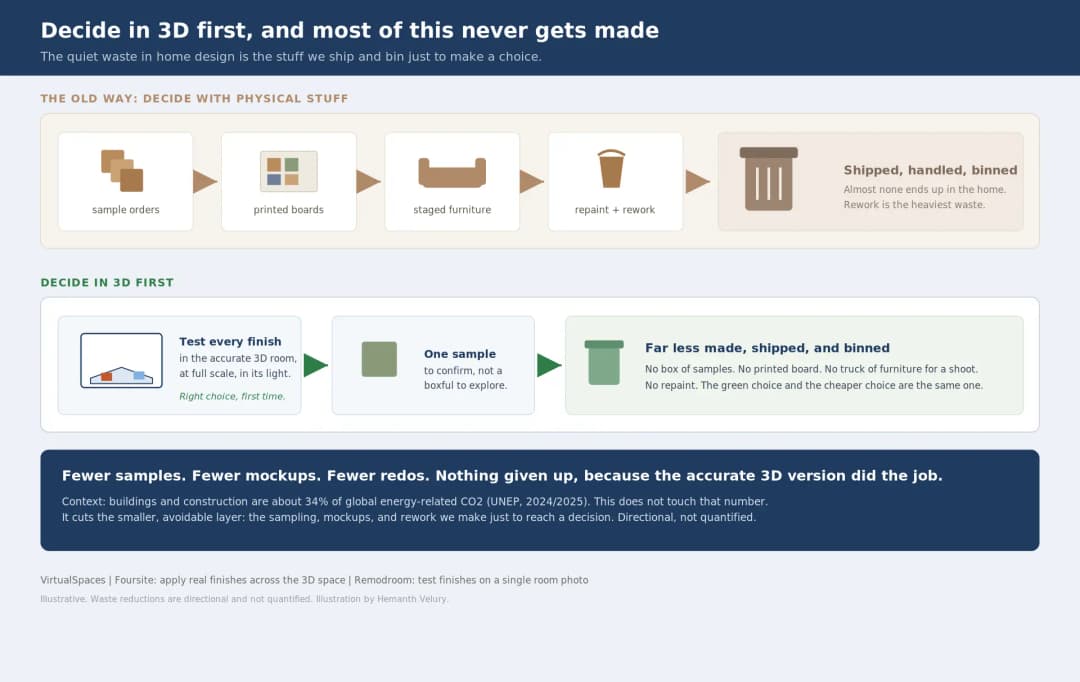
July 24, 2026
The Quiet Sustainability Win of Deciding in 3D | VirtualSpaces
HHemanth Velury
CEO & Co-Founder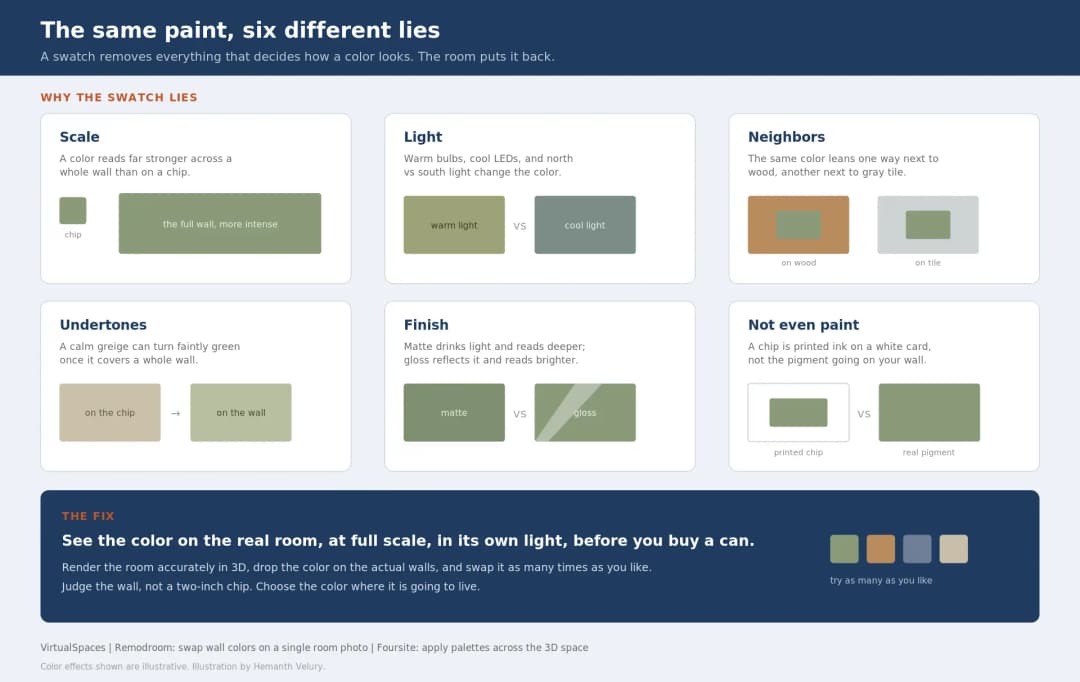
July 22, 2026
Why Paint Swatches Lie: Test Color in 3D First | VirtualSpaces
HHemanth Velury
CEO & Co-Founder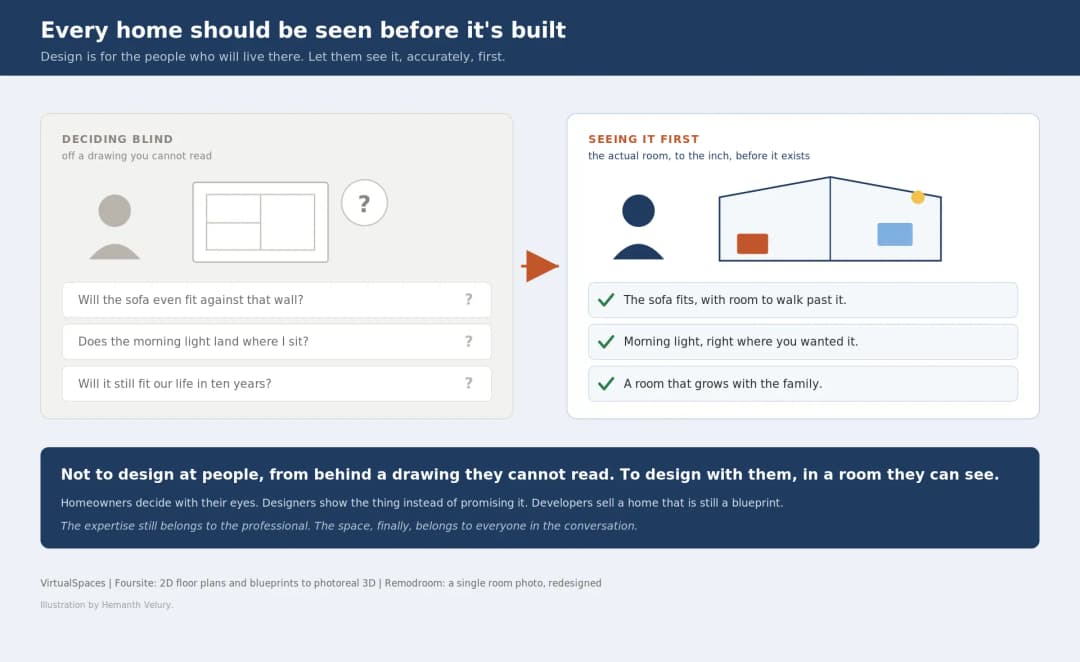
July 20, 2026
Why Every Home Should Be Seen Before It's Built | VirtualSpaces
HHemanth Velury
CEO & Co-Founder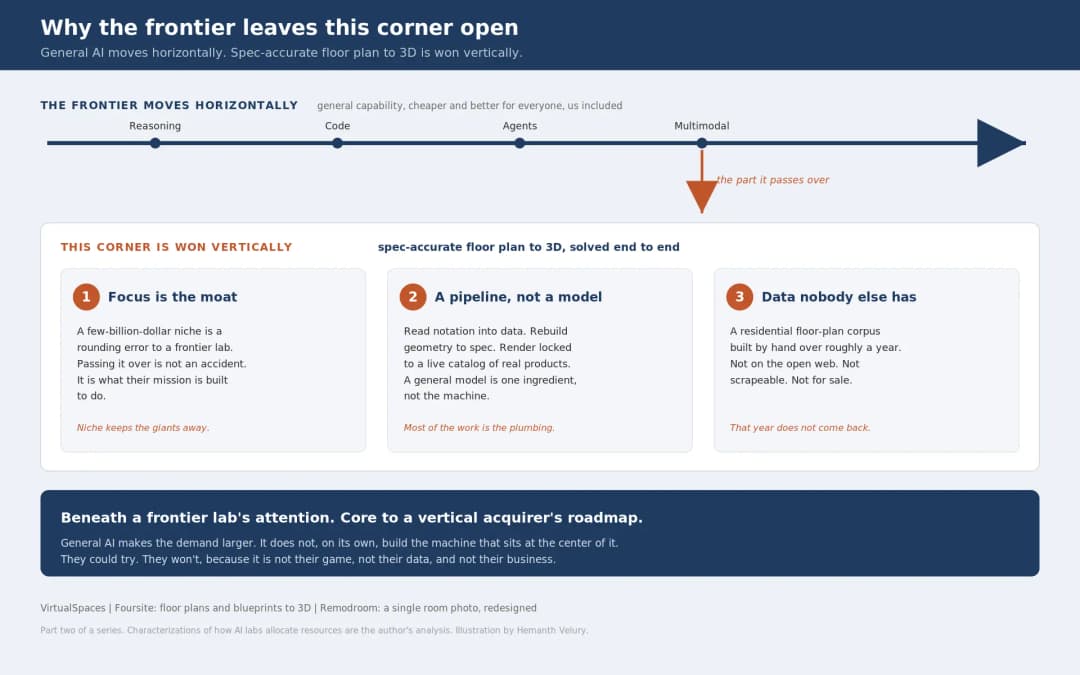
July 17, 2026
Why Big AI Labs Won't Build Floor Plan to 3D | VirtualSpaces
HHemanth Velury
CEO & Co-Founder
July 15, 2026
How We Solve Floor Plan to 3D, Accurately | VirtualSpaces
HHemanth Velury
CEO & Co-Founder
July 13, 2026
Designing Homes That Age With the People in Them | VirtualSpaces
HHemanth Velury
CEO & Co-Founder
July 10, 2026
Designing Spaces for How Light Actually Moves | VirtualSpaces
HHemanth Velury
CEO & Co-Founder
July 08, 2026
Designing Homes for Every Life Stage in 3D | VirtualSpaces
HHemanth Velury
CEO & Co-Founder
July 06, 2026
Build an Interior Design Portfolio Without Clients | VirtualSpaces
HHemanth Velury
CEO & Co-Founder
June 26, 2026
AI Interior Design: Full 3D Workflow in One Platform | VirtualSpaces
HHemanth Velury
CEO & Co-Founder
June 24, 2026
Scope Creep in Interior Design: How AI Visualization Fixes It | VirtualSpaces
HHemanth Velury
CEO & Co-Founder
June 22, 2026
What Buyers See on a Floor Plan: Your Biggest Sales Problem | VirtualSpaces
HHemanth Velury
CEO & Co-Founder
June 19, 2026
Small Design Studios vs Big Firms: The AI Advantage | VirtualSpaces
HHemanth Velury
CEO & Co-Founder
June 17, 2026
After the Mood Board: AI Interior Visualization | VirtualSpaces
HHemanth Velury
CEO & Co-Founder
June 15, 2026
Foursite Pro Editor: Full Floor Plan Control for Designers | VirtualSpaces
HHemanth Velury
CEO & Co-Founder
June 12, 2026
AI Interior Design: Style Any Room in Seconds with Foursite | VirtualSpaces
HHemanth Velury
CEO & Co-Founder
June 10, 2026
Foursite: Floor Plan to 3D Walkthrough in Minutes | VirtualSpaces
HHemanth Velury
CEO & Co-Founder
June 08, 2026
Win More Pitches With AI Renders Before the Meeting | VirtualSpaces
HHemanth Velury
CEO & Co-Founder
June 05, 2026
From Floor Plan to Finished Room: What AI Now Makes Possible | VirtualSpaces
HHemanth Velury
CEO & Co-Founder
June 03, 2026
The Interior Design Brief Is Broken. AI Fixes It | VirtualSpaces
HHemanth Velury
CEO & Co-Founder
June 01, 2026
Pre-Construction Home Sales: AI Interior Visualization Guide | VirtualSpaces
HHemanth Velury
CEO & Co-Founder
May 30, 2026
Interior Design Principles: Applied with AI | VirtualSpaces
HHemanth Velury
CEO & Co-Founder
May 28, 2026
Designing Spaces for People, Not Blueprints | VirtualSpaces
HHemanth Velury
CEO & Co-Founder
May 26, 2026
The Future of Interior Design: Closing the Visualization Gap with Foursite and Remodroom | VirtualSpaces
HHemanth Velury
CEO & Co-Founder
May 18, 2026
How AI Visualization Upgrades Property Data Platforms | VirtualSpaces
HHemanth Velury
CEO & Co-Founder
May 14, 2026
How AI-First Insurers Can Use 3D Property Data to Transform Home Claims | VirtualSpaces
HHemanth Velury
CEO & Co-FounderMay 12, 2026
Why Photoreal 3D Renders Are Replacing Mood Boards | Interior Design Client Presentations | VirtualSpaces
HHemanth Velury
CEO & Co-Founder
May 08, 2026
From 2D Floor Plans To Living Worlds: The Spec‑Accurate 3D Engine | VirtualSpaces
HHemanth Velury
CEO & Co-Founder
May 06, 2026
Why Furniture Brands Need AI 3D Visualization Now | VirtualSpaces
HHemanth Velury
CEO & Co-Founder
May 4, 2026
How Property Portals Can Turn 2D Floor Plans into 3D Design Decisions | VirtualSpaces
HHemanth Velury
CEO & Co-Founder
April 29, 2026
The Home-Fit Test: Why Square Footage Misleads | VirtualSpaces
HHemanth Velury
CEO & Co-Founder
April 27, 2026
Designing Homes That Sell: 3D Visualization ROI Data | VirtualSpaces
HHemanth Velury
CEO & Co-FounderApril 24, 2026
What's Next: Foursite & Remodroom's New AI Features | VirtualSpaces
HHemanth Velury
CEO & Co-Founder
April 22, 2026
AI in Architecture: Closing the 85% Exposure Gap | VirtualSpaces
HHemanth Velury
CEO & Co-Founder
April 20, 2026
Interior Design Pricing in 2026: From Hourly to Value-Based Fees | VirtualSpaces
HHemanth Velury
CEO & Co-FounderApril 17, 2026
How Foursite and Remodroom Help Designers Win Clients | VirtualSpaces
HHemanth Velury
CEO & Co-Founder
April 15, 2026
Designing Spaces for People: Remodroom + Foursite AI Guide | VirtualSpaces
HHemanth Velury
CEO & Co-Founder
April 13, 2026
Designing for the Way People Actually Live: How AI 3D Is Finally Closing the Gap Between Floor Plan and Reality
HHemanth Velury
CEO & Co-Founder
April 11, 2026
Design in Real Time: AI Renders in Your First Client Meeting
HHemanth Velury
CEO & Co-Founder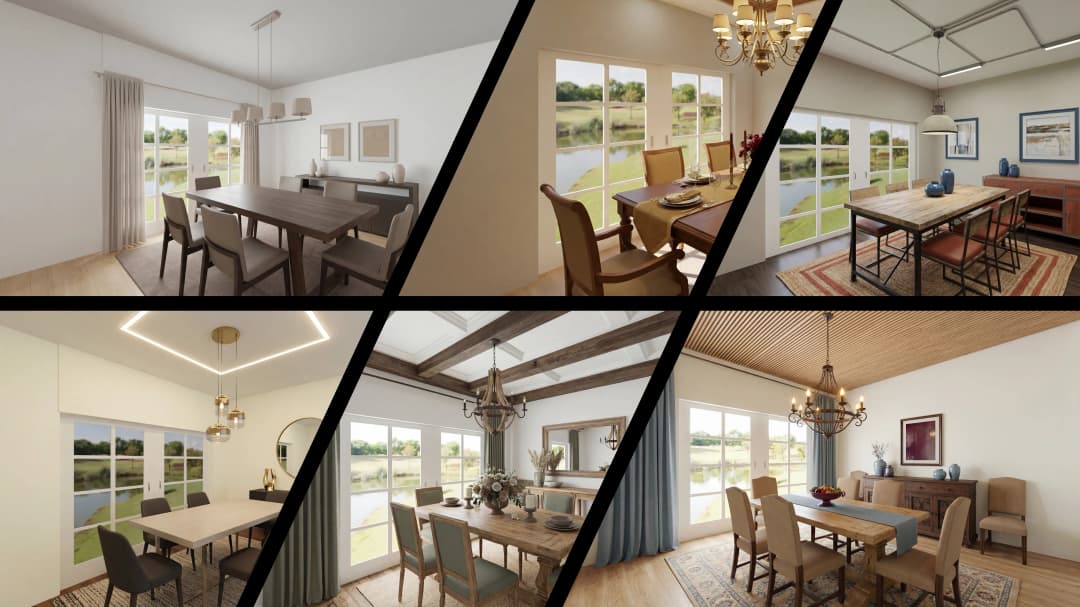
April 06, 2026
Why Real Estate Photography Is No Longer Enough: The Shift to Spatial-First Listings
HHemanth Velury
CEO & Co-Founder
April 03, 2026
Property Management's Hidden Weapon: AI 3D Floor Plans That Cut Vacancy Time and Raise Tenant Quality
HHemanth Velury
CEO & Co-Founder
March 30, 2026
Why Foursite Beats Generic AI Tools for Interior Design 3D Visualization
HHemanth Velury
CEO & Co-Founder
March 27, 2026
7 Tenets of Interior Design: How AI Accelerates Harmony in Residential Spaces
HHemanth Velury
CEO & Co-Founder
March 25, 2026
What Is the 3-5-7 Rule in Interior Design? Foursite's AI Guide for Residential Spaces
HHemanth Velury
CEO & Co-Founder
March 23, 2026
What Is the 70/30 Rule in Interior Design? Foursite's AI Guide for Residential Spaces
HHemanth Velury
CEO & Co-Founder
March 20, 2026
How AI 3D Visualization Is Rewriting Residential Interior Design Workflows
HHemanth Velury
CEO & Co-Founder
March 18, 2026
Beyond Marketing: How 3D Floorplans Transform FM, Retrofit Planning & ESG Operations
HHemanth Velury
CEO & Co-Founder
March 16, 2026
Why AI Companies Use Token Payments (And Why VirtualSpaces Is Returning To Fiat)
HHemanth Velury
CEO & Co-Founder
March 13, 2026
Floorplan‑Native Digital Twins: Beyond BIM for Consumer‑Ready Real Estate Experiences
HHemanth Velury
CEO & Co-Founder
March 11, 2026
The Foursite Platform Thesis: Why Floor Plans, Not Photos, Are the Next Property Software Primitive
HHemanth Velury
CEO & Co-Founder
March 09, 2026
Design Systems for Space: Building Reusable 3D Component Libraries on Top of AI Floorplan‑to‑3D Engines
HHemanth Velury
CEO & Co-Founder
March 06, 2026
How to Standardize Design Quality Across Global Projects Using AI Floorplan-to-3D Tools
HHemanth Velury
CEO & Co-Founder
March 04, 2026
From CAD-First to AI-First: Reskilling Your Team for AI-Native Design Workflows
HHemanth Velury
CEO & Co-Founder
March 02, 2026
Algorithmic Ergonomics Meets Photorealistic 3D: Designing Human-Centered Smart Homes with Foursite in 2026
HHemanth Velury
CEO & Co-Founder
February 27, 2026
The Ethics of AI in Interior Design: Ownership, Originality, and Client Transparency
HHemanth Velury
CEO & Co-Founder
February 25, 2026
Designing with Empathy: Using AI 3D Visualization to Improve Client Communication and Emotional Clarity
HHemanth Velury
CEO & Co-Founder
February 23, 2026
From Tool to Infrastructure: AI Floorplan-to-3D and the Next Wave of PropTech
HHemanth Velury
CEO & Co-Founder
February 20, 2026
AI Interior Design for Holiday Homes: Turn Spare Flats into High-Demand Short-Stay Rentals with 3D Visuals
HHemanth Velury
CEO & Co-Founder
February 18, 2026
The Pre‑Purchase Power Play: How Savvy Home Buyers Use 3D Floor Plan Visualization to Negotiate Better Deals
HHemanth Velury
CEO & Co-FounderFebruary 16, 2026
AI Interior Design for Non‑Designers: How Homeowners Can Brief Like Pros
HHemanth Velury
CEO & Co-Founder
February 13, 2026
Scaling a Design Business Without Hiring a 3D Team: An Owner's Guide
HHemanth Velury
CEO & Co-Founder
February 11, 2026
From Bland to Bold: How to Rescue Builder-Grade Interiors on Any Budget
HHemanth Velury
CEO & Co-Founder
February 6, 2026
The Psychology of Space: How Room Dimensions Influence Interior Design Decisions
HHemanth Velury
CEO & Co-Founder
February 4, 2026
The Future of Interior Design Visualization: How AI Technology is Transforming 2D Concepts Into 3D Reality
HHemanth Velury
CEO & Co-Founder
February 2, 2026
AI Interior Décor: How Artificial Intelligence Generates Design Options from Your Floor Plan
HHemanth Velury
CEO & Co-Founder
January 30, 2026
Photoreal vs. Reality: What Clients Actually Expect from Interior Design Visualization
HHemanth Velury
CEO & Co-Founder
January 28, 2026
The Design Approval Conversation That Changes Everything: Communication Strategy When Using Photorealistic Visualization
HHemanth Velury
CEO & Co-Founder
January 25, 2026
Interior Design as Experience Design: How 3D Visualization Changes Your Professional Identity
HHemanth Velury
CEO & Co-Founder
January 23, 2026
The Professional Gap: How 3D Visualization Changes Interior Design Client Perception
HHemanth Velury
CEO & Co-Founder
January 21, 2026
Why Clients Fire Designers (And How 3D Visualization Could Have Saved the Project)
HHemanth Velury
CEO & Co-Founder
January 16, 2026
Blueprint to Vision: Why Seeing Is Believing in Interior Design
HHemanth Velury
CEO & Co-Founder
January 14, 2026
The Speed of Responsiveness: How AI Visualization Tools Make You Look Like You Care More
HHemanth Velury
CEO & Co-Founder
January 12, 2026
Why Interior Designers and Architects Can't Compete Without AI 3D Visualization Tools
HHemanth Velury
CEO & Co-Founder
January 07, 2026
From "Saved" to "Sold": How Homeowners Are Planning Renovations with AI
HHemanth Velury
CEO & Co-Founder
January 05, 2026
The Interior Designer's Secret Weapon: Speed as Premium Positioning
HHemanth Velury
CEO & Co-Founder
December 31, 2025
Gratitude, Growth & Game-Changing Innovation: VirtualSpaces' 2025 Journey & What's Coming in 2026
HHemanth Velury
CEO & Co-Founder
December 29, 2025
Why Interior Designers Are Switching to AI Floor Plan-to-3D Tools in 2026
HHemanth Velury
CEO & Co-Founder
December 26, 2025
AI Virtual Staging for Real Estate Agents: Sell More Homes Faster with Foursite
HHemanth Velury
CEO & Co-Founder
December 24, 2025
Why Architects Are Switching to AI 2D-to-3D: The SketchUp Alternative
HHemanth Velury
CEO & Co-Founder
December 22, 2025
Cut 3 Weeks from Real Estate Sales Cycle: The ROI of AI 2D to 3D Visualization
HHemanth Velury
CEO & Co-Founder
December 19, 2025
2D Floor Plans Are Dying: Why 3D Visualization & AI Virtual Staging Are the Future
HHemanth Velury
CEO & Co-Founder
December 17, 2025
Virtual Staging vs Physical Staging: How AI Saves Money Per Property
HHemanth Velury
CEO & Co-Founder
December 15, 2025
AI Floor Plan to Image: Revolutionizing Real Estate Marketing for Agents
HHemanth Velury
CEO & Co-Founder
December 12, 2025
Color of the Year 2026: Cloud Dancer | VirtualSpaces AI Interior Design Guide
HHemanth Velury
CEO & Co-Founder
December 10, 2025
AI Floor Plan to 3D: The New Standard for Interior Design Workflows
HHemanth Velury
CEO & Co-Founder
December 08, 2025
How Interior Design Studios Can Operationalize AI 2D-to-3D Workflows (Without Breaking Their Process)
HHemanth Velury
CEO & Co-Founder
December 06, 2025
How to Implement AI Interior Design Workflows in Your Studio
HHemanth Velury
CEO & Co-Founder
December 4, 2025
How Homeowners Can Use AI Interior Design Tools to Plan Renovations with Confidence
HHemanth Velury
CEO & Co-Founder
November 28, 2025
Interior Designers in the Age of AI: From Threat Narrative to Superpower
HHemanth Velury
CEO & Co-Founder
November 21, 2025
Foursite Launch: Embracing 'Release Early, Release Often'
HHemanth Velury
CEO & Co-Founder
November 13, 2025
Foursite by VirtSpaces: Empowering Interior Designers, Architects, and Homeowners
HHemanth Velury
CEO & Co-Founder
November 7, 2025
Reimagining Architectural Education: How AI Floorplan-to-3D Technology Can Transform Design Learning
VVirtualSpaces Research Labs
AI Research Initiative
October 27, 2025
Archisculpt AI: Turning Architectural Drawings into Photorealistic 3D Spaces
AAbhijeet Naik
Co-Founder & CTO
October 13, 2025
Home Makeover: From Floor Plan to Dream Space with AI
HHemanth Velury
CEO & Co-Founder
October 6, 2025
Real-Time Rendering & AI: Revolutionizing Interactive Property Walkthroughs with VirtSpaces
HHemanth Velury
CEO & Co-Founder
September 26, 2025
Foursite - A True AI-Native Experience in Design Visualization
AAbhijeet Naik
CTO & Co-Founder
September 18, 2025
Why PropTech Startups Are Betting on AI Interior Design
HHemanth Velury
CEO & Co-Founder
September 11, 2025
How AI Differs from Traditional 3D Rendering Software
HHemanth Velury
CEO & Co-Founder
September 2, 2025
From Client to Investor: How Nila Spaces and VirtSpaces Are Redefining Proptech with AI
HHemanth Velury
CEO & Co-Founder
August 25, 2025
VirtSpaces From Virtual Reality to AI – Transforming Real Estate Visualization.
HHemanth Velury
CEO & Co-Founder


We help teams collaborate seamlessly and reduce costs. Virtual Spaces offers cutting-edge technology with flexible plans designed to fit modern teams.
Copyright © VirtSpaces Pvt. Ltd. 2025 All Rights Reserved.
CIN: U74999KA2016PTC094921