August 19, 2026
- Real Estate
- AI Technology
The End of the Model Home? 3D Changes the Math | VirtualSpaces
Hemanth Velury
CEO & Co-FounderThe End of the Model Home? Why the Show Flat's Math Is Breaking
Every new development has one. In the United States it is the model home. In India it is the sample flat, or the show flat. A single unit, finished to the highest standard, furnished by a merchandiser, lit like a magazine spread, and kept spotless for months so buyers can walk through and imagine themselves living there. It is one of the oldest tools in real estate, and for good reason. It works. Standing inside a real, finished home sells in a way a floor plan never could.
It is also expensive, singular, and increasingly hard to justify. A model home is a large, fixed bet on one floor plan, in one style, in one location, and it is being quietly outflanked by something that does the same job for every unit at once. This post is about what the model home was really for, what changed, and why the economics that built it are starting to come apart, on both sides of the world.
What a model home actually is, and costs
Strip away the styling and a model home is a marketing expense with a building attached. The developer takes a sellable unit and pours money into it: upgraded finishes, custom furniture, art, landscaping, lighting, and a professional merchandiser to pull it together. Then it has to be maintained, staffed, insured, and kept climate-controlled for as long as the community is selling, which can be a year or more. At the end, the model is often sold at a discount or carries the cost of being stripped back to a normal unit.
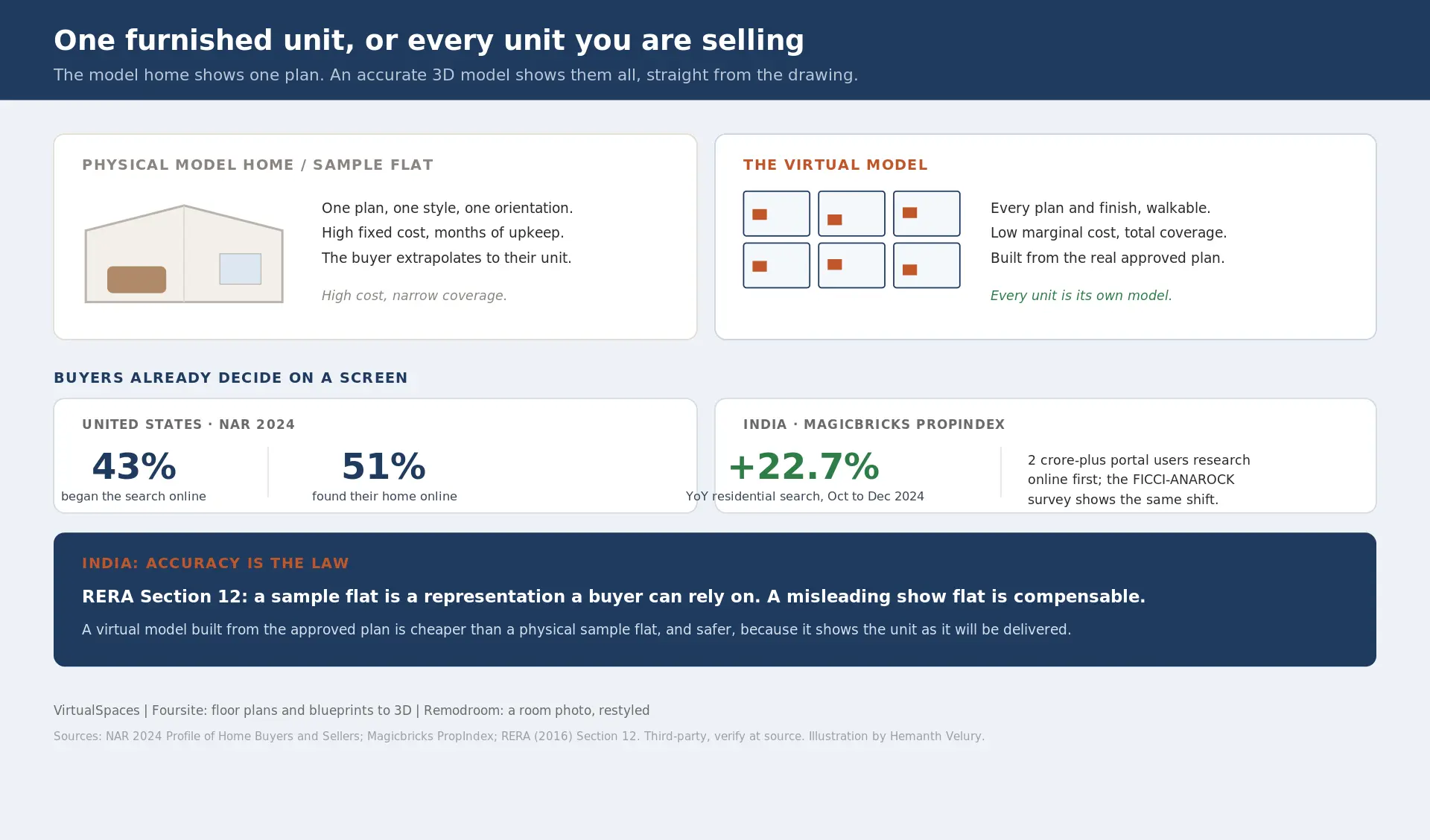
None of that is cheap, and here is the catch that matters most: all of it shows a buyer exactly one thing. One floor plan. One finish package. One furniture style. A buyer standing in a beautiful three-bedroom model may actually be buying the two-bedroom on the other side of the building, in a different orientation, with different light. They are asked to extrapolate from the model to the unit they will really own, which is the same imagination problem the model was built to solve, just moved one step down the hall.
In India the sample flat plays the identical role, and often carries even more weight, because so many homes there are sold before they are built. The show flat is how a developer lets a buyer experience a unit that is still a foundation and a plan.
Why it existed
It is worth being fair to the model home, because it solved a real problem for a long time. People cannot read floor plans. Brochures and price sheets do not sell homes; a walkable, furnished space does. For decades, the only way to let a buyer stand inside the product before it existed at scale was to build one and furnish it. The model home was the best available answer to a genuine question: how do you let someone experience a home they cannot yet buy?
That question has not changed. The answer has.
What changed
What changed is that a home can now be experienced accurately without being built. When you can convert a floor plan to 3D and produce a photoreal, correctly scaled interior, a buyer can stand inside the space, look around it, and see it furnished, on a screen, before a single wall is framed. The thing the model home did, let a buyer picture a life in a space that does not exist yet, is now something you can do for every unit in the development, not just the one you chose to build.
And this is the part that breaks the old math. A physical model shows one plan to whoever walks in. An accurate 3D model shows every plan to everyone, everywhere, at once. The buyer looking at the two-bedroom sees the two-bedroom, in its real orientation, not an extrapolation from the three-bedroom down the hall. The couple in another city walks the unit online before they book a trip. The extrapolation problem does not get smaller. It disappears, because there is nothing left to extrapolate from. Every unit is its own model.
The economics invert
Look at the two approaches as cost curves and the shift is obvious.
The physical model home is a high fixed cost that buys narrow coverage. You spend a lot, up front, to show one configuration. Want to show a second floor plan? Build and furnish a second model. A third? A third. The cost scales with the number of things you want buyers to see, and it scales steeply.
Virtual model units are the opposite. The cost of visualizing and staging one more floor plan from its drawing is a fraction of building and furnishing a room, and it falls as you add units rather than rising. Total coverage, low marginal cost. For a developer with a range of layouts, that is not a rounding-error saving. It is a different model for how a whole community gets marketed.
Buyers already decided on a screen
The deeper reason the physical model is losing its grip is that the buyer's journey moved online years ago, and the model home now arrives late to its own sale.
In the United States, the National Association of Realtors' 2024 Profile of Home Buyers and Sellers found that 43% of buyers began their home search online, and 51% found the home they purchased online (third-party figures, verify at the source below). By the time a buyer wants to visit in person, they have usually already chosen, on a screen, from what they could see there.
India is on the same path and moving fast. Magicbricks, one of the country's largest property portals, draws its "How India Searched for Homes" insights from more than two crore, over twenty million, customers, and reported a roughly 22.7% year-on-year rise in residential search activity in the October to December 2024 quarter (Magicbricks PropIndex; third-party, verify at source). Industry sentiment trackers such as the FICCI-ANAROCK Homebuyer Sentiment Survey describe the same digital-first behavior. Long before an Indian buyer visits a site, they have almost always shortlisted online.
If the decisive part of the search happens on a screen, then the sales tool that only exists at the end of the street, or inside a half-built tower, is showing up after the choice is largely made. The virtual model is where the selling now actually happens.
The India angle: accuracy is not optional, it is the law
India adds a twist that makes this more than an economics argument. So much of the market sells homes before they are built, and the sample flat is the traditional way a developer lets a buyer experience an unbuilt unit. That makes accuracy a legal matter, not just good manners.
Under RERA, the Real Estate (Regulation and Development) Act, 2016, a sample flat or model apartment is treated as a representation a buyer is entitled to rely on. Section 12 can make a developer liable to compensate a buyer who pays on the basis of an incorrect or false statement in an advertisement or prospectus, or on the basis of a model apartment, and it lets that buyer withdraw and reclaim their entire investment with interest. A show flat that oversells what the delivered unit will actually be is not just a soft risk in India. It is a compensable one.
Seen that way, a virtual model built from the actual approved plan is both cheaper than a physical sample flat and safer, because it shows the unit as it will really be delivered, to the real dimensions, rather than an aspirational build that may quietly differ from what a buyer eventually receives.
Be honest about what the physical model still does
The model home is not simply dead, and it would be a weak argument to pretend it is. A physical space still does things a screen cannot. You feel the weight of a door, the texture of a countertop, the real quality of the light through a real window. A beautifully merchandised model creates an emotional "this is the one" moment that is hard to fully reproduce. And a model home is a destination: it pulls foot traffic, hosts events, and gives a sales team a stage to close on.
So the honest read is not that the model home vanishes. It is that its job shrinks, and the case for doing it the old way, at the old scale, falls apart. You probably do not need a furnished model of every floor plan. You may need one hero experience, or none, with everything else shown virtually.
The hybrid that is emerging
What replaces "a model of every plan" tends to be one of two things. Some developers keep a single flagship physical model, the hero unit, and cover the entire range of plans and finishes virtually. Others go virtual-first, especially for off-plan and pre-launch sales where nothing is built yet and there is no unit to furnish anyway. Either way, the physical build stops being the workhorse of the sales process and becomes, at most, a supporting act.
-
Virtual-first, physical-flagship: one showpiece home to create the emotional moment, plus accurate 3D for every other plan and finish.
-
Fully virtual for pre-launch: sell the whole range from the plans, then build a physical experience only once the project is far enough along to justify it, if at all.
How it works in practice
This is what VirtualSpaces is built for. Foursite converts a floor plan to 3D, turning 2D floor plans and blueprints into spec-accurate 3D interiors, and produces photoreal interior design renders and AI virtual staging from the plan itself. A developer can turn each floor plan in a community into a furnished, walkable space, so buyers see the exact unit they are considering rather than extrapolating from the one model that happened to get built. Because the output is built from the drawing's real dimensions, the space a buyer sees matches the space they will get, which is exactly what an off-plan buyer, and RERA, expect.
Remodroom extends the same idea toward personalization: a buyer can take a room and see it in a different style or finish, so the unit feels less like a showroom and more like theirs. Both run on the same accurate 2D to 3D engine. Together, this is AI interior design and AI 3D visualization doing what the sample flat was always trying to do: let a specific buyer picture their specific life, delivered for every unit instead of one.
The bigger picture
Step back and the model home was really physical infrastructure for a single human need: to stand inside a home before buying it. For a century, meeting that need meant building and furnishing a room. Now the same need is met with accurate AI visualization, a 3D model that sits under every unit in the development and costs a fraction of a single build to produce. When the cost of letting a buyer stand inside a home falls toward zero, and the coverage rises to every unit at once, the question is no longer whether you can afford to show buyers the home. It is whether you can afford to keep doing it the expensive, narrow, old way.
The bottom line
The model home is not dead. But the reason to build one for every floor plan is. Show every unit, in 3D, to every buyer, and reserve the physical build for the one moment where standing in a real room still earns its cost, if it earns it at all. The home that sells the community is no longer the one at the end of the street or the one furnished floor in a half-built tower. It is the one on the buyer's screen, and now it can be every home you are actually selling.
Recommended for you
August 17, 2026
Designing Spaces That Actually Get Built | VirtualSpaces
HHemanth Velury
CEO & Co-Founder
August 12, 2026
Designing Homes for the Stuff People Actually Own | VirtualSpaces
HHemanth Velury
CEO & Co-Founder
August 07, 2026
Floor Plan to Bill of Materials: The 3D Model as Data | VirtualSpaces
HHemanth Velury
CEO & Co-Founder.png&w=1080&q=75)
August 05, 2026
Designing Homes for How People Actually Live | VirtualSpaces
HHemanth Velury
CEO & Co-Founder
August 03, 2026
Honest by Design: Trust in AI Real Estate Imagery | VirtualSpaces
HHemanth Velury
CEO & Co-Founder
July 29, 2026
Kitchen and Bath: The Two Rooms That Decide Resale | VirtualSpaces
HHemanth Velury
CEO & Co-Founder
July 27, 2026
Why Empty Rooms Don't Sell: Virtual Staging | VirtualSpaces
HHemanth Velury
CEO & Co-Founder
July 24, 2026
The Quiet Sustainability Win of Deciding in 3D | VirtualSpaces
HHemanth Velury
CEO & Co-Founder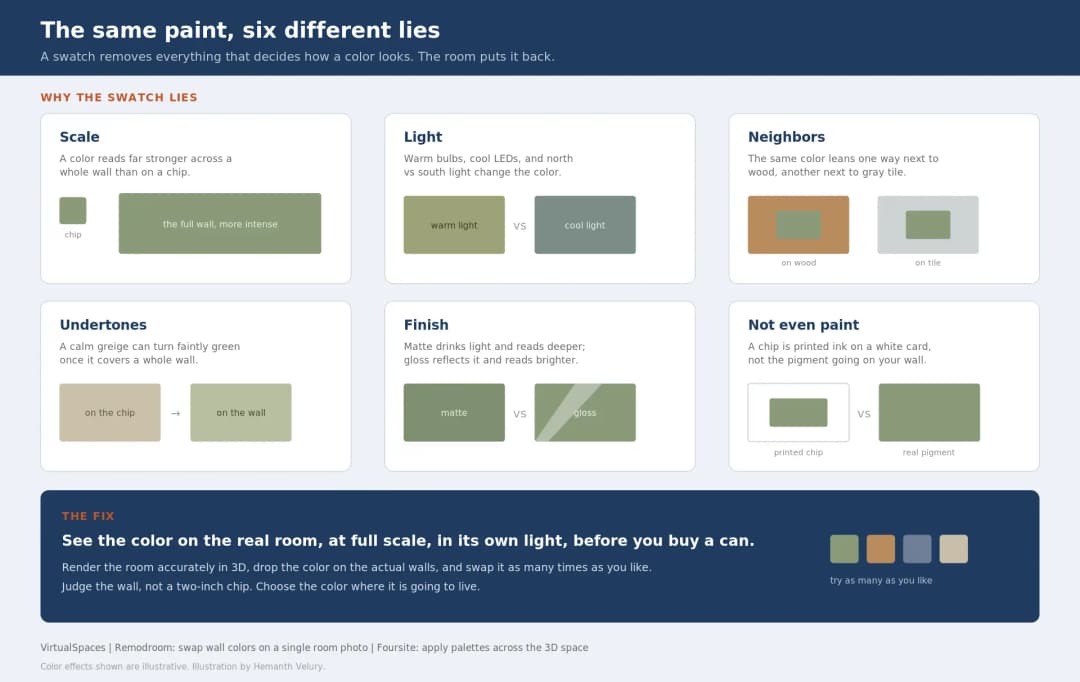
July 22, 2026
Why Paint Swatches Lie: Test Color in 3D First | VirtualSpaces
HHemanth Velury
CEO & Co-Founder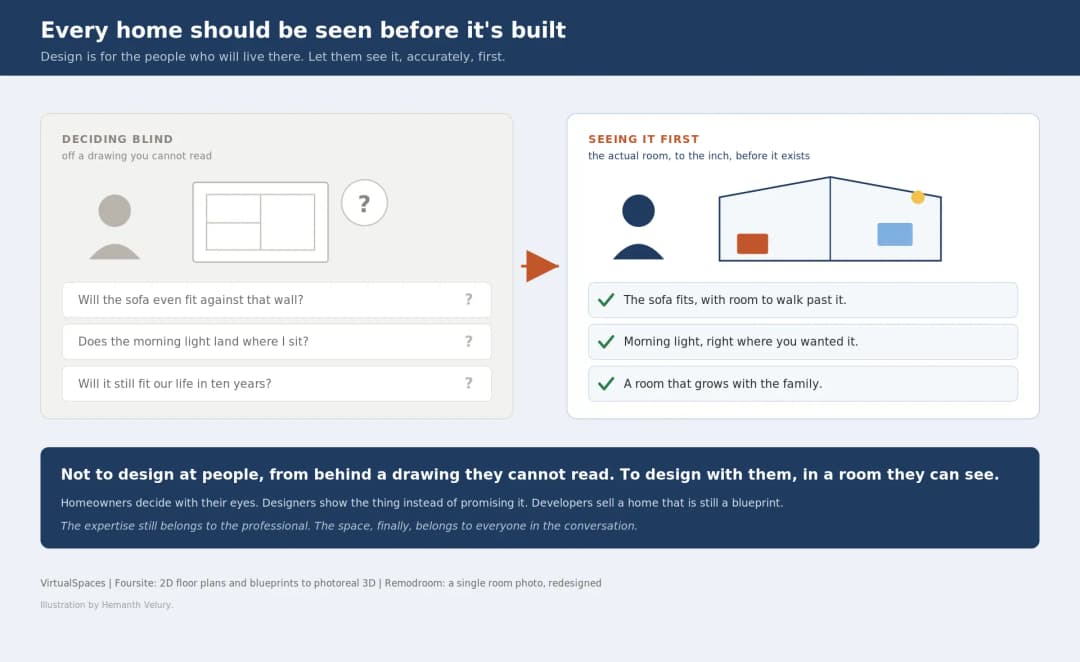
July 20, 2026
Why Every Home Should Be Seen Before It's Built | VirtualSpaces
HHemanth Velury
CEO & Co-Founder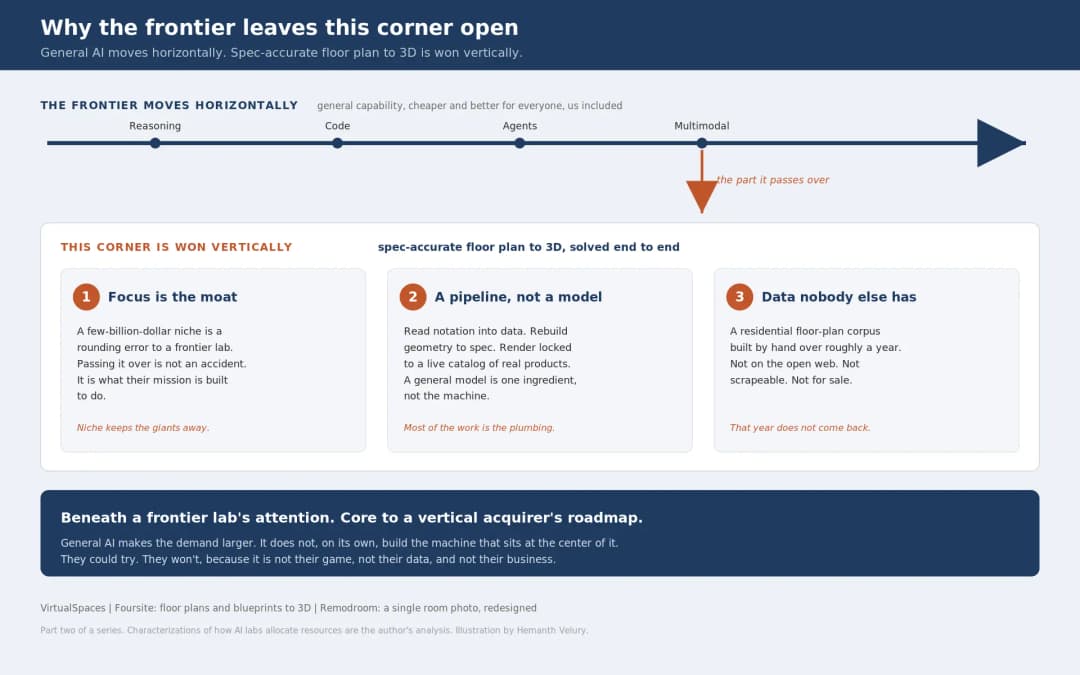
July 17, 2026
Why Big AI Labs Won't Build Floor Plan to 3D | VirtualSpaces
HHemanth Velury
CEO & Co-Founder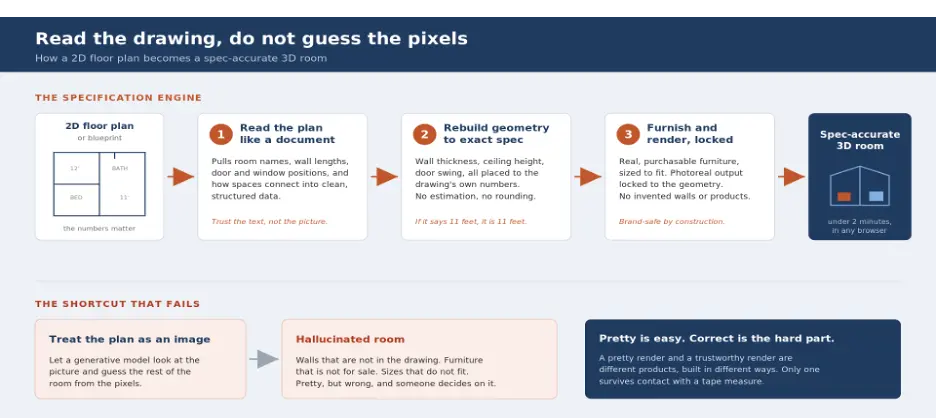
July 15, 2026
How We Solve Floor Plan to 3D, Accurately | VirtualSpaces
HHemanth Velury
CEO & Co-Founder
July 13, 2026
Designing Homes That Age With the People in Them | VirtualSpaces
HHemanth Velury
CEO & Co-Founder
July 10, 2026
Designing Spaces for How Light Actually Moves | VirtualSpaces
HHemanth Velury
CEO & Co-Founder
July 08, 2026
Designing Homes for Every Life Stage in 3D | VirtualSpaces
HHemanth Velury
CEO & Co-Founder
July 06, 2026
Build an Interior Design Portfolio Without Clients | VirtualSpaces
HHemanth Velury
CEO & Co-Founder
June 26, 2026
AI Interior Design: Full 3D Workflow in One Platform | VirtualSpaces
HHemanth Velury
CEO & Co-Founder
June 24, 2026
Scope Creep in Interior Design: How AI Visualization Fixes It | VirtualSpaces
HHemanth Velury
CEO & Co-Founder
June 22, 2026
What Buyers See on a Floor Plan: Your Biggest Sales Problem | VirtualSpaces
HHemanth Velury
CEO & Co-Founder
June 19, 2026
Small Design Studios vs Big Firms: The AI Advantage | VirtualSpaces
HHemanth Velury
CEO & Co-Founder
June 17, 2026
After the Mood Board: AI Interior Visualization | VirtualSpaces
HHemanth Velury
CEO & Co-Founder
June 15, 2026
Foursite Pro Editor: Full Floor Plan Control for Designers | VirtualSpaces
HHemanth Velury
CEO & Co-Founder
June 12, 2026
AI Interior Design: Style Any Room in Seconds with Foursite | VirtualSpaces
HHemanth Velury
CEO & Co-Founder
June 10, 2026
Foursite: Floor Plan to 3D Walkthrough in Minutes | VirtualSpaces
HHemanth Velury
CEO & Co-Founder
June 08, 2026
Win More Pitches With AI Renders Before the Meeting | VirtualSpaces
HHemanth Velury
CEO & Co-Founder
June 05, 2026
From Floor Plan to Finished Room: What AI Now Makes Possible | VirtualSpaces
HHemanth Velury
CEO & Co-Founder
June 03, 2026
The Interior Design Brief Is Broken. AI Fixes It | VirtualSpaces
HHemanth Velury
CEO & Co-Founder
June 01, 2026
Pre-Construction Home Sales: AI Interior Visualization Guide | VirtualSpaces
HHemanth Velury
CEO & Co-Founder
May 30, 2026
Interior Design Principles: Applied with AI | VirtualSpaces
HHemanth Velury
CEO & Co-Founder
May 28, 2026
Designing Spaces for People, Not Blueprints | VirtualSpaces
HHemanth Velury
CEO & Co-Founder
May 26, 2026
The Future of Interior Design: Closing the Visualization Gap with Foursite and Remodroom | VirtualSpaces
HHemanth Velury
CEO & Co-Founder
May 18, 2026
How AI Visualization Upgrades Property Data Platforms | VirtualSpaces
HHemanth Velury
CEO & Co-Founder
May 14, 2026
How AI-First Insurers Can Use 3D Property Data to Transform Home Claims | VirtualSpaces
HHemanth Velury
CEO & Co-FounderMay 12, 2026
Why Photoreal 3D Renders Are Replacing Mood Boards | Interior Design Client Presentations | VirtualSpaces
HHemanth Velury
CEO & Co-Founder
May 08, 2026
From 2D Floor Plans To Living Worlds: The Spec‑Accurate 3D Engine | VirtualSpaces
HHemanth Velury
CEO & Co-Founder
May 06, 2026
Why Furniture Brands Need AI 3D Visualization Now | VirtualSpaces
HHemanth Velury
CEO & Co-Founder
May 4, 2026
How Property Portals Can Turn 2D Floor Plans into 3D Design Decisions | VirtualSpaces
HHemanth Velury
CEO & Co-Founder
April 29, 2026
The Home-Fit Test: Why Square Footage Misleads | VirtualSpaces
HHemanth Velury
CEO & Co-Founder
April 27, 2026
Designing Homes That Sell: 3D Visualization ROI Data | VirtualSpaces
HHemanth Velury
CEO & Co-FounderApril 24, 2026
What's Next: Foursite & Remodroom's New AI Features | VirtualSpaces
HHemanth Velury
CEO & Co-Founder
April 22, 2026
AI in Architecture: Closing the 85% Exposure Gap | VirtualSpaces
HHemanth Velury
CEO & Co-Founder
April 20, 2026
Interior Design Pricing in 2026: From Hourly to Value-Based Fees | VirtualSpaces
HHemanth Velury
CEO & Co-FounderApril 17, 2026
How Foursite and Remodroom Help Designers Win Clients | VirtualSpaces
HHemanth Velury
CEO & Co-Founder
April 15, 2026
Designing Spaces for People: Remodroom + Foursite AI Guide | VirtualSpaces
HHemanth Velury
CEO & Co-Founder
April 13, 2026
Designing for the Way People Actually Live: How AI 3D Is Finally Closing the Gap Between Floor Plan and Reality
HHemanth Velury
CEO & Co-Founder
April 11, 2026
Design in Real Time: AI Renders in Your First Client Meeting
HHemanth Velury
CEO & Co-Founder
April 06, 2026
Why Real Estate Photography Is No Longer Enough: The Shift to Spatial-First Listings
HHemanth Velury
CEO & Co-Founder
April 03, 2026
Property Management's Hidden Weapon: AI 3D Floor Plans That Cut Vacancy Time and Raise Tenant Quality
HHemanth Velury
CEO & Co-Founder
April 01, 2026
Off-Plan and Oversubscribed: How AI 3D Visualization Is Transforming Real Estate Pre-Sales
HHemanth Velury
CEO & Co-Founder
March 30, 2026
Why Foursite Beats Generic AI Tools for Interior Design 3D Visualization
HHemanth Velury
CEO & Co-Founder
March 27, 2026
7 Tenets of Interior Design: How AI Accelerates Harmony in Residential Spaces
HHemanth Velury
CEO & Co-Founder
March 25, 2026
What Is the 3-5-7 Rule in Interior Design? Foursite's AI Guide for Residential Spaces
HHemanth Velury
CEO & Co-Founder
March 23, 2026
What Is the 70/30 Rule in Interior Design? Foursite's AI Guide for Residential Spaces
HHemanth Velury
CEO & Co-Founder
March 20, 2026
How AI 3D Visualization Is Rewriting Residential Interior Design Workflows
HHemanth Velury
CEO & Co-Founder
March 18, 2026
Beyond Marketing: How 3D Floorplans Transform FM, Retrofit Planning & ESG Operations
HHemanth Velury
CEO & Co-Founder
March 16, 2026
Why AI Companies Use Token Payments (And Why VirtualSpaces Is Returning To Fiat)
HHemanth Velury
CEO & Co-Founder
March 13, 2026
Floorplan‑Native Digital Twins: Beyond BIM for Consumer‑Ready Real Estate Experiences
HHemanth Velury
CEO & Co-Founder
March 11, 2026
The Foursite Platform Thesis: Why Floor Plans, Not Photos, Are the Next Property Software Primitive
HHemanth Velury
CEO & Co-Founder
March 09, 2026
Design Systems for Space: Building Reusable 3D Component Libraries on Top of AI Floorplan‑to‑3D Engines
HHemanth Velury
CEO & Co-Founder
March 06, 2026
How to Standardize Design Quality Across Global Projects Using AI Floorplan-to-3D Tools
HHemanth Velury
CEO & Co-Founder
March 04, 2026
From CAD-First to AI-First: Reskilling Your Team for AI-Native Design Workflows
HHemanth Velury
CEO & Co-Founder
March 02, 2026
Algorithmic Ergonomics Meets Photorealistic 3D: Designing Human-Centered Smart Homes with Foursite in 2026
HHemanth Velury
CEO & Co-Founder
February 27, 2026
The Ethics of AI in Interior Design: Ownership, Originality, and Client Transparency
HHemanth Velury
CEO & Co-Founder
February 25, 2026
Designing with Empathy: Using AI 3D Visualization to Improve Client Communication and Emotional Clarity
HHemanth Velury
CEO & Co-Founder
February 23, 2026
From Tool to Infrastructure: AI Floorplan-to-3D and the Next Wave of PropTech
HHemanth Velury
CEO & Co-Founder
February 20, 2026
AI Interior Design for Holiday Homes: Turn Spare Flats into High-Demand Short-Stay Rentals with 3D Visuals
HHemanth Velury
CEO & Co-Founder
February 18, 2026
The Pre‑Purchase Power Play: How Savvy Home Buyers Use 3D Floor Plan Visualization to Negotiate Better Deals
HHemanth Velury
CEO & Co-FounderFebruary 16, 2026
AI Interior Design for Non‑Designers: How Homeowners Can Brief Like Pros
HHemanth Velury
CEO & Co-Founder
February 13, 2026
Scaling a Design Business Without Hiring a 3D Team: An Owner's Guide
HHemanth Velury
CEO & Co-Founder
February 11, 2026
From Bland to Bold: How to Rescue Builder-Grade Interiors on Any Budget
HHemanth Velury
CEO & Co-Founder
February 6, 2026
The Psychology of Space: How Room Dimensions Influence Interior Design Decisions
HHemanth Velury
CEO & Co-Founder
February 4, 2026
The Future of Interior Design Visualization: How AI Technology is Transforming 2D Concepts Into 3D Reality
HHemanth Velury
CEO & Co-Founder
February 2, 2026
AI Interior Décor: How Artificial Intelligence Generates Design Options from Your Floor Plan
HHemanth Velury
CEO & Co-Founder
January 30, 2026
Photoreal vs. Reality: What Clients Actually Expect from Interior Design Visualization
HHemanth Velury
CEO & Co-Founder
January 28, 2026
The Design Approval Conversation That Changes Everything: Communication Strategy When Using Photorealistic Visualization
HHemanth Velury
CEO & Co-Founder
January 25, 2026
Interior Design as Experience Design: How 3D Visualization Changes Your Professional Identity
HHemanth Velury
CEO & Co-Founder
January 23, 2026
The Professional Gap: How 3D Visualization Changes Interior Design Client Perception
HHemanth Velury
CEO & Co-Founder
January 21, 2026
Why Clients Fire Designers (And How 3D Visualization Could Have Saved the Project)
HHemanth Velury
CEO & Co-Founder
January 16, 2026
Blueprint to Vision: Why Seeing Is Believing in Interior Design
HHemanth Velury
CEO & Co-Founder
January 14, 2026
The Speed of Responsiveness: How AI Visualization Tools Make You Look Like You Care More
HHemanth Velury
CEO & Co-Founder
January 12, 2026
Why Interior Designers and Architects Can't Compete Without AI 3D Visualization Tools
HHemanth Velury
CEO & Co-Founder
January 07, 2026
From "Saved" to "Sold": How Homeowners Are Planning Renovations with AI
HHemanth Velury
CEO & Co-Founder
January 05, 2026
The Interior Designer's Secret Weapon: Speed as Premium Positioning
HHemanth Velury
CEO & Co-Founder
December 31, 2025
Gratitude, Growth & Game-Changing Innovation: VirtualSpaces' 2025 Journey & What's Coming in 2026
HHemanth Velury
CEO & Co-Founder
December 29, 2025
Why Interior Designers Are Switching to AI Floor Plan-to-3D Tools in 2026
HHemanth Velury
CEO & Co-Founder
December 26, 2025
AI Virtual Staging for Real Estate Agents: Sell More Homes Faster with Foursite
HHemanth Velury
CEO & Co-Founder
December 24, 2025
Why Architects Are Switching to AI 2D-to-3D: The SketchUp Alternative
HHemanth Velury
CEO & Co-Founder
December 22, 2025
Cut 3 Weeks from Real Estate Sales Cycle: The ROI of AI 2D to 3D Visualization
HHemanth Velury
CEO & Co-Founder
December 19, 2025
2D Floor Plans Are Dying: Why 3D Visualization & AI Virtual Staging Are the Future
HHemanth Velury
CEO & Co-Founder
December 17, 2025
Virtual Staging vs Physical Staging: How AI Saves Money Per Property
HHemanth Velury
CEO & Co-Founder
December 15, 2025
AI Floor Plan to Image: Revolutionizing Real Estate Marketing for Agents
HHemanth Velury
CEO & Co-Founder
December 12, 2025
Color of the Year 2026: Cloud Dancer | VirtualSpaces AI Interior Design Guide
HHemanth Velury
CEO & Co-Founder
December 10, 2025
AI Floor Plan to 3D: The New Standard for Interior Design Workflows
HHemanth Velury
CEO & Co-Founder
December 08, 2025
How Interior Design Studios Can Operationalize AI 2D-to-3D Workflows (Without Breaking Their Process)
HHemanth Velury
CEO & Co-Founder
December 06, 2025
How to Implement AI Interior Design Workflows in Your Studio
HHemanth Velury
CEO & Co-Founder
December 4, 2025
How Homeowners Can Use AI Interior Design Tools to Plan Renovations with Confidence
HHemanth Velury
CEO & Co-Founder
November 28, 2025
Interior Designers in the Age of AI: From Threat Narrative to Superpower
HHemanth Velury
CEO & Co-Founder
November 21, 2025
Foursite Launch: Embracing 'Release Early, Release Often'
HHemanth Velury
CEO & Co-Founder
November 13, 2025
Foursite by VirtSpaces: Empowering Interior Designers, Architects, and Homeowners
HHemanth Velury
CEO & Co-Founder
November 7, 2025
Reimagining Architectural Education: How AI Floorplan-to-3D Technology Can Transform Design Learning
VVirtualSpaces Research Labs
AI Research Initiative
October 27, 2025
Archisculpt AI: Turning Architectural Drawings into Photorealistic 3D Spaces
AAbhijeet Naik
Co-Founder & CTO
October 13, 2025
Home Makeover: From Floor Plan to Dream Space with AI
HHemanth Velury
CEO & Co-Founder
October 6, 2025
Real-Time Rendering & AI: Revolutionizing Interactive Property Walkthroughs with VirtSpaces
HHemanth Velury
CEO & Co-Founder
September 26, 2025
Foursite - A True AI-Native Experience in Design Visualization
AAbhijeet Naik
CTO & Co-Founder
September 18, 2025
Why PropTech Startups Are Betting on AI Interior Design
HHemanth Velury
CEO & Co-Founder
September 11, 2025
How AI Differs from Traditional 3D Rendering Software
HHemanth Velury
CEO & Co-Founder
September 2, 2025
From Client to Investor: How Nila Spaces and VirtSpaces Are Redefining Proptech with AI
HHemanth Velury
CEO & Co-Founder
August 25, 2025
VirtSpaces From Virtual Reality to AI – Transforming Real Estate Visualization.
HHemanth Velury
CEO & Co-Founder


We help teams collaborate seamlessly and reduce costs. Virtual Spaces offers cutting-edge technology with flexible plans designed to fit modern teams.
Copyright © VirtSpaces Pvt. Ltd. 2025 All Rights Reserved.
CIN: U74999KA2016PTC094921